
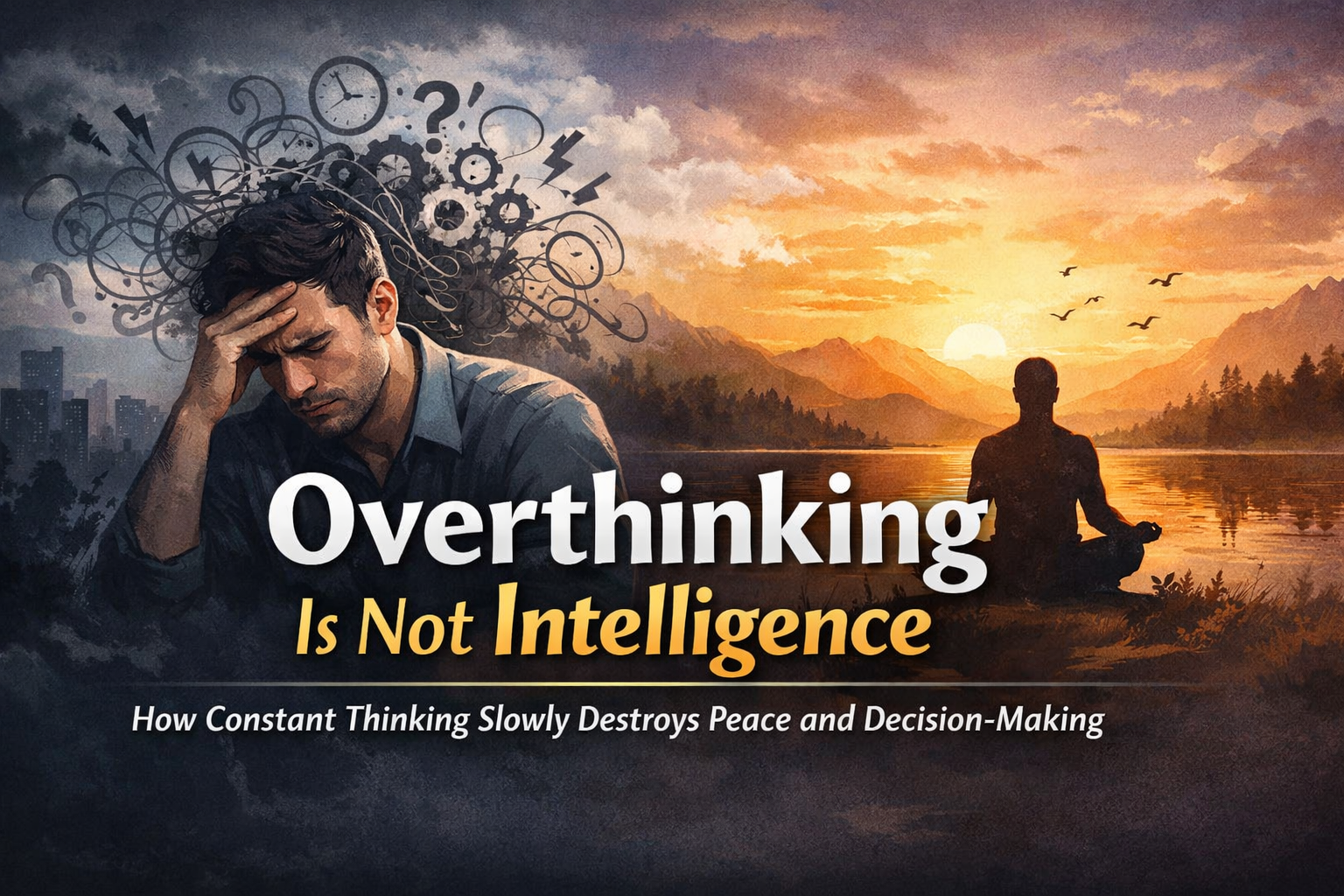
Overthinking Is Not Intelligence
How Constant Thinking Slowly Destroys Peace and Decision-Making
In today’s world, we often mistake overthinking for intelligence. We assume that the person who thinks the most is the smartest in the room. But constant thinking is not wisdom. It is not clarity. And it is definitely not peace.
In reality, overthinking is mental noise disguised as productivity.
Let’s understand why.
What Is Overthinking?
Overthinking is not deep thinking.
Deep thinking leads to clarity and solutions.
Overthinking leads to confusion and doubt.
It usually looks like this:
-
Replaying past conversations again and again
-
Imagining worst-case scenarios
-
Doubting every decision
-
Analyzing small things for hours
-
Thinking about what others think about you
The mind keeps moving, but it goes nowhere.
Why We Mistake It for Intelligence
Many people believe:
-
“I think a lot, so I must be smart.”
-
“Careful analysis prevents mistakes.”
-
“If I stop thinking, I’ll make a wrong decision.”
But intelligence is not about quantity of thoughts.
It is about quality of judgment.
A sharp mind knows when to think — and when to stop.
Overthinkers rarely feel satisfied. Even after making a decision, they question it again. This is not intelligence. This is anxiety wearing the mask of logic.
How Overthinking Destroys Peace
Peace comes from clarity.
Overthinking creates mental chaos.
Here’s how it slowly damages your inner stability:
1. It Increases Anxiety
When your brain constantly searches for problems, it finds them — even if they don’t exist.
2. It Weakens Confidence
The more you question your choices, the less you trust yourself.
3. It Disrupts Sleep
Your body wants rest.
Your mind wants “one more thought.”
4. It Steals the Present Moment
Instead of living today, you’re stuck in yesterday or worried about tomorrow.
How Overthinking Destroys Decision-Making
Ironically, the more you think, the harder decisions become.
Overthinking leads to:
-
Analysis paralysis
-
Fear of failure
-
Delay in action
-
Regret even after success
Smart decision-making requires:
-
Clear information
-
Limited analysis
-
Trust in your judgment
-
Willingness to accept uncertainty
No decision comes with a 100% guarantee. Intelligence understands this. Overthinking fights it.
The Difference Between Deep Thinking and Overthinking
| Deep Thinking | Overthinking |
|---|---|
| Focused | Repetitive |
| Purpose-driven | Fear-driven |
| Time-limited | Endless |
| Leads to action | Leads to delay |
| Brings clarity | Brings confusion |
One builds strength.
The other drains energy.
Why Your Brain Loves Overthinking
Your brain is designed to protect you. It constantly scans for danger.
In modern life, there are fewer real threats — so the brain creates imagined ones.
It believes:
“If I think more, I will be safer.”
But safety doesn’t come from endless thought.
It comes from emotional balance and practical action.
How to Stop Overthinking
You cannot “force” your mind to be silent.
But you can guide it.
1. Set a Thinking Deadline
Give yourself 20 minutes to think about a problem. Then decide.
2. Write It Down
Most thoughts feel bigger in your head. Writing shrinks them.
3. Take Action Quickly
Action breaks the cycle of mental looping.
4. Accept Imperfection
Not every choice will be perfect — and that’s okay.
5. Practice Mental Discipline
Ask yourself:
“Is this helping me or just exhausting me?”
Real Intelligence Is Calm
Truly intelligent people are not restless thinkers.
They are calm observers.
They think when necessary.
They act when required.
They rest when possible.
They understand one powerful truth:
Not every thought deserves attention.