
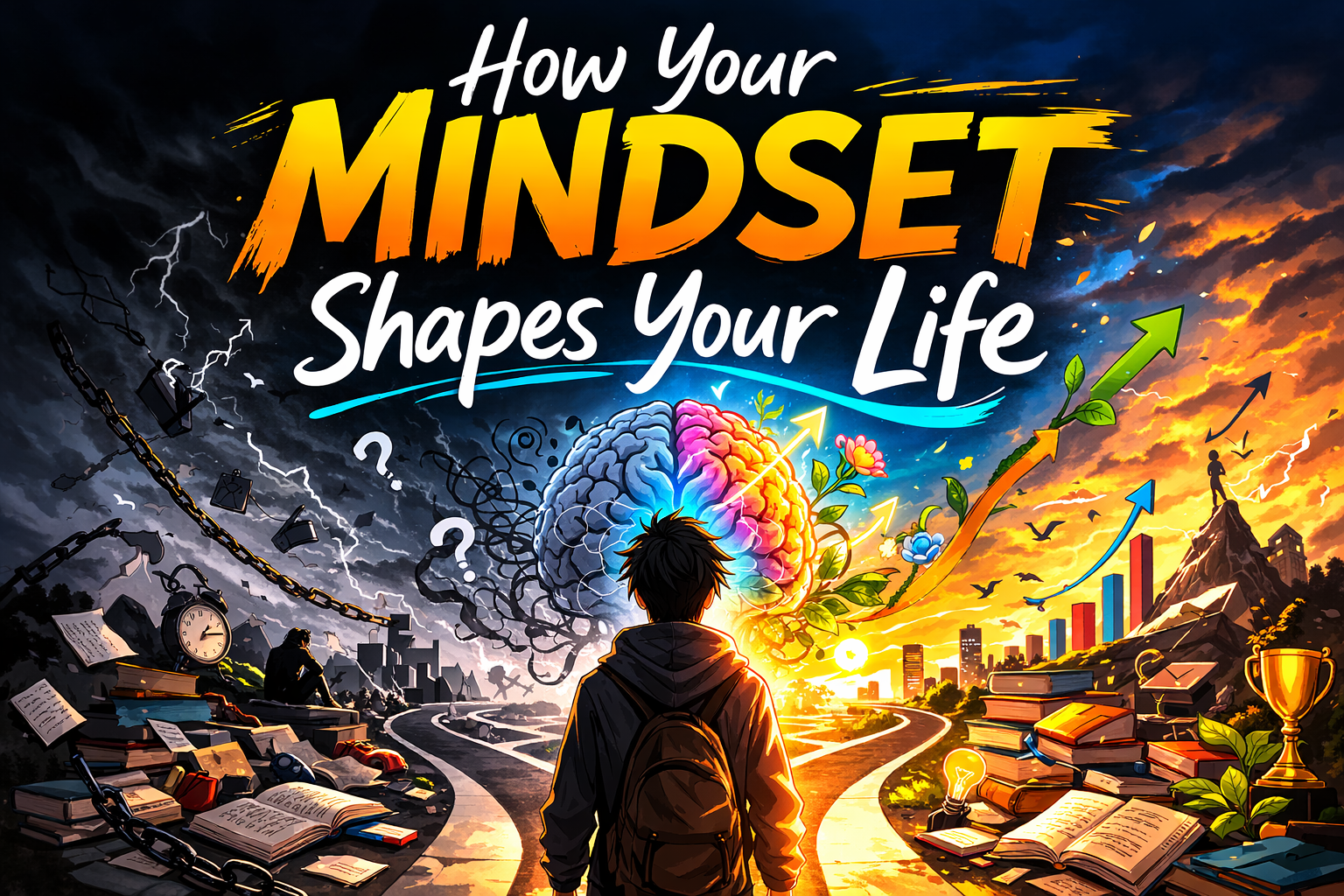
How Your Mindset Shapes Your Life: Key to Living a Successful Life
Every life is shaped by something invisible. It is not money, education, or luck. It is something far deeper and more powerful. It is the way we think. It is our mindset. Two people can start from the same place in life, go to the same school, live in the same neighborhood, and even possess similar abilities, yet their lives can unfold in completely different ways. One may grow, succeed, and feel fulfilled, while the other may remain stuck, frustrated, and dissatisfied. The difference between them is rarely intelligence or opportunity. More often, it is mindset. Now the question is
What Is Mindset?
Mindset is the mental framework through which we interpret the world. It shapes how we see challenges, how we react to failure, and how we pursue success. It influences our decisions, our habits, our confidence, and even the direction of our lives.
The Roman emperor and philosopher Marcus Aurelius once wrote,
“The happiness of your life depends upon the quality of your thoughts.”
This simple statement carries profound truth. The quality of your thoughts determines the quality of your life. Our minds constantly interpret reality. Every experience we face is filtered through our beliefs. If someone believes that they are capable of growth and improvement, they see opportunities where others see obstacles. But if someone believes that their abilities are limited and fixed, they often give up before even trying. Psychologists have studied mindset for decades, and their research consistently shows that the beliefs we hold about ourselves have an enormous impact on our outcomes. Stanford psychologist Carol Dweck, in her influential book Mindset: The New Psychology of Success, explains that people generally operate with two fundamental mindsets: a fixed mindset and a growth mindset.
Now, you may be thinking, well, what is the difference between a fixed mindset and a growth mindset? A fixed mindset is the belief that intelligence, talent, and abilities are permanent traits. People with this mindset often think that they either have the talent or they do not. When they face challenges, they feel threatened because failure appears to confirm their limitations. A growth mindset, on the other hand, is the belief that abilities can develop through effort, learning, and persistence. People with this mindset understand that improvement is possible. They view challenges not as threats but as opportunities to grow.
Dr. Dweck’s research revealed something remarkable: students who believed their intelligence could grow performed significantly better academically than those who believed intelligence was fixed. The difference was not intelligence itself but belief. This discovery has influenced education systems, businesses, and leadership training around the world. It has also revealed a powerful truth about human potential: the way we think about our abilities influences what we ultimately achieve.
But mindset is not just about success in school or work. It shapes every dimension of life. Consider how people respond to failure. Some individuals interpret failure as proof that they are not good enough. They feel discouraged and withdraw from the challenge. Others interpret failure as feedback. They ask themselves what they can learn and how they can improve. Thomas Edison famously failed thousands of times before successfully inventing the light bulb. When asked about these failures, he replied,
“I have not failed. I’ve just found 10,000 ways that won’t work.”
This response perfectly illustrates the power of mindset. Edison did not see failure as defeat. He saw it as progress.
This ability to reinterpret setbacks is one of the defining characteristics of successful individuals. Entrepreneurs, scientists, athletes, and artists who achieve greatness often share one common trait: they believe improvement is possible. Research in psychology and neuroscience supports this idea. Modern science has shown that the brain is far more adaptable than once believed. This phenomenon is known as neuroplasticity. Neuroplasticity refers to the brain’s ability to change and reorganize itself by forming new neural connections throughout life. Every time we learn something new, practice a skill, or challenge ourselves, our brain literally rewires itself.
The neuroscientist Norman Doidge describes this in his book The Brain That Changes Itself, explaining that the brain is constantly evolving in response to experience. This means that intelligence, creativity, and skills are not fixed traits determined at birth. They are dynamic abilities that can develop over time. Understanding this concept changes the way we view ourselves. If our brains can grow and adapt, then our potential is far greater than we often imagine. Mindset also influences how we experience stress and adversity. Life inevitably brings difficulties—loss, disappointment, uncertainty, and hardship. The way we interpret these experiences determines how we cope with them.
Studies in psychology have found that individuals with growth-oriented mindsets tend to be more resilient during stressful situations. They see challenges as temporary and solvable rather than permanent and overwhelming.
Resilience, the ability to recover from setbacks, is deeply connected to mindset. When people believe they can adapt and improve, they are more likely to persist through difficult circumstances. Angela Duckworth, the psychologist who popularized the concept of “grit,” found that perseverance and passion for long-term goals are often more important than talent. In her book Grit: The Power of Passion and Perseverance, she argues that sustained effort is a key factor behind exceptional achievement.
This perseverance is rooted in mindset. People who believe growth is possible are willing to invest effort over time. Mindset also shapes our relationships with others. Our beliefs about people influence how we interact with them. Individuals who believe that personalities and behaviors can change are more likely to approach conflicts with understanding and patience. They focus on communication and growth rather than blame.
In contrast, those who believe people cannot change often become rigid in their judgments. They may label others permanently based on mistakes or disagreements. Relationships thrive when individuals adopt a mindset of empathy, curiosity, and learning. When people believe that growth is possible, they become more open to feedback, compromise, and mutual development. Another powerful aspect of mindset is its influence on motivation. Motivation is not simply a matter of willpower. It is deeply connected to how we interpret effort.
People with fixed mindsets often see effort as a sign of weakness. They assume that if they were truly talented, success would come easily. When they struggle, they feel discouraged. People with growth mindsets see effort differently. They understand that effort is the path to mastery. Challenges become opportunities to build strength and skill. The legendary basketball player Michael Jordan once said, “I’ve missed more than 9,000 shots in my career. I’ve lost almost 300 games. Twenty-six times I was trusted to take the final shot, and I missed. I have failed again and again in my life. And that is why I succeed.”
The meaning behind this famous statement is powerful. The greatest basketball players in history did not become legends because they never failed. They became legends because they refused to allow failure to define them. Every missed shot became a lesson. Every lost game became feedback. Every disappointment became motivation. This is where mindset reveals its real power. When a person truly understands this principle, life begins to look very different. Instead of asking, “Why is this happening to me?” they begin to ask a far more powerful question: “What can this teach me?” That small shift in thinking changes the direction of action. It transforms frustration into curiosity, and defeat into determination. The situation outside may remain the same, but the response inside becomes stronger and wiser.
Throughout history, individuals who achieved extraordinary things were not those who avoided difficulty but those who developed the ability to interpret difficulty differently. They understood that struggle is not the opposite of success; it is often the path that leads to it. Every scientist experimenting in a laboratory, every athlete practicing for years, and every writer revising countless drafts is guided by a mindset that values progress over perfection. The British naturalist Charles Darwin once observed that survival does not necessarily belong to the strongest or the most intelligent, but to those who are the most adaptable to change. Adaptability is deeply connected to mindset. When people believe they can adjust, learn, and improve, they become far more capable of navigating uncertainty.
In the modern world, where change is constant and rapid, this ability has become more important than ever. Technology evolves, industries transform, and new challenges emerge almost every day. Those who hold rigid beliefs about their abilities often struggle to keep up with such changes. But those who cultivate a flexible and learning-oriented mindset tend to adapt more quickly. They view change not as a threat but as an invitation to grow. This perspective influences even the smallest daily decisions. Imagine two individuals learning a new skill. One might become discouraged the moment the process feels difficult, assuming that the difficulty proves a lack of talent. The other understands that difficulty is simply a sign that the brain is stretching beyond its comfort zone. As a result, the second person continues practicing, improving gradually until the skill becomes natural.
In many ways, the story of human progress is the story of people refusing to accept limitations. Every major advancement in science, medicine, technology, and art came from someone who believed that improvement was possible. When the Wright brothers first experimented with flying machines, many people dismissed their ideas as unrealistic. Yet their mindset allowed them to persist through repeated failures until the first successful flight became a reality. The same principle operates within individual lives. People often underestimate how much their thinking patterns influence their daily habits. A person who believes improvement is possible tends to invest more time in learning, reading, practicing, and exploring new ideas. Over months and years, these small efforts accumulate into remarkable progress.
This gradual accumulation is important to understand. Success rarely arrives suddenly. More often, it grows quietly through consistent effort. Each day’s learning may seem insignificant, but over time those small improvements compound. Just as a tiny seed slowly grows into a towering tree, small changes in thinking can eventually transform an entire life. Another important element of mindset is self-awareness. Many of the beliefs that guide our behavior operate unconsciously. We may not even realize how strongly certain assumptions shape our decisions. For example, someone who believes they are “not creative” may avoid activities that require imagination. Over time, this avoidance reinforces the belief itself.
However, when people become aware of such beliefs, they gain the power to question them. They begin to ask whether these assumptions are truly permanent or simply reflections of past experiences. By challenging limiting beliefs, individuals open the door to new possibilities. Self-awareness also allows people to recognize negative patterns of thinking such as excessive self-criticism or fear of failure. These patterns often develop during childhood or early experiences, but they do not have to remain permanent. With conscious effort, people can replace destructive inner dialogue with more constructive perspectives.
For instance, instead of thinking, “I am not good at this,” one might begin to think, “I am still learning this.” This subtle shift from judgment to progress changes the emotional experience of effort. Learning becomes less threatening and more engaging. Mindset also influences how people set goals. Individuals who believe growth is possible tend to pursue challenging goals that push them beyond their current abilities. They understand that meaningful achievements require patience and persistence. Rather than expecting immediate results, they focus on steady improvement.
This approach often leads to greater satisfaction as well. When success is defined purely by external outcomes such as money or recognition, happiness can become fragile. But when success is defined as continuous learning and contribution, fulfillment becomes more sustainable. Many philosophers and thinkers have recognized this idea long before modern psychology studied it scientifically. The ancient Stoic philosophers emphasized the importance of controlling one’s inner attitudes rather than trying to control every external circumstance. They believed that while events themselves may be unpredictable, our interpretation of them remains within our influence.
This insight remains deeply relevant today. In a world filled with uncertainty, cultivating a resilient mindset can provide stability and direction. Instead of waiting for perfect conditions, individuals with strong mindsets learn to act despite imperfections. Mindset also affects how people perceive other individuals’ success. Those with limited mindsets may feel threatened when others achieve something remarkable, interpreting it as evidence that their own opportunities are shrinking. In contrast, those with growth-oriented perspectives often feel inspired by others’ achievements. They see them as proof that improvement and success are possible.
This attitude creates a healthier environment for collaboration and learning. Instead of competing through insecurity, people begin to share ideas, encourage each other, and grow collectively. Another interesting aspect of mindset is its influence on creativity. Creativity flourishes when individuals allow themselves to experiment, make mistakes, and explore unconventional ideas. When people fear failure too strongly, they often suppress creativity because experimentation becomes risky. But when failure is accepted as part of the creative process, innovation becomes far more likely. Artists, scientists, and inventors frequently emphasize the importance of curiosity in their work. Curiosity itself is closely tied to mindset. It reflects a belief that there is always something new to learn and discover.
This sense of curiosity keeps the mind active and engaged throughout life. Instead of seeing learning as something limited to school or youth, individuals with curious mindsets treat learning as a lifelong journey. Over time, this continuous learning strengthens confidence. Confidence does not appear suddenly or magically. It grows through repeated experiences of effort and progress. Each small victory reinforces the belief that improvement is possible, making future challenges less intimidating. Eventually, this belief becomes self-reinforcing. The more people believe they can grow, the more they act in ways that promote growth. And the more they grow, the stronger that belief becomes.
At this point, mindset begins to function like a powerful internal engine driving personal development. It influences not only how people respond to events but also the opportunities they create for themselves. Ultimately, the idea that mindset shapes life is not merely philosophical—it is practical. It affects everyday choices such as whether to try something new, whether to persist through difficulty, whether to learn from criticism, and whether to believe in the possibility of improvement. Every one of these choices contributes to the direction of a person’s life.
To sum up, if someone repeatedly chooses avoidance, doubt, and resignation, their world gradually becomes smaller. But if someone repeatedly chooses curiosity, effort, and resilience, their world gradually expands. This is why mindset is often described as the invisible architect of our lives. Long before results appear externally, they begin forming internally within our beliefs and attitudes. When people begin to consciously cultivate empowering mindsets—embracing learning, welcoming challenges, and believing in growth—they unlock a deeper level of potential within themselves. And over time, this transformation in thinking quietly reshapes the entire trajectory of their lives.