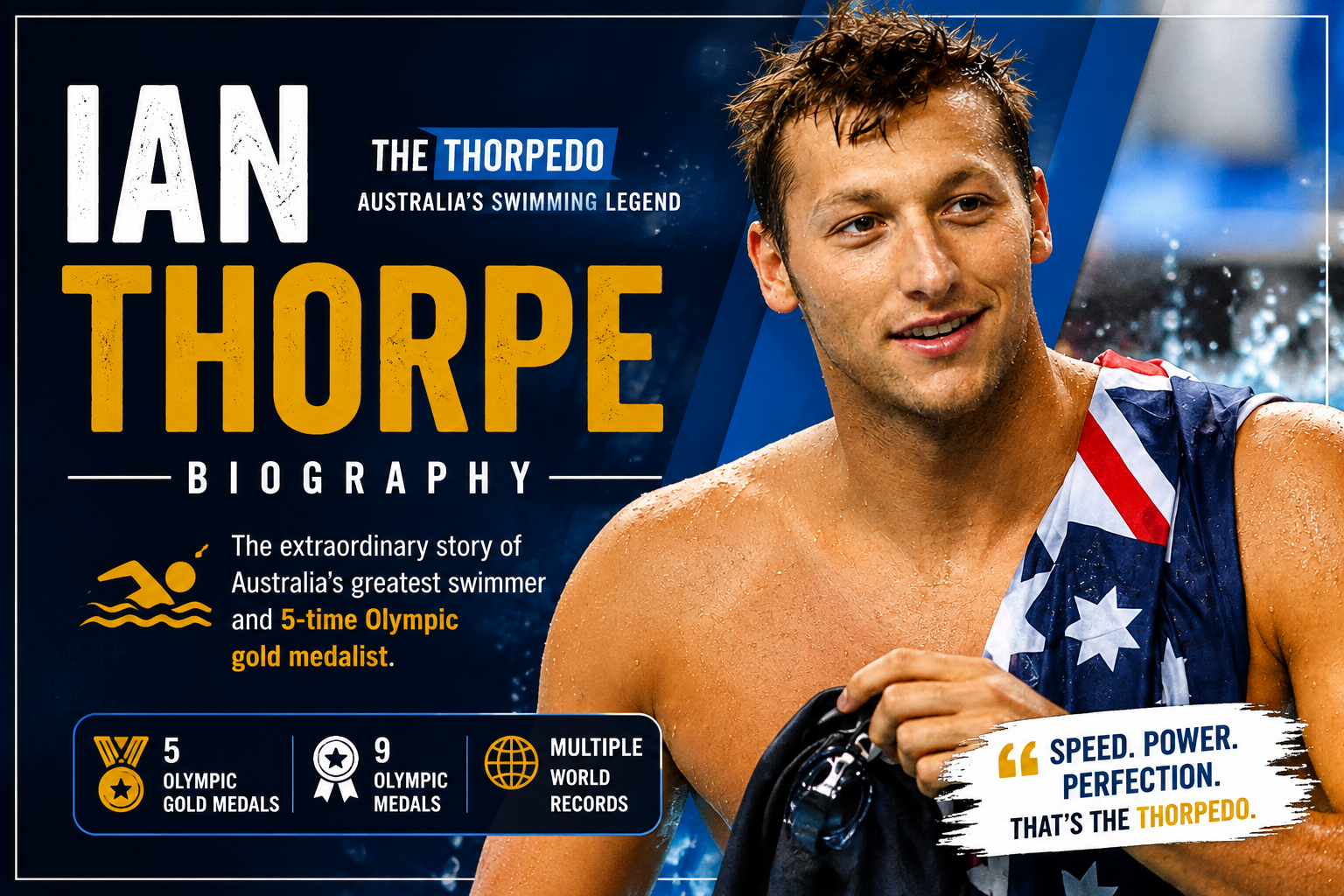
Ian Thorpe
Ian Thorpe is an Australian former competitive swimmer and one of the greatest swimmers in Olympic history. Born on October 13, 1982, in Sydney, Australia, Thorpe became a swimming sensation at a remarkably young age. Known by the nickname “Thorpedo,” he was famous for his powerful freestyle technique, exceptional endurance, and ability to dominate international swimming competitions.
Ian Thorpe made his Olympic debut at the 2000 Sydney Olympics when he was only 17 years old. Competing in front of a home crowd, he won three gold medals and two silver medals, becoming one of the stars of the Games. He continued his Olympic success at the 2004 Athens Olympics, where he won two gold medals, one silver, and one bronze.
Throughout his swimming career, Thorpe won five Olympic gold medals and a total of nine Olympic medals. He also became a multiple-time world champion and established numerous world records, particularly in freestyle events. His achievements made him one of Australia's most celebrated athletes and a major figure in international swimming.
Beyond his Olympic medals and world records, Ian Thorpe's life story includes intense training, sporting pressure, setbacks, retirement, and attempts to return to competitive swimming. His journey demonstrates the importance of discipline, resilience, confidence, and perseverance.
Today, Ian Thorpe is remembered as an Olympic champion, Australian swimming legend, world-record holder, and inspirational athlete whose career continues to influence swimmers around the world.
Profession:
Australian Former Competitive Swimmer, Olympic Champion
Nationality:
Australian
Born:
1982
Ian Thorpe is one of the most successful Australian swimmers and one of the greatest freestyle swimmers in Olympic history. Born on October 13, 1982, in Sydney, Australia, Ian James Thorpe rose from being a talented young swimmer to becoming a five-time Olympic gold medalist, multiple world champion and world-record holder. Known around the world by his famous nickname “Thorpedo,” he became an international sports icon because of his exceptional speed, powerful swimming technique, endurance and remarkable achievements at a very young age.
Thorpe's swimming career began during childhood, and his talent quickly became impossible to ignore. He progressed through Australian junior swimming before making his international breakthrough as a teenager. At just 15 years old, he became a world champion, establishing himself as one of the most exciting young athletes in international swimming.
His greatest early success came at the 2000 Sydney Olympics, where he competed in front of his home crowd at only 17 years old. Thorpe won three gold medals and two silver medals, becoming one of the biggest stars of the Games. Four years later, at the 2004 Athens Olympics, he added two more gold medals, one silver and one bronze to his Olympic record.
Overall, Ian Thorpe won five Olympic gold medals and nine Olympic medals. He also won numerous World Championship titles, Commonwealth Games medals and established multiple world records, particularly in the 200-metre and 400-metre freestyle.
However, Ian Thorpe's life story is about more than medals and records. His journey includes early success, intense training, international fame, pressure, retirement, a comeback attempt and life beyond competitive swimming. His career demonstrates the importance of talent, discipline, preparation, resilience and the ability to adapt when life changes.
Personal Information
Full Name: Ian James Thorpe
Known As: Ian Thorpe, “Thorpedo”
Born: October 13, 1982
Birthplace: Sydney, New South Wales, Australia
Nationality: Australian
Profession: Former Competitive Swimmer, Olympic Athlete, Sports Personality
Sport: Swimming
Speciality: Freestyle Swimming
Famous Events: 200m Freestyle, 400m Freestyle, Olympic Relay Events
Olympic Games: Sydney 2000, Athens 2004
Olympic Gold Medals: 5
Total Olympic Medals: 9
World Championships: Multiple World Championship Titles
Nickname: Thorpedo
Early Life and Family
Ian James Thorpe was born on October 13, 1982, in Sydney, New South Wales, Australia. He grew up in a family with a strong connection to sports.
His father, Ken Thorpe, was a talented cricketer, while his mother, Margaret Thorpe, played netball. His older sister, Christina Thorpe, was also a competitive swimmer.
Christina's involvement in swimming helped introduce Ian to the sport. However, Ian did not immediately appear destined to become one of the world's greatest swimmers.
As a young child, Thorpe experienced problems with chlorine. He suffered irritation and discomfort when swimming, which could have discouraged him from pursuing the sport.
Instead, he continued.
His persistence eventually allowed him to become comfortable in the swimming environment. As he grew older, his natural physical characteristics became increasingly useful in competitive swimming.
Thorpe developed a tall and powerful frame, long arms, large hands and unusually large feet. His large feet provided significant propulsion in the water, while his long reach helped him cover considerable distance with every stroke.
But his physical characteristics were only one part of the story.
Thorpe possessed exceptional coordination, endurance, competitive intelligence and an ability to learn and improve quickly. With the help of his coaches and family, he began developing these qualities into world-class swimming ability.
Discovering a Natural Swimming Talent
Thorpe started competing seriously at a young age.
He trained at Soccajoey Swim Club in Sydney, where he worked under coach Doug Frost. Frost became one of the most important influences on Thorpe's swimming development.
Thorpe's progress was extraordinary.
As a young teenager, he began competing successfully against older swimmers. His performances in freestyle events attracted increasing attention.
He was particularly impressive in the 200-metre freestyle and 400-metre freestyle.
These events require a combination of speed, endurance, technical efficiency and intelligent pacing. Thorpe possessed all of these qualities.
His ability to maintain a fast pace over a long distance became one of his biggest competitive advantages.
By his early teenage years, it was clear that Thorpe was not simply a talented junior swimmer.
He was developing into an elite athlete.
Becoming Australia's Youngest Swimming Star
At just 14 years old, Thorpe became the youngest male swimmer selected for an Australian team at the time.
This achievement represented an important turning point.
While most teenagers were still developing their skills at junior competitions, Thorpe was already competing at the national and international level.
His performances attracted attention from Australian swimming fans and the international sporting community.
Thorpe's rapid rise also created expectations.
Australia has a strong swimming tradition, and successful swimmers often become national sporting figures. Thorpe's extraordinary performances meant that expectations surrounding him increased quickly.
Despite this pressure, he continued to improve.
His times became faster, his technique became more efficient and his confidence grew.
1998 World Championships
Ian Thorpe's major international breakthrough came at the 1998 World Championships in Perth, Australia.
He was only 15 years old.
Competing against some of the best swimmers in the world, Thorpe won the 400-metre freestyle world championship title.
The achievement was historic.
At the time, he became the youngest male world champion in swimming.
The victory transformed Thorpe from a promising Australian teenager into a global swimming sensation.
Winning a world championship at 15 also demonstrated that Thorpe could perform under enormous pressure.
He was competing in front of a home audience while carrying the expectations associated with being one of Australia's brightest young sporting talents.
Instead of allowing the pressure to overwhelm him, Thorpe used the opportunity to demonstrate his ability.
Rise of the “Thorpedo”
As Thorpe became more successful, his nickname “Thorpedo” became famous around the world.
The nickname combined his surname with the word “torpedo” and reflected his incredible speed through the water.
Thorpe's swimming style was distinctive.
He possessed a long stroke, powerful kick and efficient body position. His unusually large feet helped him generate propulsion, while his long arms allowed him to cover substantial distance with each stroke.
His greatest advantage, however, was his ability to combine power with endurance.
Thorpe could swim extremely fast while maintaining his technique for a long period.
This made him particularly dominant in middle-distance freestyle events.
World Records and International Success
Thorpe soon began establishing world records.
His performances in freestyle swimming repeatedly pushed the boundaries of international competition.
The 200m freestyle and 400m freestyle became his signature events, although he also competed successfully in other freestyle races and relay events.
Thorpe's world-record performances demonstrated that his success was not based on one exceptional competition.
He was consistently faster than his competitors.
His technique, conditioning, race strategy and mental preparation allowed him to maintain an extraordinary level of performance.
He also developed a reputation for producing strong finishes.
When other swimmers began to tire, Thorpe could often maintain his pace and finish with exceptional speed.
The 2000 Sydney Olympics
The 2000 Sydney Olympics became the defining moment of Ian Thorpe's early career.
Thorpe was only 17 years old.
The Olympics were being held in his home city, which meant that he was competing in front of millions of Australians who expected him to succeed.
The pressure was enormous.
Thorpe had already become a world champion and world-record holder, but the Olympics represented a completely different level of competition.
Instead of being overwhelmed, Thorpe produced an extraordinary performance.
He won three gold medals and two silver medals.
His gold medals came in:
- 400m freestyle
- 4×100m freestyle relay
- 4×200m freestyle relay
He won silver medals in:
- 200m freestyle
- 4×100m medley relay
His performance made him one of the biggest stars of the Sydney Olympics.
At just 17 years old, Thorpe had become an Olympic champion and one of Australia's most recognizable athletes.
400m Freestyle Olympic Victory
The 400m freestyle was one of Thorpe's most important events.
His Olympic victory demonstrated his extraordinary endurance and tactical intelligence.
The race requires swimmers to balance speed and energy carefully.
A swimmer who starts too quickly can become exhausted before the finish.
A swimmer who starts too slowly may lose too much distance.
Thorpe had the ability to establish an extremely fast pace while still maintaining enough energy for the final stages.
His victory became one of the memorable swimming moments of the Sydney Olympics.
Olympic Relay Success
Thorpe also played a crucial role in Australia's relay victories.
The 4×100m freestyle relay was one of the most memorable events of the Sydney Games.
Australia faced a powerful American team, but the Australian swimmers produced an outstanding performance.
Thorpe's contribution helped Australia win the gold medal.
He also helped Australia win the 4×200m freestyle relay.
These victories demonstrated that Thorpe was not only an outstanding individual swimmer.
He was also an important team competitor who could perform under intense pressure.
Becoming an Australian Sports Icon
The Sydney Olympics transformed Ian Thorpe's public profile.
He became one of the most recognizable athletes in Australia.
His youthful appearance, distinctive swimming style, famous nickname and Olympic achievements made him extremely popular.
However, fame came with responsibilities.
Thorpe was suddenly dealing with interviews, sponsorships, media attention and public expectations while still being a teenager.
Every race received enormous attention.
Every result was discussed by the media.
Every competition brought expectations that he would win.
Despite these distractions, Thorpe continued to focus on training and competition.
2001 World Championships
Thorpe continued his dominance at the 2001 World Championships.
He won multiple world titles and strengthened his reputation as one of the best swimmers in the world.
His performances demonstrated that the Sydney Olympics had not been a one-time achievement.
He could maintain his success year after year.
Thorpe remained particularly dominant in freestyle events and continued contributing to Australia's relay teams.
His ability to compete successfully at both individual and relay events made him an extremely valuable member of the Australian swimming team.
2002 Commonwealth Games
The 2002 Commonwealth Games in Manchester provided another opportunity for Thorpe to demonstrate his abilities.
He won multiple medals and became one of the most successful athletes at the competition.
By this point, Thorpe had become a global sporting star.
His success at the Commonwealth Games further strengthened his reputation as one of the world's greatest freestyle swimmers.
He was no longer simply an Olympic champion.
He had become a consistent international champion.
2003 World Championships
At the 2003 World Championships in Barcelona, Thorpe continued his remarkable career.
He won multiple gold medals and remained one of the dominant swimmers in international competition.
His performances in the 200m and 400m freestyle were particularly impressive.
He also contributed to Australia's success in relay events.
Thorpe's ability to maintain such a high level of performance while still being relatively young demonstrated his extraordinary consistency.
The 2004 Athens Olympics
Thorpe entered the 2004 Athens Olympics with enormous expectations.
Unlike Sydney, where he had been a teenage newcomer, Athens saw Thorpe competing as an established Olympic champion.
The world expected him to win.
The pressure was immense.
One of the most dramatic moments came during the qualifying stages of the 400m freestyle.
Thorpe made a mistake at the start and was nearly eliminated from the event.
However, he eventually qualified and went on to win the Olympic final.
His performance demonstrated his ability to recover from a difficult situation and perform under pressure.
At Athens 2004, Thorpe won:
- Gold — 200m freestyle
- Gold — 400m freestyle
- Silver — 4×200m freestyle relay
- Bronze — 100m freestyle
His two gold medals brought his career total to five Olympic gold medals.
The 200m Freestyle at Athens
The 200m freestyle final at Athens was one of the most competitive races of Thorpe's career.
He faced some of the world's best swimmers.
Despite the enormous pressure, Thorpe produced a powerful performance and won the gold medal.
The victory demonstrated that he could continue performing at the highest level even after becoming one of the world's most famous athletes.
Ian Thorpe and Michael Phelps
Ian Thorpe and Michael Phelps were two of the most famous swimmers of their generation.
Their careers overlapped during a particularly competitive period in international swimming.
Phelps became famous for his versatility across butterfly, individual medley and freestyle events.
Thorpe became particularly dominant in freestyle.
The two swimmers were frequently compared because of their extraordinary achievements.
Phelps eventually became the most decorated Olympian in history, but Thorpe's achievements remain remarkable.
Five Olympic gold medals and nine Olympic medals place Thorpe among the greatest swimmers in Olympic history.
Ian Thorpe's Swimming Technique
Thorpe's physical characteristics and technique played a major role in his success.
His tall frame gave him a long reach.
His large hands helped him generate propulsion.
His unusually large feet functioned almost like natural fins.
His powerful kick allowed him to maintain speed.
However, his biggest advantage was the ability to combine these physical qualities with exceptional efficiency.
Thorpe's stroke looked smooth and controlled.
He did not appear to waste unnecessary energy.
This was particularly important in the 400m freestyle, where conserving energy while maintaining a fast pace is essential.
His technique became a subject of interest among coaches and young swimmers around the world.
Training and Discipline
Behind Thorpe's success was an enormous amount of training.
Elite swimmers spend countless hours in the pool developing endurance, speed, technique and race strategy.
Thorpe's training involved repeated swimming sessions, conditioning, strength work and recovery.
He also had to maintain his physical and mental health while dealing with the demands of international competition.
The difference between winning and losing at the Olympic level can be measured in fractions of a second.
Thorpe's success came from years of consistently working on those small improvements.
Pressure and International Fame
One of the most challenging aspects of Thorpe's career was becoming famous at such a young age.
Winning a world championship at 15 and Olympic gold at 17 meant that he was under public scrutiny throughout his teenage years.
Australia expected him to win.
International competitors studied him.
The media followed his career closely.
Every race became an important event.
Thorpe had to learn how to handle pressure while continuing to train at an elite level.
His ability to compete successfully despite these expectations was one of the most impressive aspects of his career.
Retirement From Swimming
In 2006, Ian Thorpe announced his retirement from competitive swimming.
He was only 24 years old.
The decision surprised many people because he was still young and had already achieved extraordinary success.
However, Thorpe had begun to feel that his motivation for continuing competitive swimming had changed.
Retirement marked the end of one of Australia's greatest swimming careers.
At the time of his retirement, he had achieved:
- Five Olympic gold medals
- Nine Olympic medals overall
- Multiple World Championship titles
- Numerous Commonwealth Games medals
- Numerous world records
- International recognition as one of the greatest freestyle swimmers
Ian Thorpe's Comeback Attempt
Several years after retirement, Thorpe decided to return to competitive swimming.
His comeback became a major international sports story.
He began training with the goal of qualifying for the 2012 London Olympics.
However, returning to elite competition after years away proved extremely difficult.
Thorpe experienced injuries and other challenges while attempting to regain his previous form.
Although he worked hard, he was unable to qualify for the Australian Olympic team for London.
The comeback therefore did not end with another Olympic appearance.
Nevertheless, the attempt demonstrated his willingness to challenge himself again.
Lessons From His Comeback
Thorpe's comeback provides an important lesson about failure and resilience.
Even one of the greatest swimmers in history could not simply return to the sport and immediately perform at his previous level.
Elite swimming requires years of continuous preparation.
Timing, conditioning, technique, recovery and competition experience all matter.
Thorpe's comeback demonstrated how difficult it can be to return to world-class competition after retirement.
At the same time, attempting the comeback showed courage.
He was willing to risk failure in front of the entire world.
Life After Competitive Swimming
After his swimming career, Thorpe remained involved in public life.
He became involved in broadcasting, public speaking, charity work and various other activities.
His experience as an Olympic champion gave him valuable insight into elite competition, pressure and personal development.
He also became involved in charitable and humanitarian causes.
His influence therefore continued beyond competitive swimming.
Philanthropy and Charity Work
Thorpe has used his public profile to support charitable causes.
His work has included efforts related to disadvantaged children and health-related initiatives.
His charitable activities demonstrate that the influence of an athlete can continue long after retirement.
An Olympic champion can use public recognition to support causes that improve the lives of others.
Thorpe's work outside swimming became an important part of his life and public identity.
Ian Thorpe's Major Achievements
Some of Ian Thorpe's most important achievements include:
- Five Olympic gold medals
- Nine Olympic medals overall
- Three gold medals at the 2000 Sydney Olympics
- Two gold medals at the 2004 Athens Olympics
- Multiple World Championship titles
- Multiple Commonwealth Games medals
- Numerous world records
- Youngest male world champion at the time of his first world title
- Multiple Australian swimming records
- Olympic relay victories
- International recognition as one of the greatest freestyle swimmers
- One of Australia's most successful Olympic athletes
Ian Thorpe's Olympic Medal Record
Sydney 2000
Gold
- 400m freestyle
- 4×100m freestyle relay
- 4×200m freestyle relay
Silver
- 200m freestyle
- 4×100m medley relay
Athens 2004
Gold
- 200m freestyle
- 400m freestyle
Silver
- 4×200m freestyle relay
Bronze
- 100m freestyle
Overall, Ian Thorpe won five gold medals, three silver medals and one bronze medal, giving him nine Olympic medals.
Why Ian Thorpe Is Considered One of the Greatest Swimmers
Ian Thorpe is considered one of the greatest swimmers because of his combination of Olympic success, world records, versatility and longevity.
He became a world champion as a teenager.
He became an Olympic champion at 17.
He won Olympic gold medals at two different Olympic Games.
He dominated the 200m and 400m freestyle.
He established numerous world records.
He contributed to Australia's successful relay teams.
Most importantly, he consistently performed against the strongest swimmers in the world.
His career therefore represents one of the highest levels of achievement in competitive swimming.
Ian Thorpe's Influence on Australian Swimming
Ian Thorpe became a major inspiration for young Australian swimmers.
His success at Sydney 2000 inspired many children to take up swimming and dream of competing at the Olympics.
His performances also helped reinforce Australia's position as one of the world's leading swimming nations.
Young swimmers studied his technique and watched his races.
For many Australian athletes, Thorpe represented what was possible through dedication and hard work.
His influence therefore goes far beyond his personal medal collection.
Life Lessons From Ian Thorpe
Ian Thorpe's career offers many valuable life lessons.
Talent Must Be Developed
Natural ability can provide an advantage, but consistent training is necessary to turn talent into achievement.
Discipline Creates Results
Thorpe's success came from years of disciplined training and preparation.
Learn From Great Coaches
Doug Frost played a major role in developing Thorpe's skills and competitive approach.
Perform Under Pressure
Thorpe repeatedly competed successfully despite enormous public expectations.
Set Ambitious Goals
His career demonstrates what can happen when an athlete sets extremely high standards.
Learn From Setbacks
His difficult comeback attempt showed that failure can be part of the journey.
Keep Trying
Returning to competitive swimming required courage and determination.
Success Requires Sacrifice
Elite athletic achievement requires significant time, effort and commitment.
Do Not Let Failure Define You
An unsuccessful comeback did not erase Thorpe's extraordinary career.
Build a Life Beyond Your Profession
After swimming, Thorpe developed interests and responsibilities outside competitive sport.
Use Your Influence Positively
His charitable activities show how public recognition can be used to help others.
Understand That Life Changes
Retirement demonstrated that changing direction can be an important part of personal growth.
Keep Improving
Thorpe's career was built around constant technical and physical development.
Believe in Your Ability
Confidence helped him compete against the world's best swimmers.
Leave a Positive Legacy
Thorpe's greatest legacy may be the inspiration he provided to future generations.
Ian Thorpe's Legacy
Ian Thorpe's legacy is built on much more than his five Olympic gold medals.
He became one of the greatest freestyle swimmers of his generation and one of Australia's most successful Olympic athletes.
His journey from a young swimmer in Sydney to a world champion and Olympic superstar inspired millions of people.
His performance at the 2000 Sydney Olympics remains one of the most memorable moments in Australian sporting history.
At only 17, he won three gold medals and two silver medals.
Four years later, at Athens 2004, he won another two gold medals, one silver and one bronze.
His Olympic career demonstrated remarkable consistency.
His world records demonstrated technical excellence.
His relay victories demonstrated teamwork.
His ability to perform under pressure demonstrated mental strength.
His retirement and later comeback demonstrated that even the greatest athletes experience difficult transitions.
For people searching for Ian Thorpe biography, Ian Thorpe Olympic medals, Ian Thorpe five gold medals, Ian Thorpe swimming career, Ian Thorpe world records, Ian Thorpe 2000 Olympics, Ian Thorpe 2004 Olympics, Ian Thorpe age, Ian Thorpe height, Ian Thorpe achievements, Ian Thorpe retirement, Ian Thorpe comeback, Ian Thorpe life story and Ian Thorpe legacy, his journey offers an inspiring example of extraordinary achievement combined with the challenges of elite sport.
Thorpe helped inspire a generation of Australian swimmers.
His performances encouraged young athletes to dream about Olympic success.
His nickname “Thorpedo” became synonymous with speed and excellence.
His achievements helped strengthen Australia's reputation as a swimming powerhouse.
Even after his competitive career ended, his name remained associated with Olympic swimming and sporting excellence.
Final Perspective
Ian Thorpe's life is the story of an extraordinary athlete who achieved international fame at a remarkably young age.
He became a world champion at 15.
He became an Olympic champion at 17.
He won five Olympic gold medals.
He won nine Olympic medals overall.
He established numerous world records.
He became one of the greatest freestyle swimmers of his generation.
He retired from competitive swimming at 24.
He later attempted an ambitious comeback.
He then developed a life and career beyond competitive sport.
His story demonstrates that greatness is not created overnight.
It comes from years of preparation, discipline, coaching, sacrifice, determination and the ability to continue learning.
Thorpe's career also demonstrates that even extraordinary success does not make life easy.
Being a teenage world champion brought enormous expectations.
Being an Olympic champion brought international attention.
Retirement required a major change in identity.
The comeback brought disappointment.
Yet each chapter became part of his larger story.
Today, Ian Thorpe remains an Olympic champion, Australian swimming legend, world-record holder and inspirational athlete.
His achievements at the Sydney 2000 and Athens 2004 Olympics have secured his place in Olympic history.
His influence on Australian swimming continues through the athletes he inspired.
His story remains relevant to anyone interested in Olympic athletes, swimming champions, sports biographies, personal development, perseverance, discipline and success.
Ultimately, Ian Thorpe's legacy is not simply about how many medals he won.
It is about what those achievements represented: years of hard work, extraordinary determination, resilience under pressure and the courage to pursue excellence.
From a young swimmer in Sydney to the world-famous “Thorpedo,” Ian Thorpe's journey remains one of the most remarkable stories in modern swimming history.
Major Achievements
Five-time Olympic gold medalist
Nine-time Olympic medalist
Multiple World Championship gold medalist
Multiple Commonwealth Games champion
Numerous world records
Olympic champion at Sydney 2000
Olympic champion at Athens 2004
Youngest male world champion at the time of his first title
One of Australia's most successful Olympic swimmers
One of the world's most famous freestyle swimmers
Australian swimming icon
International sports personality
Life Lessons from Ian Thorpe
Talent needs discipline. Natural ability can create opportunities, but consistent training is necessary to reach the highest level.
Success requires preparation. Olympic victories are built through years of preparation rather than a single performance.
Pressure can be managed. Thorpe competed successfully despite enormous expectations from Australia and the international media.
Setbacks are part of success. His comeback attempt did not succeed, but it did not diminish his earlier achievements.
Great athletes keep learning. Thorpe continually developed his technique and racing strategy.
Courage means taking risks. His decision to attempt a comeback demonstrated his willingness to challenge himself.
Success does not last forever. Athletes eventually have to adapt to changes in their careers and lives.
Your identity can extend beyond your profession. Thorpe developed a life outside competitive swimming after retirement.
Consistency creates excellence. His world-class career was built through years of repeated effort.
Legacy matters. His influence on young swimmers became one of the most important results of his career.
Famous Quotes
“You can't put a limit on anything. The more you dream, the farther you get.”
“I think the most important thing is to enjoy what you do and be passionate about it.”
“The journey is just as important as the result.”
“Success is not simply about winning; it is about the effort you put into becoming better.”
“You have to believe in yourself and continue working toward your goals.”
Interesting Facts
Ian Thorpe was born in Sydney, Australia.
His birthday is October 13, 1982.
He became a world champion at only 15 years old.
He became an Olympic champion at 17.
He won five Olympic gold medals.
He won nine Olympic medals overall.
He won three gold medals at the Sydney 2000 Olympics.
He won two gold medals at the Athens 2004 Olympics.
His nickname is “Thorpedo.”
He was particularly famous for the 200m and 400m freestyle.
He established numerous swimming world records.
His older sister Christina was also a swimmer.
His coach Doug Frost played an important role in his development.
He retired from competitive swimming at only 24 years old.
He later attempted a comeback to qualify for the 2012 Olympics.
His comeback did not result in Olympic qualification.
He became one of Australia's most recognizable sporting personalities.
His large feet became one of his famous physical characteristics as a swimmer.
His Olympic career included medals in both individual and relay events.
His success inspired a generation of Australian swimmers.
Legacy
His performance at the Sydney 2000 Olympics became particularly important because he was only 17 years old and competing in front of his home crowd. His three gold medals and two silver medals made him one of the defining athletes of the Games.
His success continued at Athens 2004, where he won two additional gold medals, a silver and a bronze.
However, Thorpe's legacy goes beyond statistics. He inspired young swimmers across Australia and around the world and helped establish a new standard for freestyle swimming.
His retirement and comeback also made his story more relatable. His career demonstrates that even extraordinary athletes experience pressure, uncertainty, setbacks and difficult decisions.
Today, Ian Thorpe remains an Olympic champion, Australian sports legend, world-record swimmer and inspirational figure whose achievements continue to influence the world of swimming.
Frequently Asked Questions
Ian Thorpe is a former Australian competitive swimmer and five-time Olympic gold medalist. He is widely regarded as one of the greatest freestyle swimmers of his generation.
Ian Thorpe was born on October 13, 1982, in Sydney, Australia.
Ian Thorpe won five Olympic gold medals during his career.
He won nine Olympic medals in total: five gold, three silver and one bronze.
Ian Thorpe is famous for his Olympic swimming career, freestyle dominance, world records and five Olympic gold medals.
His famous nickname is “Thorpedo.”
Ian Thorpe was only 15 years old when he won his first World Championship title.
He was 17 years old when he won his first Olympic gold medals at the Sydney 2000 Olympics.
He was particularly famous for the 200m and 400m freestyle events.
He won three gold medals at the Sydney 2000 Olympics.
He won two gold medals at the Athens 2004 Olympics.
Ian Thorpe retired from competitive swimming in 2006, at the age of 24.
Yes. He attempted a comeback several years after retirement with the goal of qualifying for the 2012 London Olympics.
No. Despite attempting to return to elite competition, he was unable to qualify for the Australian Olympic team.
His five Olympic gold medals, nine Olympic medals, world championship titles, world records and dominance in freestyle swimming place him among the greatest swimmers in Olympic history.