Mark Spitz
Mark Spitz is an American former competitive swimmer and one of the greatest Olympic athletes in swimming history. Born on February 10, 1950, in Modesto, California, Spitz became famous for his extraordinary speed, competitive determination, and record-breaking performances in the pool. He won his first Olympic gold medals at the 1968 Mexico City Olympics before producing one of the most remarkable performances in Olympic history at the 1972 Munich Games.
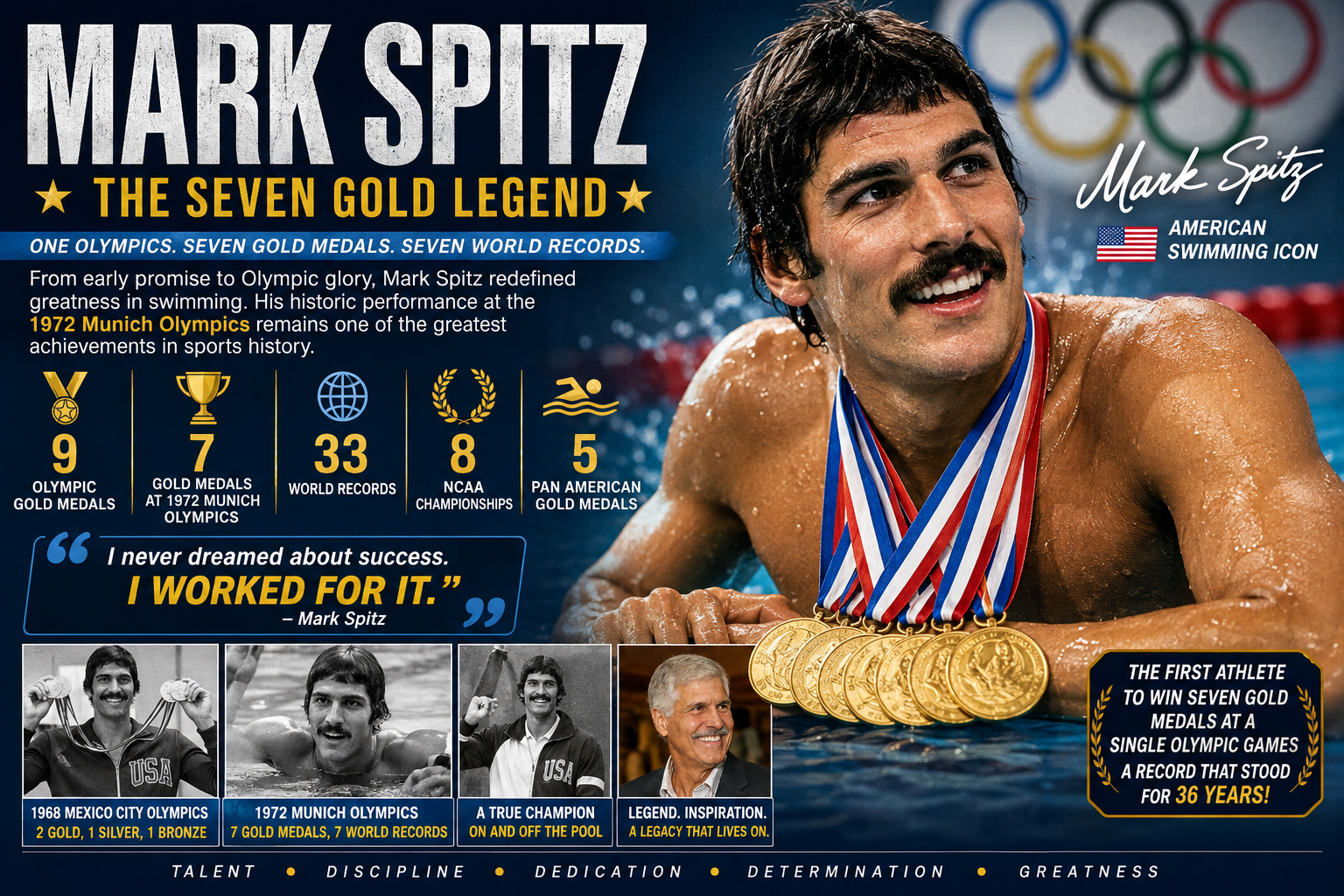
At the 1972 Olympics, Mark Spitz won seven gold medals, setting a world record in every event he won. His seven-gold-medal achievement stood as an iconic Olympic record for decades and helped establish him as one of the most famous swimmers of all time. Across his Olympic career, Spitz won nine gold medals, one silver medal, and one bronze medal.
Known for his powerful freestyle, butterfly, and relay performances, Mark Spitz transformed competitive swimming and inspired generations of athletes. His career represents excellence, discipline, preparation, confidence, and the pursuit of greatness. His name remains closely associated with Olympic swimming, world records, gold medals, and sporting history.
Profession:
American Swimmer & Olympic Champion
Nationality:
American
Born:
1950
Mark Spitz is an American former competitive swimmer, nine-time Olympic champion, world-record holder, and one of the most iconic athletes in Olympic history. Best known for winning seven gold medals at the 1972 Munich Olympics, Spitz became a global symbol of sporting excellence and dominated international swimming during the late 1960s and early 1970s.
For people searching for Mark Spitz biography, Mark Spitz age, Mark Spitz height, Mark Spitz Olympic medals, Mark Spitz seven gold medals, Mark Spitz swimming career, Mark Spitz world records, Mark Spitz 1972 Olympics, Mark Spitz 1968 Olympics, Mark Spitz family, Mark Spitz education, Mark Spitz achievements, and Mark Spitz life story, his career offers one of the most fascinating stories in the history of competitive swimming.
Spitz competed at the 1968 Mexico City Olympics and the 1972 Munich Olympics. Across those two Olympic Games, he won nine gold medals, one silver medal, and one bronze medal. At Munich in 1972, he won seven gold medals in eight days and established a world record in every event he entered. The achievement made him the first athlete to win seven gold medals at a single Olympic Games, a record that remained unmatched until Michael Phelps won eight at Beijing 2008.
But Mark Spitz's story is about much more than seven Olympic gold medals. His journey began when he was a young boy swimming in Hawaii and California. It continued through age-group records, elite coaching, national championships, college swimming, Olympic disappointment, extraordinary redemption in Munich, early retirement, television appearances, business ventures, and a lasting place in sports history.
Mark Spitz Quick Facts
Full name: Mark Andrew Spitz
Known as: Mark Spitz
Nickname: Mark the Shark
Date of birth: February 10, 1950
Birthplace: Modesto, California, United States
Nationality: American
Profession: Former competitive swimmer, Olympic champion, businessman and sports personality
Primary strokes: Freestyle and butterfly
Height: Approximately 6 feet (1.83 m)
College: Indiana University
Olympic Games: Mexico City 1968 and Munich 1972
Olympic gold medals: 9
Olympic silver medals: 1
Olympic bronze medals: 1
Total Olympic medals: 11
Pan American Games gold medals: 5
NCAA titles: 8
World records: 33 listed by the International Swimming Hall of Fame
International Swimming Hall of Fame: Inducted 1977
U.S. Olympic Hall of Fame: Inducted 1983
The International Swimming Hall of Fame records Spitz's Olympic medals, five Pan American Games gold medals, eight NCAA titles, 33 world records, and his 1972 World Swimmer of the Year honor.
Early Life of Mark Spitz
Mark Andrew Spitz was born on February 10, 1950, in Modesto, California. He was the eldest of three children in the Spitz family.
His childhood played an important role in his development as a swimmer.
When Mark was two years old, his family moved from California to Hawaii. Living near the ocean introduced him to swimming at an extremely young age. His official biography explains that he spent a great deal of time swimming at Waikiki Beach.
For a future Olympic swimmer, this early relationship with water was significant.
He was not introduced to swimming as a teenager.
He grew up around it.
Water became part of his childhood environment.
When Spitz was six, his family returned to California, and he began competing at a local swim club. By age nine, he was training at the Arden Hills Swim Club in Sacramento under coach Sherm Chavoor.
Chavoor was an important figure in Spitz's development. He was an experienced coach who helped Spitz understand that natural ability needed to be combined with disciplined training.
The young swimmer quickly began demonstrating unusual talent.
By the time he was ten years old, Spitz had already established 17 national age-group records and one world age-group record, according to his official biography.
That is an extraordinary achievement for a child.
It also provides an important lesson about elite sport: Olympic success often begins many years before the athlete reaches the Olympic stage.
Mark Spitz and His Early Swimming Development
Spitz's swimming career developed rapidly during his teenage years.
When he was 14, his family moved again, this time to Santa Clara, California. There he joined the Santa Clara Swim Club and began training under legendary coach George Haines.
Haines would become one of the most influential coaches in Spitz's career.
The International Swimming Hall of Fame identifies three major coaches who helped shape Spitz's development:
- Sherm Chavoor
- Doc Counsilman
- George Haines
All three were later inducted into the International Swimming Hall of Fame.
This coaching network was crucial because Spitz was developing into an unusually versatile swimmer.
He could compete in both freestyle and butterfly and was capable of performing at a world-class level across different distances.
As a teenager, he accumulated national records and became one of the most promising swimmers in the United States.
His rapid improvement eventually led him toward international competition.
Mark Spitz at the 1967 Pan American Games
Before becoming an Olympic legend, Spitz made a major international statement at the 1967 Pan American Games in Winnipeg, Canada.
He won five gold medals.
The performance established him as one of America's most promising young swimmers and showed that he was capable of competing successfully against international athletes. The International Swimming Hall of Fame lists five Pan American gold medals among his major achievements.
The Pan American Games success also increased expectations for his first Olympic appearance.
By the time the 1968 Olympics arrived, Spitz was already regarded as a major swimming prospect.
Mark Spitz at the 1968 Mexico City Olympics
The 1968 Mexico City Olympics were supposed to be the beginning of Spitz's Olympic dominance.
He was already an international swimming star.
His confidence was enormous.
Reports from the period describe Spitz making ambitious predictions about the number of Olympic gold medals he expected to win. Some accounts say he targeted six gold medals.
But the 1968 Olympics did not unfold exactly as he expected.
Spitz did win two gold medals, both in relay events:
- 4×100m freestyle relay
- 4×200m freestyle relay
He also won:
- Silver in the 100m butterfly
- Bronze in the 100m freestyle
The International Swimming Hall of Fame records this Olympic medal distribution.
For many athletes, four Olympic medals at age 18 would have represented an extraordinary success.
For Spitz, however, the experience was disappointing.
He had arrived expecting individual dominance.
Instead, he discovered how difficult Olympic competition could be.
The experience would become one of the most important chapters in his life.
The Disappointment That Changed Mark Spitz
The 1968 Olympics taught Spitz a lesson that would later become central to his success.
Talent was not enough.
Confidence was not enough.
Predictions were not enough.
He needed preparation, discipline, patience, and the ability to perform under enormous pressure.
The International Swimming Hall of Fame describes him as having gone from a brilliant young swimmer and a disappointing performer at the 1968 Olympics to one of the greatest swimmers in history after Munich.
The disappointment did not destroy Spitz.
It motivated him.
Instead of allowing the Mexico City Olympics to define his career, he used the experience as fuel.
The next four years would transform him.
Mark Spitz at Indiana University
After high school, Spitz attended Indiana University, where he studied and competed under legendary coach James "Doc" Counsilman.
Counsilman was not only a successful swimming coach but also a respected researcher in swimming and sports science.
At Indiana University, Spitz developed into an even more complete athlete.
His university career was highly successful.
He won eight NCAA titles, including four NCAA championships in the 100-yard butterfly.
College swimming gave Spitz another opportunity to refine his technique and competitive mentality.
Instead of simply relying on natural talent, he learned how to prepare systematically.
His relationship with Counsilman also helped him understand the scientific side of swimming.
Training methods, biomechanics, conditioning, race strategy, recovery, and technique became increasingly important.
The college years were therefore an important bridge between the talented teenager of 1968 and the Olympic champion of 1972.
Mark Spitz World Records
One of the most important parts of the Mark Spitz biography is his extraordinary world-record career.
The International Swimming Hall of Fame lists 33 world records for Spitz.
Other historical sources describe his total differently depending on whether trial and unofficial marks are included. The key point is that Spitz repeatedly broke world records across multiple freestyle and butterfly events during his peak.
Before the 1972 Munich Olympics, he had already established himself as a world-record swimmer.
Olympic historical material notes that he had set 23 world records before the Munich Games, while holding records in the 100m and 200m freestyle and 100m and 200m butterfly at the time.
This demonstrates how dominant he was before even arriving in Munich.
He was not an unknown athlete who suddenly had a lucky Olympic Games.
He entered Munich as one of the best swimmers in the world.
But what happened there exceeded even the highest expectations.
Mark Spitz at the 1972 Munich Olympics
The 1972 Munich Olympics changed Mark Spitz's life forever.
At age 22, Spitz arrived in Germany determined to redeem himself after the disappointment of Mexico City.
He had already spent years developing his swimming.
Now he had another Olympic opportunity.
He entered seven events.
He won all seven.
And he set a world record in every event.
The U.S. Olympic and Paralympic Hall of Fame describes Spitz as winning seven gold medals in eight days, setting a world record in each of the four individual events and three relay events he entered.
His seven events were:
- 100m freestyle
- 200m freestyle
- 100m butterfly
- 200m butterfly
- 4×100m freestyle relay
- 4×200m freestyle relay
- 4×100m medley relay
The International Swimming Hall of Fame records the same seven gold-medal achievements and notes that every gold came with a world record.
It was an astonishing display of versatility.
Spitz was not winning seven versions of the same race.
He was winning sprint events, longer individual events, butterfly races, freestyle races, and relays.
That made the achievement even more remarkable.
The Seven Gold Medals
1. 200m Butterfly
Spitz's first individual gold medal in Munich came in the 200-meter butterfly.
He won in world-record time.
This was an important psychological moment because it immediately demonstrated that the swimmer who had disappointed in Mexico City had returned as a much stronger competitor.
2. 4×100m Freestyle Relay
Later, Spitz helped the United States win the 4×100m freestyle relay.
Again, the American team established a world record.
Two gold medals were already secured.
3. 200m Freestyle
Spitz then won the 200m freestyle in another world-record performance.
His versatility was becoming obvious.
He was not simply a butterfly specialist.
He could also dominate freestyle.
4. 100m Butterfly
Spitz won the 100m butterfly with another world record.
The butterfly events were among his specialties, and his technique and power made him exceptionally difficult to beat.
5. 4×200m Freestyle Relay
The U.S. team won the 4×200m freestyle relay, giving Spitz another gold medal and another world record.
6. 100m Freestyle
The 100m freestyle was particularly significant because it was one of the most prestigious sprint events in swimming.
Spitz won it with a world record.
7. 4×100m Medley Relay
The final victory came in the 4×100m medley relay.
Spitz swam the butterfly leg.
The United States won gold.
The team set another world record.
Seven events.
Seven gold medals.
Seven world records.
The International Swimming Hall of Fame records the individual and relay times from the Munich Games and confirms that Spitz set a world record in each of the seven events.
Why Mark Spitz's Seven Gold Medals Were So Important
The achievement was historic because Spitz became the first athlete to win seven gold medals at one Olympic Games.
It was not simply a medal record.
It was a demonstration of consistency.
He had to perform repeatedly across eight days.
There was no room for a major mistake.
A single poor race could have ended his attempt to win all seven.
Instead, he delivered seven world-record performances.
That is why the phrase "Mark Spitz seven gold medals" remains one of the most searched and recognized facts about his career.
His Munich performance became a benchmark for Olympic greatness.
For 36 years, no athlete won more gold medals at a single Olympic Games.
The record was eventually surpassed by fellow American swimmer Michael Phelps, who won eight gold medals at the 2008 Beijing Olympics.
Spitz's achievement, however, remained legendary.
Mark Spitz vs. Michael Phelps
One of the most common comparisons in swimming history is Mark Spitz vs. Michael Phelps.
The two athletes competed in different eras, making direct comparisons difficult.
Spitz's seven gold medals at the 1972 Munich Olympics stood as the single-Games record for 36 years.
Phelps surpassed it with eight gold medals at Beijing 2008.
Phelps ultimately became the most decorated Olympian in history, but Spitz remains one of the foundational figures in modern Olympic swimming.
The comparison is especially interesting because both swimmers demonstrated extraordinary versatility.
Spitz won gold in freestyle, butterfly, and relay events.
Phelps became dominant in butterfly, individual medley, freestyle, and relay events.
Both also became symbols of American swimming.
However, Spitz's importance goes beyond medal totals.
He helped establish the idea that a swimmer could become a global sports celebrity.
Mark Spitz's Mustache
One of the most recognizable visual details of Mark Spitz's career was his mustache.
Today, it is difficult to imagine an Olympic swimmer becoming famous for facial hair.
But in 1972, Spitz's mustache became part of his image.
He reportedly grew it during his time at Indiana University.
The mustache attracted attention from competitors and journalists.
Spitz even joked about its possible effect on swimming performance, according to historical accounts. One story involved Soviet swimmers wondering whether the mustache affected water resistance. Spitz responded with a humorous explanation, and some swimmers reportedly took the idea seriously.
Whether the stories were entirely accurate or embellished over time, the mustache became an important part of the Mark Spitz image.
He had gold medals.
He had a distinctive appearance.
And he had an increasingly recognizable personality.
Together, these elements helped transform him from an athlete into an international celebrity.
Mark Spitz's Personality and Competitive Confidence
Spitz was known for his confidence.
His personality was different from the quiet, understated image associated with some athletes.
He believed strongly in his ability.
That confidence sometimes attracted criticism.
His ambitious predictions before the 1968 Olympics became part of his public image after the Games did not go according to plan.
But Munich changed the narrative.
After winning seven gold medals, his confidence appeared justified.
This is an important part of the Mark Spitz life story.
The same personality trait that could look like arrogance before success could later be interpreted as self-belief.
The difference was performance.
Spitz ultimately backed up his confidence with results.
Mark Spitz and His Coaches
No biography of Mark Spitz would be complete without discussing his coaches.
Three men were particularly important:
Sherm Chavoor
Chavoor coached Spitz during his early development at Arden Hills Swim Club.
He helped transform the talented young swimmer into an elite competitor.
George Haines
Haines coached Spitz at Santa Clara Swim Club.
He played a major role in preparing Spitz for elite international competition.
Doc Counsilman
Counsilman coached Spitz at Indiana University.
His scientific approach to swimming helped Spitz develop his technique and training.
The International Swimming Hall of Fame specifically credits these three Hall of Fame coaches with helping Spitz become the swimmer he became.
This is an important lesson from his career:
Great athletes need great coaches.
Talent may provide the foundation, but coaching can turn potential into performance.
Mark Spitz Education
Mark Spitz attended Indiana University, where he combined competitive swimming with higher education.
His time at Indiana was particularly important because he trained under Doc Counsilman, one of the most influential swimming coaches of the era.
Spitz graduated from Indiana University in 1972.
Interestingly, Spitz had originally considered becoming a dentist.
He had been accepted to dental school in 1972 and had planned to pursue dentistry.
However, his extraordinary Olympic success created new opportunities in television, public speaking, endorsements, and business, changing the direction of his career.
His education therefore became one of the less obvious but interesting parts of his biography.
He was not simply an athlete.
He had plans for a professional career outside swimming.
Mark Spitz Retirement From Swimming
One of the surprising aspects of Spitz's story is how young he was when he retired.
After the 1972 Munich Olympics, he retired from competitive swimming at just 22 years old.
Most modern fans associate long athletic careers with swimmers competing into their late twenties or thirties.
Spitz's competitive career ended much earlier.
He had already achieved what most athletes could only dream of.
Nine Olympic gold medals.
Eleven Olympic medals.
Dozens of world records.
Eight NCAA titles.
Five Pan American gold medals.
He had reached the summit.
His decision to retire demonstrated how different the sporting world was in the early 1970s.
Mark Spitz After the Olympics
Retirement did not mean disappearing.
In fact, Spitz became even more visible.
His seven gold medals had made him one of the most famous athletes in the world.
He became involved in television, advertising, public speaking, corporate endorsements, and business.
Historical accounts report that he worked with the William Morris Agency after retiring and appeared on television programs including The Tonight Show Starring Johnny Carson and other entertainment programs.
He also worked with ABC Sports, including coverage associated with the 1976 Montreal Olympics and 1984 Los Angeles Olympics.
His career therefore expanded beyond swimming.
He became a sports commentator, public personality, motivational speaker, and businessman.
This transition helped establish a model that would become increasingly common among famous athletes.
Mark Spitz as a Businessman
After his swimming career, Spitz entered the business world.
His fame created opportunities in endorsements and corporate partnerships.
Historical accounts describe him earning significant income through endorsements after Munich.
He also became involved in real estate and business ventures.
This part of his career demonstrates another side of Olympic success.
A gold medal can create opportunities, but an athlete still has to decide how to use them.
Spitz used his public profile to build a career that continued long after he stopped competing.
Mark Spitz and Television
Mark Spitz's appearance and personality made him well suited to television.
Soon after the 1972 Olympics, he appeared on entertainment programs and sports broadcasts.
He appeared as himself on a Bob Hope special and later appeared on The Tonight Show Starring Johnny Carson and The Sonny & Cher Comedy Hour. He also had a role on the television drama Emergency! according to historical biographical accounts.
His television career reflected how famous he had become.
He was no longer simply an Olympic swimmer.
He was a recognizable celebrity.
Mark Spitz Family and Personal Life
Mark Spitz has maintained a long family life outside competitive swimming.
He married Suzy Spitz in 1973.
The couple has two sons.
Although his Olympic career is extensively documented, his family life has generally received less attention than his sporting achievements.
That is understandable because the defining public chapter of Spitz's life remains his swimming career.
Nevertheless, family has been part of his post-athletic life and his transition from Olympic champion to businessman and public figure.
Mark Spitz Height and Physical Profile
Mark Spitz is commonly listed at approximately 6 feet, or 1.83 meters, tall.
His physical build was well suited to elite swimming.
But his success cannot be explained by height or physique alone.
Swimming performance requires technical efficiency, strength, endurance, flexibility, timing, breathing control, race strategy, and mental toughness.
Spitz's ability to compete successfully in both freestyle and butterfly demonstrated his extraordinary versatility.
Mark Spitz Awards and Honors
Spitz's career has been recognized by numerous sporting organizations.
Some of his most important honors include:
- 1969 World Swimmer of the Year
- 1971 World Swimmer of the Year
- 1972 World Swimmer of the Year
- 1971 James E. Sullivan Award
- 1977 International Swimming Hall of Fame induction
- 1983 U.S. Olympic Hall of Fame induction
The International Swimming Hall of Fame identifies Spitz as the 1971 Sullivan Award winner and a 1972 World Swimmer of the Year, while his historical biography records multiple World Swimmer of the Year honors.
His Hall of Fame recognition further confirms the lasting importance of his career.
Mark Spitz Olympic Medals
Mark Spitz won 11 Olympic medals in total.
His Olympic record was:
Gold — 9
Two gold medals came at the 1968 Mexico City Olympics.
Seven gold medals came at the 1972 Munich Olympics.
Silver — 1
Spitz won silver in the 100m butterfly at Mexico City in 1968.
Bronze — 1
He won bronze in the 100m freestyle at Mexico City in 1968.
The International Swimming Hall of Fame confirms this Olympic medal record.
His nine Olympic gold medals made him one of the most successful Olympians of his era.
Mark Spitz World Records
World records were one of the defining features of Spitz's career.
At the 1972 Olympics alone, he set a world record in all seven events he entered.
Those included four individual events and three relays.
His records covered:
- 100m freestyle
- 200m freestyle
- 100m butterfly
- 200m butterfly
- 4×100m freestyle relay
- 4×200m freestyle relay
- 4×100m medley relay
The International Swimming Hall of Fame lists 33 world records for Spitz.
His record-setting ability was not limited to one event.
That versatility is what made him so exceptional.
Mark Spitz's Biggest Achievements
The most important Mark Spitz achievements include:
1. Nine Olympic gold medals
He won two in 1968 and seven in 1972.
2. Seven gold medals at one Olympics
His seven victories at Munich 1972 established a record that lasted 36 years.
3. Seven world records at one Olympics
Every event he won in Munich was completed in world-record time.
4. Eleven Olympic medals
His Olympic record includes nine gold, one silver, and one bronze.
5. Five Pan American gold medals
He won five gold medals at the 1967 Pan American Games.
6. Eight NCAA championships
He became one of the most successful collegiate swimmers of his generation.
7. Dozens of world records
The International Swimming Hall of Fame lists 33 world records.
8. Multiple World Swimmer of the Year awards
He was recognized as World Swimmer of the Year in multiple years.
9. International Swimming Hall of Fame
He was inducted in 1977.
10. U.S. Olympic Hall of Fame
He was inducted into the U.S. Olympic Hall of Fame in 1983.
These accomplishments explain why Mark Spitz remains one of the most searched names in Olympic swimming history.
Mark Spitz's Legacy
Mark Spitz's legacy is much larger than the number seven.
His seven gold medals became an enduring symbol of Olympic excellence.
Before Spitz, few athletes had achieved such overwhelming dominance at one Games.
After Spitz, the standard for Olympic swimming changed.
His performance showed that a swimmer could compete successfully across multiple events and dominate both individual and relay competitions.
He also helped make swimming a mainstream spectator sport.
His personality, appearance, confidence, and media presence made him one of the first swimming superstars of the modern television era.
The International Swimming Hall of Fame describes him as one of the greatest swimmers the world has ever known.
His legacy also includes the lesson of redemption.
The young Mark Spitz who left the 1968 Olympics disappointed was not the same athlete who arrived in Munich four years later.
He learned from failure.
He changed.
He trained.
He improved.
Then he produced one of the greatest performances in Olympic history.
Lessons From Mark Spitz's Life
Mark Spitz's biography contains several powerful lessons.
Failure Can Become Motivation
The 1968 Olympics did not produce the individual success Spitz expected.
Instead of giving up, he used the disappointment as motivation.
Confidence Must Be Supported by Preparation
Spitz was known for his confidence.
But in 1972, his confidence was backed by years of preparation and world-class performances.
Greatness Requires Consistency
Winning once can be extraordinary.
Winning seven times at one Olympics while setting a world record every time is something else entirely.
Coaches Matter
Spitz worked with Sherm Chavoor, George Haines, and Doc Counsilman, three influential swimming coaches.
Versatility Creates Opportunity
He was not limited to one event.
He excelled in freestyle, butterfly, individual races, and relays.
Success Does Not Have to Define Your Entire Life
After retirement, Spitz built a career in television, business, speaking, and sports media.
His identity expanded beyond swimming.
What Happened to Mark Spitz After Swimming?
After retiring from competitive swimming in 1972, Mark Spitz remained active in business, television, sports broadcasting, public speaking, and promotional work.
He became a recognizable sports personality and continued to participate in swimming-related events.
He also became involved in motivational speaking, sharing his experiences with audiences and organizations.
His post-swimming career is important because it demonstrates that retirement from professional sport does not necessarily mean the end of an athlete's public life.
Instead, it can be the beginning of another career.
Did Mark Spitz Come Back to Swimming?
Spitz later explored a comeback attempt for the 1992 Barcelona Olympics.
He trained and attempted to qualify, but ultimately did not make the U.S. Olympic team.
The comeback attempt was unsuccessful, but it became another interesting chapter in his story.
It demonstrated how strongly Olympic competition remained part of his identity decades after his retirement.
His attempted return also showed how difficult it is to return to world-class swimming after a long period away from competitive sport.
Why Mark Spitz Is Still Famous Today
There are many reasons people continue searching for Mark Spitz biography and Mark Spitz Olympic medals decades after his greatest achievements.
First, his seven gold medals at the 1972 Olympics remain one of the most iconic achievements in Olympic history.
Second, his career came during an important era in the development of modern international sports.
Third, his rivalry with expectations and his redemption story make his biography compelling.
Fourth, his distinctive appearance and personality made him one of the first globally recognizable swimming celebrities.
And finally, his career established a benchmark later challenged by Michael Phelps.
When people search for Mark Spitz vs Michael Phelps, they are really comparing two different eras of swimming greatness.
Spitz represents one of the defining athletic performances of the 20th century.
Phelps represents the extraordinary expansion of Olympic swimming dominance in the 21st century.
Both belong among the most important names in the history of the sport.
Mark Spitz: A Career Built on Redemption
Perhaps the most powerful way to understand Mark Spitz is through the idea of redemption.
In 1968, he entered the Olympics with enormous expectations.
He left with four medals, but only two were gold, and his individual results did not match his ambitions.
Four years later, he returned to the Olympic stage.
This time, everything was different.
He won seven gold medals.
He broke seven world records.
He became a global icon.
That transformation is what makes his biography so compelling.
His story is not simply:
Young swimmer → Olympic champion.
It is:
Young swimmer → enormous expectations → Olympic disappointment → hard work → transformation → historic Olympic dominance → retirement → global celebrity → lasting legacy.
That is a much more human story.
Final Thoughts on Mark Spitz's Biography
Mark Spitz remains one of the most recognizable names in Olympic swimming history.
Born in Modesto, California, in 1950, he discovered swimming as a child, developed rapidly through age-group competition, worked with legendary coaches, became a national and international champion, competed at two Olympic Games, and ultimately produced one of the greatest performances in sporting history.
His seven gold medals at the 1972 Munich Olympics, all won in world-record time, remain the central achievement of his career. The U.S. Olympic and Paralympic Hall of Fame describes the performance as seven gold medals won in eight days, with a world record in each event.
But his full Olympic story includes even more.
He won two gold medals at the 1968 Mexico City Olympics.
He won a silver and bronze at those Games.
He became a nine-time Olympic champion.
He won five Pan American gold medals.
He won eight NCAA championships.
He established dozens of world records.
He received major sporting honors.
He entered the International Swimming Hall of Fame.
He entered the U.S. Olympic Hall of Fame.
And after leaving competitive swimming at just 22, he successfully transitioned into television, business, public speaking, and sports media.
Mark Spitz's story ultimately teaches one of the most important lessons in sport:
Your greatest disappointment does not have to become your final definition.
The 1968 Olympics could have been remembered as the story of a talented young swimmer who failed to meet his own expectations.
Instead, Spitz returned four years later and created history.
That is why the name Mark Spitz remains synonymous with Olympic gold medals, swimming records, seven gold medals, the 1972 Munich Olympics, competitive swimming, athletic excellence, and sporting greatness.
His seven-medal performance eventually became a record surpassed by Michael Phelps, but its historical importance has never disappeared.
For generations of swimmers, Mark Spitz represented what was possible when talent, ambition, preparation, confidence, coaching, and determination came together at exactly the right moment.
His career is a reminder that greatness is not always about avoiding failure.
Sometimes, greatness is about what you do after failure.
Mark Spitz experienced the disappointment of 1968.
Then he changed the story.
Four years later, in Munich, he became an Olympic legend.
Major Achievements
Nine Olympic gold medals
Eleven Olympic medals overall
Seven gold medals at the 1972 Munich Olympics
World record in every event won at the 1972 Olympics
Five gold medals at the 1967 Pan American Games
Eight NCAA individual championships
Multiple world records in freestyle and butterfly
1968 Olympic gold medalist
1972 Olympic champion in freestyle and butterfly events
James E. Sullivan Award recipient
International Swimming Hall of Fame inductee
U.S. Olympic Hall of Fame inductee
Multiple-time World Swimmer of the Year
One of the most successful American Olympic swimmers
His seven-gold Olympic record stood for 36 years
Life Lessons from Mark Spitz
Learn from failure: Spitz used the disappointment of the 1968 Olympics as motivation for improvement.
Hard work develops talent: Natural ability becomes meaningful when supported by consistent training.
Set ambitious goals: His career demonstrates the value of pursuing challenging goals.
Preparation creates confidence: Serious preparation helped him perform under Olympic pressure.
Never give up after disappointment: A difficult result does not have to determine your future.
Consistency matters: Winning seven Olympic gold medals required repeated excellence.
Listen to great mentors: His coaches played an important role in his development.
Stay disciplined: Long-term achievement requires daily commitment.
Turn setbacks into opportunities: Spitz transformed Olympic disappointment into motivation.
Believe in yourself: Confidence can help athletes perform at the highest level.
Keep improving: Even highly talented people need continuous development.
Be versatile: His success in freestyle, butterfly and relay events shows the value of developing multiple strengths.
Handle pressure: Elite achievement requires mental as well as physical preparation.
Think beyond one career: Spitz successfully built a life and career after competitive swimming.
Create a lasting legacy: True success continues to influence people long after the original achievement.
Famous Quotes
“If you have a goal, you should work toward it every day.”
“The difference between winning and losing is often the willingness to keep working when things become difficult.”
“You have to believe in yourself before you can expect anyone else to believe in you.”
“Success comes from preparation, discipline, determination and the courage to keep improving.”
“Every setback can teach you something that makes you stronger.”
“Champions are made through commitment long before they stand on the podium.”
“The hardest competition is often the competition you have with yourself.”
“Great achievements begin with the decision to pursue something that seems difficult.”
“Confidence is powerful when it is supported by preparation and hard work.”
“Winning is not only about reaching the finish line first; it is about giving your best when the pressure is greatest.”
Interesting Facts
Mark Spitz was born on February 10, 1950.
He was born in Modesto, California.
He began swimming competitively as a child.
He competed at two Olympic Games.
He won four medals at the 1968 Olympics.
He won seven gold medals at the 1972 Olympics.
He won nine Olympic gold medals overall.
He won 11 Olympic medals overall.
Every event he won at Munich 1972 was a world-record performance.
He won five gold medals at the 1967 Pan American Games.
He won eight NCAA individual championships.
He attended Indiana University.
Doc Counsilman was one of his most influential coaches.
His famous mustache became part of his recognizable Olympic image.
He retired from competitive swimming at only 22.
His seven-gold Olympic record lasted 36 years.
Michael Phelps later surpassed the record by winning eight gold medals at Beijing 2008.
Spitz established numerous world records during his career.
He was inducted into the International Swimming Hall of Fame.
He later worked in television, business and public speaking.
Legacy
His journey is particularly inspiring because of the contrast between the 1968 and 1972 Olympics. After experiencing disappointment in Mexico City, Spitz returned four years later with greater experience, preparation and determination. The result was a historic performance that established him as one of the greatest swimmers of all time.
Although Michael Phelps eventually surpassed Spitz's record for the most gold medals won at a single Olympic Games, Spitz's contribution to swimming remains enormous. He helped make competitive swimming more visible internationally and became one of the first swimmers to achieve worldwide sports celebrity.
Today, Mark Spitz is remembered as an Olympic champion, record-breaking swimmer, American sports icon and symbol of perseverance. His story continues to inspire athletes because it shows that setbacks can be transformed into extraordinary success.
Frequently Asked Questions
Mark Spitz is a former American competitive swimmer and one of the most successful Olympic swimmers in history. He won nine Olympic gold medals and 11 Olympic medals overall.
Mark Spitz won nine Olympic gold medals during his Olympic career.
He won an incredible seven gold medals at the 1972 Munich Olympics, setting a world record in every event he won.
Mark Spitz was born on February 10, 1950, in Modesto, California, United States.
Mark Spitz won 11 Olympic medals in total: nine gold, one silver, and one bronze.
Mark Spitz is best known for winning seven gold medals at the 1972 Munich Olympics, a record that stood for 36 years.
Yes. Mark Spitz competed at the 1968 Mexico City Olympics, where he won two gold medals, one silver medal, and one bronze medal.
Mark Spitz is credited with 33 world records during his swimming career, according to the International Swimming Hall of Fame.
Mark Spitz attended Indiana University, where he trained under legendary swimming coach Doc Counsilman and won eight NCAA individual championships.
Mark Spitz is generally listed at approximately 6 feet (1.83 meters) tall.
Mark Spitz retired from competitive swimming after the 1972 Munich Olympics, when he was only 22 years old.
Important coaches in Mark Spitz's career included Sherm Chavoor, George Haines, and Doc Counsilman, all of whom contributed to his development as an elite swimmer.
Yes. Mark Spitz's record of seven gold medals at a single Olympic Games stood for 36 years. Michael Phelps won eight gold medals at the 2008 Beijing Olympics, surpassing Spitz's record.
His seven gold medals at the 1972 Munich Olympics, with a world record in every event he won, are generally regarded as the greatest achievement of his swimming career.
Mark Spitz combined exceptional swimming ability, discipline, versatility, competitive confidence, and consistency. His nine Olympic gold medals, 11 Olympic medals, numerous world records, NCAA championships, and historic seven-gold performance at Munich 1972 established his lasting place in swimming history.