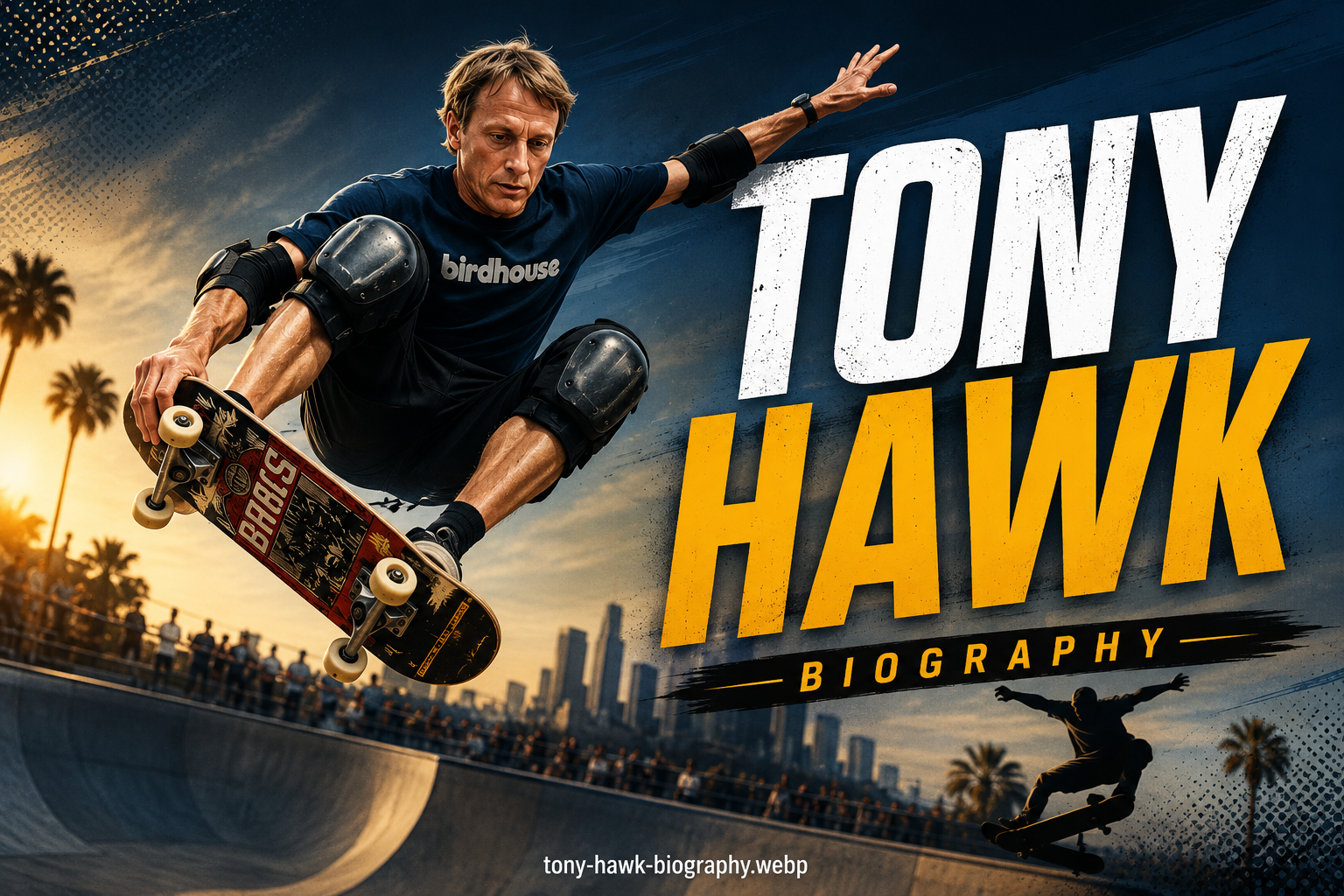
Tony Hawk
Tony Hawk is an American professional skateboarder, entrepreneur, author, and philanthropist who transformed skateboarding from a niche hobby into a global sport. Born on May 12, 1968, in San Diego, California, Hawk showed extraordinary talent from a young age and became one of the world's most successful skateboarders. If you have ever searched for Tony Hawk net worth, Tony Hawk age, Tony Hawk games, Tony Hawk skateboard, Tony Hawk Pro Skater, or Tony Hawk biography, you have already seen the impact of his remarkable career.
You may know him best for landing the first-ever 900-degree aerial spin during the 1999 X Games, a historic achievement that inspired millions of skateboarders around the world. We can also see his influence through the hugely popular Tony Hawk's Pro Skater video game series, which introduced skateboarding to an entirely new generation.
Beyond competitions, Tony Hawk built successful businesses, wrote bestselling books, and established the Tony Hawk Foundation (now The Skatepark Project), helping communities build public skateparks for young people. His dedication to sports, business, and giving back has made him a respected global icon.
Today, Tony Hawk continues to inspire athletes, entrepreneurs, and creators through his passion, innovation, and lifelong commitment to skateboarding, proving that dedication and perseverance can turn a passion into an extraordinary legacy.
Profession:
Professional Skateboarder, Entrepreneur, Author, Philanthropist
Nationality:
American
Born:
1968
Introduction
When you think about skateboarding, one name almost always comes to mind—Tony Hawk. For millions of people around the world, he is much more than a professional skateboarder. He is a sports legend, entrepreneur, author, philanthropist, and one of the most influential figures in action sports history. Whether you discovered him through the X Games, the iconic Tony Hawk's Pro Skater video games, or his inspiring story of determination, there is no denying the enormous impact he has had on skateboarding and popular culture.
Tony Hawk earned worldwide recognition after becoming the first skateboarder to successfully land a 900-degree aerial spin during the 1999 X Games. The moment instantly became one of the greatest achievements in sports history and inspired countless young athletes to believe that impossible goals can become reality with enough practice and persistence.
But Tony Hawk's story is about much more than one famous trick. Throughout his career, he transformed skateboarding from an underground hobby into a respected global sport. We can see his influence in professional competitions, public skateparks, successful businesses, bestselling books, charitable work, and even in the way modern skateboarding is viewed today.
If you have ever searched for Tony Hawk biography, Tony Hawk age, Tony Hawk net worth, Tony Hawk skateboard, Tony Hawk games, Tony Hawk Pro Skater, Tony Hawk achievements, or Tony Hawk foundation, you are exploring the life of someone who completely changed his industry through innovation, hard work, and passion.
His journey reminds us that greatness rarely happens overnight. Success comes from thousands of hours of learning, failing, improving, and refusing to quit. As you read his story, you'll discover how a shy young boy from California became the world's most recognizable skateboarder and one of the greatest ambassadors for action sports.
Early Life and Childhood
Tony Hawk was born on May 12, 1968, in San Diego, California, United States. Growing up in Southern California gave him access to one of the world's most vibrant skateboarding communities. However, his path to success wasn't always easy.
As a child, Tony was known for having extraordinary energy and intelligence. His parents noticed that he learned quickly but often became frustrated whenever things didn't go perfectly. He expected a lot from himself and could become emotional if he made mistakes. Instead of discouraging him, his parents looked for activities that could channel his energy into something positive.
That opportunity arrived when Tony was nine years old. His older brother gave him a used skateboard, thinking it would simply be a fun hobby. None of them imagined that this simple gift would change the future of skateboarding forever.
Tony immediately became fascinated by the sport. Unlike many children who played occasionally, he spent nearly every free moment practicing new tricks. If he fell, he got back up. If he failed, he tried again. This relentless attitude would become one of the defining characteristics of his career.
Within just a few years, local skateboarders and coaches realized they were witnessing an extraordinary talent. Tony learned tricks at an incredible pace and displayed remarkable balance, coordination, and creativity. More importantly, he genuinely loved skateboarding.
His parents recognized his dedication and fully supported his dream. They drove him to competitions, encouraged him during difficult moments, and helped him pursue opportunities that many families might have considered unrealistic. Their encouragement became one of the foundations of his future success.
By the time Tony entered his early teenage years, he was already competing against older, more experienced skateboarders. Instead of feeling intimidated, he used every competition as an opportunity to improve. Every victory increased his confidence, while every loss taught him valuable lessons about perseverance.
Looking back today, it is easy to see that Tony Hawk's success wasn't simply the result of natural talent. It was the combination of curiosity, discipline, supportive parents, and an unstoppable desire to become better every single day.
Family and Education
Tony Hawk grew up in a close-knit family that believed in encouraging creativity and independence. His father, Frank Hawk, worked as a businessman and later played an important role in supporting Tony's early skateboarding career. His mother, Nancy Hawk, was equally supportive and helped create a stable environment where Tony could pursue his passion.
Tony has siblings who also encouraged his interest in skateboarding. In fact, it was one of his older brothers who first introduced him to the skateboard that would eventually change his life. That simple act became one of the most significant moments in sports history, although no one realized it at the time.
During his school years, Tony balanced academics with an increasingly demanding skateboarding schedule. As his reputation grew, competitions required more travel, practice, and sponsorship commitments. Managing both school and professional skateboarding was challenging, but Tony remained committed to improving both on and off the skateboard.
Unlike traditional athletes who often receive structured coaching through schools or universities, skateboarders during the 1970s and 1980s had very few organized pathways. Tony largely developed his skills through self-practice, observation, and constant experimentation. Every skatepark became a classroom, and every competition became a learning opportunity.
His family also founded the California Amateur Skateboard League (CASL), an organization that helped create more opportunities for young skateboarders to compete safely and develop their skills. This contribution reflected the Hawk family's commitment not only to Tony's career but also to the broader skateboarding community.
Tony's upbringing demonstrates how important family support can be when someone is pursuing an unconventional dream. Rather than discouraging his passion, his parents embraced it responsibly, helping him build a career that would eventually inspire millions around the world.
How Tony Hawk Became a Professional Skateboarder
Tony Hawk's rise to becoming the world's most famous skateboarder did not happen overnight. It was built through thousands of hours of practice, countless falls, and an unwavering belief that he could always improve. His story shows us that extraordinary success often begins with ordinary dedication.
After receiving his first skateboard at the age of nine, Tony quickly became obsessed with learning new tricks. While many children treated skateboarding as an occasional hobby, Tony spent nearly every day riding. He practiced before school, after school, on weekends, and during holidays. Every obstacle became an opportunity to experiment with something new.
His determination caught the attention of experienced skateboarders throughout Southern California. Coaches, competition organizers, and sponsors noticed that Tony possessed not only remarkable technical skills but also a fearless attitude toward innovation. He constantly attempted tricks that many older skateboarders considered too difficult.
By the age of 12, Tony had already begun attracting sponsorship opportunities from local skateboarding companies. At just 14 years old, he officially became a professional skateboarder, making him one of the youngest professional skateboarders in the world at that time.
Becoming a professional athlete at such a young age was both exciting and challenging. Unlike today's skateboarders, professional skateboarding during the early 1980s offered limited financial security. Prize money was relatively small, sponsorship opportunities were fewer, and skateboarding itself was still considered an underground sport rather than a mainstream career.
Instead of becoming discouraged, Tony viewed every competition as another opportunity to prove himself. He traveled across the United States competing against some of the best skateboarders of his generation. Although he occasionally lost events, each competition helped him refine his techniques and develop greater confidence.
One of Tony's greatest strengths was his willingness to learn from failure. When he couldn't land a trick, he didn't simply move on to something easier. Instead, he analyzed what went wrong, adjusted his technique, and tried again. This mindset separated him from many competitors and became one of the defining characteristics of his career.
His performances soon earned him recognition as one of the best vertical (vert) skateboarders in the world. Vert skateboarding involves performing tricks on large half-pipes and ramps where athletes launch high into the air before landing back on the curved surface. This demanding discipline requires exceptional balance, timing, courage, and creativity.
Tony's smooth style, technical precision, and innovative tricks quickly made him a fan favorite. Sponsors increasingly wanted him representing their brands, magazines featured him regularly, and young skateboarders began trying to imitate his moves.
Although success was coming rapidly, Tony remained focused on improving rather than celebrating his achievements. He believed there was always another trick to learn and another level to reach.
Rise to Fame and Competitive Success
Throughout the 1980s, Tony Hawk steadily built a reputation as one of the most dominant skateboarders in professional competition. His consistency was remarkable. While many athletes experienced short periods of success followed by decline, Tony remained competitive year after year.
During this period, he won dozens of major skateboarding competitions around the world. His ability to perform under pressure earned him respect from fellow professionals, judges, sponsors, and fans alike.
Tony became especially known for inventing and perfecting difficult aerial tricks that pushed the boundaries of what people believed was possible on a skateboard. Rather than repeating existing moves, he constantly experimented with new combinations, spins, grabs, and rotations.
Innovation became one of his greatest trademarks.
As his popularity increased, skateboarding magazines regularly placed him on their covers. Interviews, television appearances, and sponsorship deals introduced him to audiences far beyond the skateboarding community.
However, the late 1980s also brought significant challenges.
Skateboarding experienced a decline in popularity, resulting in fewer competitions, reduced sponsorship opportunities, and lower prize money. Many professional skateboarders struggled financially, and several left the sport entirely to pursue more stable careers.
Tony faced difficult decisions during this period. Despite earning recognition as one of the world's best skateboarders, there were moments when professional skateboarding offered very little financial reward.
Instead of quitting, Tony adapted.
He diversified his income through demonstrations, sponsorship partnerships, instructional appearances, and business opportunities. More importantly, he continued practicing every day because his passion for skateboarding extended beyond money or fame.
This period taught Tony valuable lessons about resilience and long-term thinking. Rather than focusing only on short-term setbacks, he continued investing in his skills and reputation.
When skateboarding experienced a major resurgence during the 1990s, Tony was perfectly positioned to become the face of the sport.
His years of persistence during difficult times allowed him to benefit when millions of new fans discovered skateboarding through television, competitions, and video games.
Birdhouse Skateboards and Building a Business
Tony Hawk understood that athletic careers eventually come to an end. Instead of relying solely on competition winnings, he began building businesses connected to the sport he loved.
In 1992, Tony co-founded Birdhouse Skateboards, a company dedicated to designing high-quality skateboards, clothing, wheels, accessories, and equipment for riders of all skill levels.
The company quickly became one of the most respected brands in the skateboarding industry.
Unlike many celebrity-owned businesses that depend entirely on marketing, Birdhouse earned its reputation by focusing on product quality, supporting talented skateboarders, and contributing to skateboarding culture.
Tony remained actively involved in the company's development, helping shape product designs, recruiting team riders, and promoting the brand around the world.
Birdhouse also became an important platform for introducing young skateboarders to international audiences. Many future stars launched successful careers after joining the Birdhouse team.
Through Birdhouse, Tony demonstrated that athletes can become successful entrepreneurs by combining passion with smart business decisions.
His entrepreneurial journey eventually expanded beyond skateboards into books, apparel, endorsements, public speaking, licensing agreements, documentaries, digital media, and entertainment.
Today, Birdhouse remains one of the most recognizable names in skateboarding and reflects Tony Hawk's long-term commitment to growing the sport beyond his own competitive career.
The X Games and Becoming a Global Superstar
Although Tony Hawk was already highly respected within skateboarding circles, the X Games transformed him into a worldwide celebrity.
Launched by ESPN in 1995, the X Games showcased action sports—including skateboarding, BMX, motocross, and inline skating—to millions of television viewers. For many people, this was their first introduction to professional skateboarding.
Tony quickly became one of the event's biggest attractions.
His fearless performances, creative tricks, and calm personality made him a favorite among fans of all ages.
The X Games also helped change public perceptions of skateboarding. Instead of being viewed as a rebellious pastime, it became recognized as a legitimate competitive sport requiring exceptional athletic ability, discipline, and creativity.
Tony consistently won medals and delivered unforgettable performances, becoming one of the most successful athletes in X Games history.
His greatest moment, however, was still waiting.
In 1999, during the X Games in San Francisco, Tony Hawk attempted one of the most difficult tricks ever imagined in skateboarding—a 900-degree spin.
It was a challenge that many believed was impossible.
After numerous failed attempts, Tony refused to quit.
What happened next became one of the most iconic moments in sports history and permanently changed skateboarding forever.
The Historic 900: The Trick That Changed Skateboarding Forever
By the late 1990s, Tony Hawk had already established himself as one of the greatest skateboarders in history. He had won numerous competitions, earned the respect of fellow professionals, and inspired a new generation of riders. Yet there was one challenge that had remained unconquered for years—a 900-degree aerial spin.
A 900 is exactly what its name suggests: a skateboarder launches into the air from a vert ramp and rotates 900 degrees, completing two and a half full spins before landing back on the ramp. While it sounds straightforward on paper, in reality it is one of the most technically demanding tricks in skateboarding. It requires incredible speed, height, timing, balance, body control, and complete commitment.
For years, many of the world's best skateboarders had attempted the trick but failed. Some believed it simply wasn't possible.
Tony Hawk refused to believe that.
During the 1999 X Games in San Francisco, thousands of spectators gathered to watch the world's best vert skateboarders compete. Tony had already performed well throughout the event, but he had one final goal in mind.
He repeatedly attempted the 900.
Each attempt ended in failure.
Sometimes he under-rotated.
Sometimes he lost his balance.
Sometimes he landed with only one foot on the board.
Most athletes would have accepted defeat after several failed attempts, especially after an exhausting competition. But Tony wasn't focused on winning another medal—he wanted to make history.
The crowd stayed. Fellow skateboarders stayed. Television cameras continued recording every attempt.
Again and again, Tony climbed back to the top of the ramp.
Again and again, he fell.
Finally, after numerous attempts, everything came together.
Tony launched into the air, completed two and a half rotations, spotted the landing, and rolled away successfully.
The crowd erupted.
Commentators shouted with excitement.
Fellow competitors rushed onto the ramp to celebrate.
One of the most impossible tricks in skateboarding had finally been landed.
That single moment transformed Tony Hawk from a legendary skateboarder into an international sports icon. Videos of the trick were broadcast worldwide, appearing on television, in newspapers, magazines, documentaries, and eventually across the internet.
Even today, more than two decades later, the successful 900 remains one of the greatest moments in action sports history.
Tony later explained that the achievement wasn't simply about talent—it was about refusing to stop trying until success became possible.
That lesson continues to inspire athletes, entrepreneurs, students, artists, and anyone chasing ambitious goals.
Tony Hawk's Pro Skater: The Video Game That Inspired Millions
While Tony Hawk had already become a superstar within skateboarding, another opportunity helped introduce him to millions of people who had never stepped onto a skateboard.
In 1999, the first Tony Hawk's Pro Skater video game was released.
At the time, few people expected it to become one of the most successful sports video game franchises ever created.
Instead, it became a global phenomenon.
Players could perform spectacular tricks, complete challenges, unlock new levels, customize characters, and experience skateboarding in exciting ways that had never been seen before.
The game featured realistic physics, creative level design, energetic music, and legendary professional skateboarders from around the world.
For many children and teenagers, Tony Hawk's Pro Skater became their first introduction to skateboarding.
Millions of players eventually decided to buy their first skateboard after enjoying the game.
The franchise continued growing with multiple sequels, including:
- Tony Hawk's Pro Skater 2
- Tony Hawk's Pro Skater 3
- Tony Hawk's Pro Skater 4
- Tony Hawk's Underground
- Tony Hawk's American Wasteland
- Tony Hawk's Project 8
- Tony Hawk's Proving Ground
- Tony Hawk's Pro Skater 1 + 2 Remastered
Collectively, the series sold tens of millions of copies worldwide, making it one of the most successful sports gaming franchises ever created.
More importantly, it helped bring skateboarding into mainstream culture.
Young people from countries with little skateboarding tradition suddenly became passionate fans.
Many eventually became professional skateboarders themselves, often crediting Tony Hawk's games as their inspiration.
The success of the franchise also demonstrated Tony's ability to think beyond competition.
Rather than limiting his career to athletic achievements, he expanded into entertainment, technology, and education.
Expanding Beyond Skateboarding
Although most people know Tony Hawk as a skateboarder, his career eventually expanded into many different fields.
He became a successful:
- Entrepreneur
- Investor
- Author
- Television personality
- Documentary producer
- Public speaker
- Brand ambassador
- Podcast guest
- Philanthropist
His business success reflects an important principle: your skills can open doors far beyond your original profession.
Tony partnered with major global companies while remaining authentic to the skateboarding community that had supported him from the beginning.
He also appeared in movies, television shows, documentaries, commercials, and interviews, making skateboarding more accessible to mainstream audiences.
His approachable personality and willingness to laugh at himself helped fans connect with him.
Even today, humorous videos regularly appear online showing people recognizing Tony Hawk without realizing they are speaking directly to him.
Instead of becoming frustrated, Tony often shares these moments with good humor, making him even more relatable to fans around the world.
Books and Writing Career
Tony Hawk has also shared his experiences through books that offer insight into both his professional career and personal life.
His autobiography, "Hawk: Occupation: Skateboarder," provides an honest look at his childhood, competitive career, struggles, family life, and business journey.
He has also contributed to books about skateboarding, motivation, sports, and youth culture.
Readers appreciate his willingness to discuss both victories and failures.
Rather than presenting himself as someone who never struggled, Tony openly describes the hard work, injuries, disappointments, and sacrifices required to achieve lasting success.
This honesty has made his books valuable not only for skateboarders but also for entrepreneurs, athletes, and anyone pursuing ambitious goals.
Becoming a Global Ambassador for Skateboarding
One of Tony Hawk's greatest achievements cannot be measured by medals or trophies.
He changed how the world views skateboarding.
When Tony began competing professionally in the early 1980s, skateboarding was often misunderstood.
Many people dismissed it as a temporary trend or rebellious hobby.
Today, skateboarding is an Olympic sport, supported by national federations, international competitions, public skateparks, professional coaching, and millions of participants worldwide.
Although countless athletes contributed to this transformation, Tony Hawk played one of the most influential roles.
Through competitions, business leadership, media appearances, video games, education, and philanthropy, he introduced skateboarding to audiences across every continent.
His influence extends far beyond tricks performed on a ramp.
He helped create an entire culture that celebrates creativity, individuality, perseverance, and self-expression.
Millions of young people have discovered confidence, friendships, discipline, and purpose through skateboarding because pioneers like Tony Hawk believed the sport deserved global recognition.
Today, whether you visit a skatepark in California, Brazil, Japan, Australia, India, or Europe, there is a good chance you'll find someone whose journey into skateboarding began after watching Tony Hawk compete or playing one of his video games.
His legacy is not only measured by what he achieved personally but also by the opportunities he created for future generations.
Tony Hawk Foundation: Giving Back Through The Skatepark Project
Tony Hawk's influence extends far beyond competitions and business success. Throughout his career, he has believed that skateboarding has the power to change lives. For many young people, a skateboard is more than just sports equipment—it is a source of confidence, creativity, friendship, and personal growth.
To make skateboarding more accessible, Tony established the Tony Hawk Foundation in 2002. The foundation's mission was simple but powerful: help underserved communities build safe, high-quality public skateparks where young people could learn, practice, and connect.
Over time, the organization expanded its impact and was renamed The Skatepark Project to better reflect its growing mission.
Since its creation, the organization has helped support the construction of hundreds of public skateparks across the United States. Many of these parks are located in communities where young people previously had few recreational opportunities.
The Skatepark Project provides grants, technical guidance, advocacy, and educational resources for local organizations and governments interested in building skateparks.
For Tony, this work has always been about more than skateboarding.
He believes that skateparks create safe spaces where young people can develop confidence, discipline, creativity, resilience, and lasting friendships. Instead of spending time in unsafe environments, children and teenagers gain access to welcoming communities that encourage positive personal growth.
The organization has become one of Tony Hawk's proudest achievements because its impact will continue long after his competitive career has ended.
His charitable work reminds us that true success is not measured only by personal accomplishments but also by how many opportunities we create for others.
Personal Life
Although Tony Hawk is one of the most recognizable athletes in the world, he has generally kept much of his personal life private while remaining open about the challenges of balancing family, business, and professional sports.
Throughout his life, Tony has been married more than once and has spoken honestly about the difficulties of maintaining relationships while traveling extensively for competitions, business commitments, and public appearances.
In 2022, he married Catherine Goodman, and the couple has continued to share parts of their life together while maintaining a relatively private lifestyle.
Tony is also the father of four children, including Riley Hawk, who has followed in his father's footsteps as a professional skateboarder.
Rather than pressuring Riley to imitate his own career, Tony encouraged him to develop his own style and identity within skateboarding. Riley eventually became respected for his own achievements, demonstrating that success should be earned rather than inherited.
Outside of skateboarding, Tony enjoys spending time with family, traveling, listening to music, supporting charitable causes, and exploring creative projects.
Despite his worldwide fame, many fans describe him as humble, approachable, and down-to-earth. Numerous stories have gone viral online in which people unknowingly meet Tony Hawk without realizing they are talking to one of the greatest athletes of all time. Instead of correcting them immediately, Tony often shares these moments with humor, making him even more relatable.
His personality has become just as admired as his skateboarding achievements.
Injuries and Challenges
No professional skateboarder reaches the highest level without experiencing injuries, and Tony Hawk is no exception.
Over several decades, he has suffered:
- Broken bones
- Torn muscles
- Sprains
- Concussions
- Dental injuries
- Deep bruises
- Countless cuts and scrapes
Many of these injuries required long recovery periods.
Some forced him to withdraw from competitions.
Others required surgery and months of rehabilitation.
Yet Tony consistently returned to skateboarding because of his passion for the sport.
Even after retiring from full-time professional competition, he continued skating and learning new tricks.
In 2022, Tony suffered a serious leg injury after breaking his femur while practicing. Recovery was difficult, especially because he was in his fifties.
Many people assumed he would stop skateboarding permanently.
Instead, after months of rehabilitation, he returned to skating once again.
His determination demonstrated that passion does not disappear with age.
Tony often reminds people that progress is rarely a straight line. Injuries, setbacks, failures, and disappointments are part of every meaningful journey.
What matters most is the willingness to keep moving forward.
Business Ventures and Entrepreneurship
Although Tony Hawk first became famous through skateboarding, he also built an impressive business career.
Over the years, he has invested in and developed businesses related to:
- Skateboarding equipment
- Clothing and apparel
- Video games
- Digital media
- Licensing
- Public speaking
- Entertainment
- Brand partnerships
- Publishing
One of his most successful businesses remains Birdhouse Skateboards, which continues to produce skateboards and accessories used by riders around the world.
His licensing partnership for Tony Hawk's Pro Skater became one of the most successful athlete-branded entertainment franchises ever created.
Tony also works with major international companies through sponsorships and endorsement agreements while carefully choosing partnerships that align with his personal values.
His entrepreneurial success shows that athletes can build lasting careers beyond competition by combining expertise, credibility, and smart business decisions.
Net Worth and Financial Success
Tony Hawk's financial success comes from much more than competition prize money.
Throughout his career, he has earned income from:
- Professional competitions
- Sponsorships
- Video game royalties
- Business ownership
- Book sales
- Television appearances
- Speaking engagements
- Merchandise
- Licensing agreements
- Investments
Because these revenue streams have continued for decades, Tony has built substantial long-term wealth.
Financial experts frequently estimate his net worth to be in the tens of millions of dollars, although exact figures vary because private investments and business assets are not publicly disclosed.
One of the biggest lessons from Tony's financial journey is the importance of building multiple sources of income rather than relying on a single career.
Even while actively competing, he invested in businesses that continued generating value long after individual competitions ended.
Awards, Records, and Achievements
Throughout his extraordinary career, Tony Hawk has received numerous awards and honors that recognize both his athletic excellence and his contribution to skateboarding.
Some of his most notable achievements include:
- Becoming one of the youngest professional skateboarders in history.
- Winning more than 70 professional skateboarding competitions during his career.
- Dominating vert skateboarding throughout the 1980s and 1990s.
- Successfully landing the world's first documented 900-degree aerial spin in competition at the 1999 X Games.
- Co-founding Birdhouse Skateboards, one of the world's leading skateboard companies.
- Launching the highly successful Tony Hawk's Pro Skater video game series.
- Establishing the Tony Hawk Foundation, now known as The Skatepark Project.
- Receiving multiple action sports and lifetime achievement awards.
- Helping introduce skateboarding to millions of people worldwide.
- Playing a significant role in the global growth and acceptance of skateboarding.
Although trophies and medals are impressive, many people believe Tony's greatest achievement is transforming skateboarding into one of the world's most respected action sports.
His influence continues to inspire athletes decades after his competitive career began.
Tony Hawk's Legacy: How One Skateboarder Changed the World
Tony Hawk's impact goes far beyond the trophies he won or the tricks he invented. His greatest achievement is changing the way the world views skateboarding. Before his rise to fame, many people saw skateboarding as nothing more than a hobby or a rebellious pastime. Today, it is recognized as a respected competitive sport, featured in international events and even the Olympic Games.
Through his talent, professionalism, and dedication, Tony helped introduce skateboarding to millions of people across every continent. His competitions, television appearances, books, businesses, charitable work, and video games inspired countless young people to pick up a skateboard for the first time.
Unlike many athletes who disappear after retirement, Tony has remained deeply involved in the skateboarding community. He continues to mentor younger skateboarders, support skatepark development, promote the sport through social media, and encourage people of all ages to stay active.
One of the reasons Tony Hawk remains so respected is his humility. Despite becoming one of the most recognizable athletes in the world, he has never stopped appreciating his fans or the community that supported him. Whether he is signing autographs, helping build skateparks, or simply sharing funny stories online, he continues to connect with people in an authentic way.
Today, many of the world's top professional skateboarders openly credit Tony Hawk as one of their biggest inspirations. His influence can be seen not only in skateboarding but also in entrepreneurship, sports marketing, philanthropy, and youth development.
His story proves that true greatness is measured not only by personal success but also by the opportunities you create for others.
Conclusion
Tony Hawk's life is a remarkable example of what can happen when passion meets persistence. From a young boy practicing on a skateboard in San Diego to becoming the most recognizable name in skateboarding, his journey is built on determination, creativity, and a willingness to keep improving.
You can see his influence almost everywhere in modern skateboarding. Professional athletes continue to build on the tricks he pioneered. Young riders still dream of landing their first big aerial after watching his videos. Entrepreneurs study how he turned a sports career into a successful business empire. Communities across the United States benefit from skateparks made possible through his charitable work. Millions of gamers were introduced to skateboarding through the Tony Hawk's Pro Skater series.
What makes Tony Hawk truly inspiring is not just his achievements but his mindset. He never allowed setbacks, injuries, or failures to define him. Instead, he treated every obstacle as another chance to learn and improve. We can all apply that lesson in our own lives—whether we are pursuing education, building a business, growing a career, or chasing a personal dream.
Tony Hawk's story reminds us that lasting success isn't created by one unforgettable moment. It is built through years of dedication, resilience, humility, and the courage to keep moving forward. His legacy will continue to inspire future generations, proving that with passion and perseverance, even the boldest dreams can become reality.
Major Achievements
1. Became a Professional Skateboarder at Age 14: Tony Hawk turned professional in 1982 at just 14 years old, becoming one of the youngest professional skateboarders of his time.
2. Won More Than 70 Professional Competitions: Throughout his competitive career, Tony won over 70 professional skateboarding contests, establishing himself as one of the most successful vert skateboarders in history.
3. Dominated Vert Skateboarding: During the 1980s and 1990s, Tony Hawk was widely regarded as the world's best vert skateboarder, winning numerous national and international championships.
4. Landed the First-Ever 900: In 1999, at the X Games, Tony became the first skateboarder in history to successfully land a 900-degree aerial spin, one of the sport's most iconic achievements.
5. Popularized Skateboarding Worldwide: Tony helped transform skateboarding from a niche activity into a mainstream global sport through competitions, television appearances, and media exposure.
6. Launched the Best-Selling Tony Hawk's Pro Skater Video Game Series: His video game franchise became one of the best-selling sports video game series of all time, inspiring millions of people to take up skateboarding.
7. Co-Founded Birdhouse Skateboards: In 1992, Tony co-founded Birdhouse Skateboards, one of the world's most respected skateboard companies.
8. Founded The Skatepark Project: In 2002, he established the Tony Hawk Foundation (now The Skatepark Project), which has helped fund and support the construction of hundreds of public skateparks in underserved communities across the United States.
9. Inducted into the Skateboarding Hall of Fame: Tony Hawk has been honored with induction into the Skateboarding Hall of Fame in recognition of his extraordinary contributions to the sport.
10. Received Numerous Lifetime Achievement Awards: He has received multiple lifetime achievement and action sports honors for his impact on skateboarding, youth culture, and sports innovation.
11. Expanded Skateboarding Through Business: Tony built a successful business empire through skateboard products, books, endorsements, documentaries, public speaking, and licensing, showing that athletes can thrive beyond competition.
12. Inspired Millions Around the World: Perhaps his greatest achievement is inspiring generations of skateboarders, athletes, entrepreneurs, and creators to pursue their passions with determination and resilience.
Life Lessons from Tony Hawk
1. Passion Creates Extraordinary Results: Tony didn't become successful because someone forced him to skateboard. He loved doing it. When you genuinely enjoy your work, practicing becomes exciting instead of exhausting. Passion gives you the motivation to continue even when progress feels slow.
2. Failure Is Part of Success: Tony fell thousands of times while learning new tricks. The famous 900 wasn't landed on the first attempt—or even the tenth. Every failure taught him something valuable. We often think successful people avoid failure, but the opposite is true. They simply refuse to let failure stop them.
3. Never Stop Learning: Even after becoming world champion, Tony continued creating new tricks. He never believed he knew everything. If you continue learning, improving, and adapting, you remain valuable regardless of your profession.
4. Build More Than One Career: Tony understood that athletic careers don't last forever. Instead of relying only on competition winnings, he built businesses, wrote books, developed video games, gave speeches, and invested in long-term opportunities. Diversifying your skills creates long-term security.
5. Give Back to Society: Success becomes even more meaningful when it helps other people. Through The Skatepark Project, Tony has helped thousands of young people gain access to safe places where they can learn, grow, and build confidence. Your legacy isn't only about what you achieve—it's also about what you leave behind.
6. Stay Humble: Despite worldwide fame, Tony Hawk is known for being approachable and kind. Humility earns lasting respect. People remember how you treat others long after they forget your achievements.
Famous Quotes
"Progress comes from being willing to try again after every fall."
"You don't have to be fearless. You just have to keep going despite fear."
"Success isn't about never failing—it's about refusing to quit."
"Your biggest competition is the person you were yesterday."
"The greatest opportunities often begin as simple hobbies."
Interesting Facts
Here are some fascinating facts you may not know:
Tony Hawk became a professional skateboarder at just 14 years old.
His nickname is "The Birdman."
He landed the first successful 900 in skateboarding history.
He has appeared in movies, television shows, documentaries, and animated series.
His video games have sold tens of millions of copies worldwide.
He has authored books about skateboarding and his life.
His son Riley Hawk is also a professional skateboarder.
He has helped fund hundreds of public skateparks through The Skatepark Project.
Even after turning 50, he continued skating and learning new tricks.
He is widely considered one of the most influential skateboarders of all time.
Tony Hawk's journey proves that passion, perseverance, and a willingness to innovate can leave a lasting mark not just on a sport, but on generations of people around the world.
Legacy
One of his greatest contributions was proving that skateboarding could become a professional career. During the early years of his journey, the sport received little mainstream recognition. Through years of success in competitions, innovative tricks, and media appearances, Tony helped change public perception. Today, skateboarding is celebrated around the world and is even an Olympic sport, a milestone that reflects the efforts of pioneers like him.
His influence also extends into entertainment. The Tony Hawk's Pro Skater video game series introduced millions of children and teenagers to skateboarding, inspiring many to pick up a skateboard for the first time. For countless professional skateboarders today, those games were the beginning of their love for the sport.
Beyond competitions and business, Tony Hawk has made a lasting impact through philanthropy. His organization, The Skatepark Project (formerly the Tony Hawk Foundation), has helped communities build hundreds of public skateparks, giving young people safe places to learn, grow, and express themselves through skateboarding.
As an entrepreneur, author, and public speaker, Tony demonstrated that athletes can build successful careers beyond sports by embracing innovation and lifelong learning. His businesses, books, and partnerships have shown that passion combined with smart decision-making can create lasting success.
Perhaps the most inspiring part of Tony Hawk's legacy is his mindset. Throughout his career, he faced injuries, failures, and periods when skateboarding struggled to gain popularity. Instead of giving up, he continued to improve, adapt, and believe in his vision. His determination eventually changed not only his own life but also the future of an entire sport.
Today, Tony Hawk is remembered not only as one of the greatest skateboarders in history but also as a global ambassador for action sports, a role model for perseverance, and a philanthropist dedicated to helping future generations. His story reminds us that true greatness is measured not only by personal achievements but also by the positive impact we leave on others.
Frequently Asked Questions
Tony Hawk is an American professional skateboarder, entrepreneur, author, and philanthropist. He is widely regarded as one of the greatest skateboarders of all time.
Tony Hawk was born on May 12, 1968, in San Diego, California, United States.
His age depends on the current year. As of 2026, Tony Hawk is 58 years old.
He became famous for dominating professional vert skateboarding, landing the first successful 900-degree spin, and helping make skateboarding popular around the world.
The 900 is a skateboarding trick involving two-and-a-half rotations (900 degrees) in the air before landing back on the ramp.
Tony Hawk successfully landed the first documented 900 during the 1999 X Games.
It is one of the best-selling skateboarding video game franchises ever created, featuring professional skateboarders, iconic skateparks, and realistic tricks.
Yes. Although he retired from professional competition, Tony Hawk continues to skateboard, participate in exhibitions, and support the skateboarding community.
He co-founded Birdhouse Skateboards, has worked on the Tony Hawk's Pro Skater franchise, and has invested in several businesses, media projects, and brand partnerships.
He founded the Tony Hawk Foundation, now known as The Skatepark Project, which helps communities build safe public skateparks.
Yes. Tony Hawk married Catherine Goodman in 2022.
Yes. He has four children, including professional skateboarder Riley Hawk.
Tony Hawk is widely known as "The Birdman."
Throughout his career, he has won more than 70 professional competitions, multiple X Games medals, and numerous lifetime achievement honors for his contributions to skateboarding.
Tony Hawk's legacy is transforming skateboarding into a globally respected sport while inspiring millions through competition, innovation, business, philanthropy, and education.