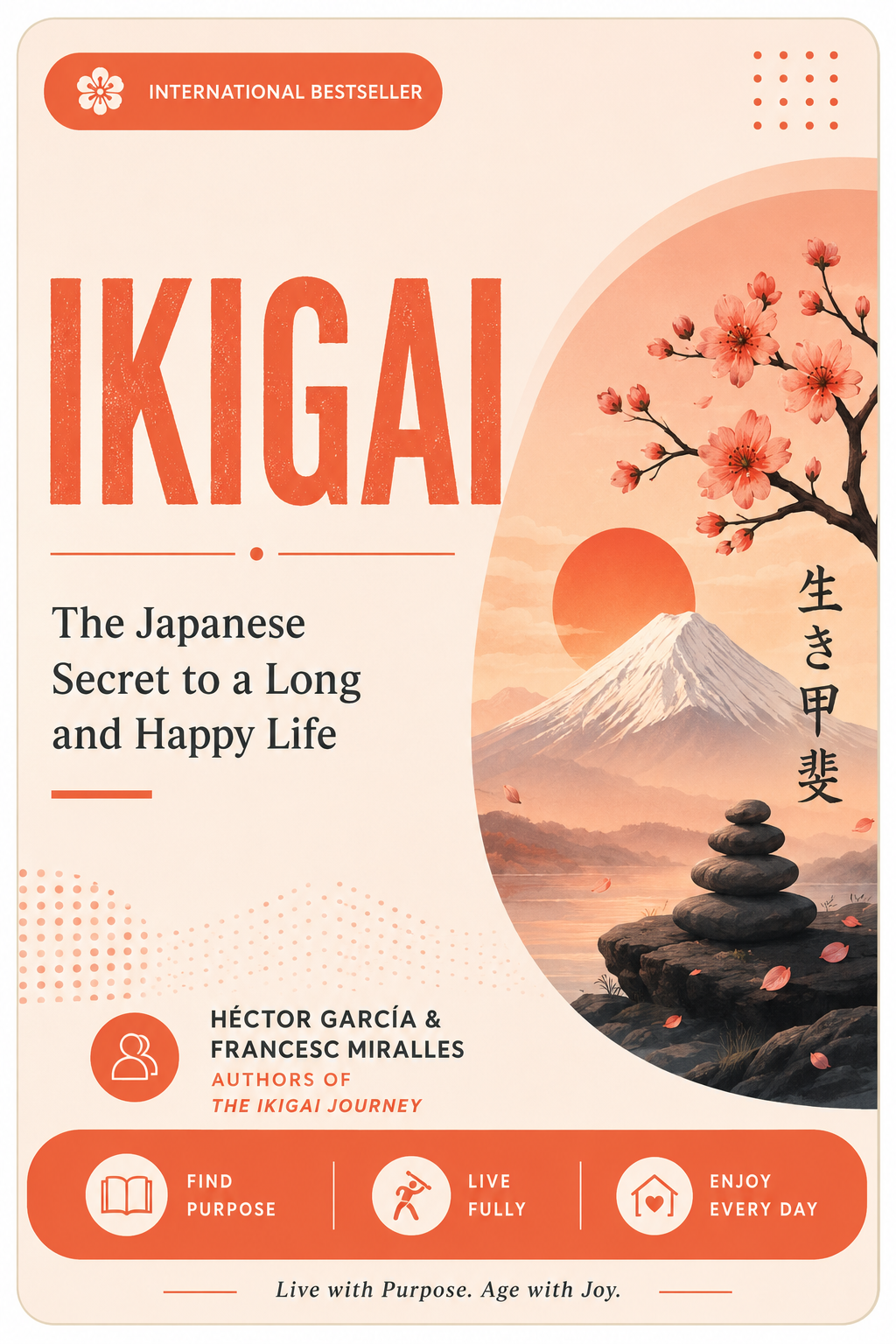
Ikigai teaches us that a meaningful and fulfilling life comes from having a reason to live, staying active, nurturing relationships, finding joy in what we do, and continuing to grow. We do not need to completely change our lives to become happier. Small, purposeful choices made consistently can help us create a life that feels more balanced, connected, and worthwhile.
★★★★★ 5.0·5 ratings
Sign in to permanently save your library, reading progress and ratings.
THE IDEA SPACE
About this book
Understand the central idea, see the six most important ideas, and turn the summary into something practical.
THE CENTRAL IDEA
Core idea
Ikigai teaches us that a meaningful and fulfilling life comes from having a reason to live, staying active, nurturing relationships, finding joy in what we do, and continuing to grow. We do not need to completely change our lives to become happier. Small, purposeful choices made consistently can help us create a life that feels more balanced, connected, and worthwhile.
Why it matters
kigai matters because it encourages us to slow down and think about what truly makes life worth living. Instead of focusing only on money, success, or achievement, the book asks us to look at our purpose, our relationships, our daily habits, and the things that genuinely bring us joy.
Its biggest message is simple: a meaningful life is built through small choices every day. By understanding what we love, what we are good at, what the world needs, and what can give our lives purpose, we can begin creating a life that feels more balanced and fulfilling.
The ideas in Ikigai can help readers rethink their priorities, build healthier habits, stay connected with people they care about, and find greater meaning in their everyday work and activities. It reminds us that a fulfilling life does not have to be extraordinary—it can be found in ordinary moments when we live with purpose and intention.
READ WITH INTENTION
Before you begin
You may feel lost, stuck, or unsure about what truly gives your life meaning. You may be busy achieving goals but still feel that something is missing. You might feel disconnected from your work, uncertain about your direction, or simply caught in the routine of everyday life.
After applyingYou can feel more clear about what matters to you and more connected to your own sense of purpose. You may begin enjoying ordinary moments more deeply, feel motivated to take better care of your body and relationships, and approach your work and goals with greater focus. Instead of simply asking, “What should I achieve?” you begin asking, “What makes my life worth living?”
THE SIX IDEA MAP
Six key ideas
The six key ideas already stored in your Woderfin summary — designed to be scanned, remembered and revisited.
6 key ideas
01KEY IDEA
Find Your Ikigai
The authors explain that ikigai is the reason that gives our life meaning and gives us a reason to get up each morning. It can come from our work, relationships, hobbies, creativity, helping others, or anything that makes us feel useful and connected to life. Our ikigai does not have to be something extraordinary; it can be found in the things we genuinely care about.
Instead of asking, “What career will make me successful?”, we can ask ourselves, “What activity makes me feel alive and useful?” We might discover that teaching, writing, creating, caring for family, or helping people gives us a strong sense of purpose. We can then make more space for that activity in our everyday life.
02KEY IDEA
Keep Moving
The authors emphasize that people who live long and active lives generally do not stop moving completely as they grow older. Physical activity is naturally included in their daily routines through walking, gardening, household activities, and other forms of movement. The message is to avoid a completely sedentary lifestyle and keep the body active.
Instead of sitting for hours after work, we can take regular walks, use stairs when possible, stretch, do household tasks, or spend time gardening. The goal is not necessarily intense exercise but making movement a regular part of our day.
03KEY IDEA
Discover Flow
Flow is the state in which we become deeply absorbed in an activity and lose track of time. The authors explain that finding flow can make work and hobbies more enjoyable because our attention becomes completely focused on what we are doing. Reducing distractions can make it easier to experience this state.
If we are writing, studying, painting, coding, or playing an instrument, we can put our phone away and focus on that one activity for a set period. As our concentration deepens, we may become so involved that we stop noticing the passage of time.
04KEY IDEA
Eat with Moderation
The authors discuss the Okinawan principle of hara hachi bu, which involves stopping eating before becoming completely full. They connect moderation and a varied diet with the traditional eating habits of Okinawan communities, where many people have lived exceptionally long lives.
Instead of continuing to eat simply because food is available, we can slow down while eating and pay attention to when we are comfortably satisfied. We can also aim for variety rather than relying heavily on a small number of foods.
05KEY IDEA
Build Strong Relationships
The authors highlight the importance of social connections in the lives of long-lived Okinawans. Groups such as moai provide companionship, emotional support, and a sense of belonging. Having people around us who care about our wellbeing can make life more meaningful.
We can regularly meet friends, stay connected with family, join a community group, or create a small circle of people with whom we can share both good and difficult moments.
06KEY IDEA
Stay Active in Life
The authors observe that many older people with long, fulfilling lives continue to work, create, help others, or pursue interests. They do not simply withdraw from meaningful activities because they have reached a certain age. Continuing to participate gives them reasons to remain engaged with life.
After leaving a full-time career, someone might teach, volunteer, grow vegetables, learn a new skill, mentor younger people, or work on a personal project. The activity gives structure and meaning to everyday life.
TURN KNOWLEDGE INTO ACTION
Make it practical
Your practical takeaway
You can feel more clear about what matters to you and more connected to your own sense of purpose. You may begin enjoying ordinary moments more deeply, feel motivated to take better care of your body and relationships, and approach your work and goals with greater focus. Instead of simply asking, “What should I achieve?” you begin asking, “What makes my life worth living?”
NEXT STEP
Today
Write down three activities that make you feel genuinely happy, useful, or deeply engaged.
Choose one and spend at least 30 focused minutes doing it without distractions.
NEXT STEP
This week
Identify your personal sources of purpose, reduce one unnecessary distraction, move your body every day, spend meaningful time with someone you care about, and practice eating with greater awareness and moderation.
NEXT STEP
This month
Create a simple daily routine around your purpose: regular movement, meaningful work, quality relationships, focused time, learning, and moments of reflection.
Track which activities make you feel most engaged and fulfilled.
NEXT STEP
Long term
Build a life around your ikigai rather than constantly chasing external measures of success.
Continue learning, stay connected with people, remain physically active, protect your sense of purpose, and adapt as your interests and circumstances change.
Move through your action plan one step at a time.
FINAL TAKEAWAYThe biggest lesson of Ikigai is that a good life is not simply about living longer—it is about having reasons to enjoy the life we have. We should keep moving, keep learning, stay connected with people we care about, appreciate the present, face difficulties with resilience, and continue doing things that give us a sense of purpose. Our ikigai may be different from everyone else's, but discovering and living it can make each day more meaningful.FAVOURITE QUOTE““We all have an ikigai.”
“There is no magic recipe for finding happiness.”
“One key ingredient is the ability to reach this state of flow.”
“Your purpose does not have to be extraordinary; it only needs to make your life meaningful.”
“A meaningful life is built through the small things we choose to do every day.”
“Keep moving, keep learning, keep connecting, and never stop giving yourself a reason to wake up.”
“Growing older is inevitable; losing our curiosity and purpose is not.”
“When we become deeply absorbed in what we love, even ordinary moments can become extraordinary.”
“We cannot control every challenge life brings us, but we can choose how we face it.””
— Héctor García and Francesc Miralles
FIND YOUR REASON TO READ
Who is this book for?
["If you feel unsure about your direction in life or often wonder what truly makes you happy and fulfilled, Ikigai can help you reflect on your purpose and identify the activities, relationships, and goals that give your life meaning.","Students and young adults can use the ideas in the book to think beyond marks, degrees, and career choices and consider what kind of life they actually want to build.","If your work feels repetitive, stressful, or disconnected from what matters to you, the book offers ideas about purpose, flow, balance, and finding greater meaning in everyday activities.","Entrepreneurs can benefit from the book's ideas about purpose, persistence, focused work, and staying engaged with meaningful goals while dealing with challenges.","Anyone who enjoys self-improvement can use the book's ideas about habits, movement, relationships, mindfulness, resilience, and continuous learning to examine their daily lifestyle.","If you want to understand what contributes to a satisfying life, Ikigai encourages you to appreciate simple experiences, meaningful relationships, purposeful activities, and the present moment.","Readers interested in healthy aging can explore the book's discussion of Okinawan lifestyle habits, including regular movement, moderation in eating, social connections, and remaining active throughout life.","The book can be particularly meaningful for people entering retirement or later stages of life because it encourages us to continue having interests, relationships, responsibilities, and activities that give us a reason to stay engaged with the world."]
THE PERSON BEHIND THE IDEAS
Meet the author behind this book
Explore the author information already connected to this title in your Woderfin summary system.
Héctor García and Francesc Miralles are Spanish authors and internationally bestselling writers best known for Ikigai: The Japanese Secret to a Long and Happy Life. Their work explores purpose, happiness, mindfulness, Japanese philosophy, personal growth, healthy living, and the search for a more meaningful life. Héctor García was born in Spain, worked at CERN in Switzerland, and later moved to Japan, where he spent more than two decades and worked in the technology industry before dedicating himself fully to writing. His experience of Japanese culture inspired books including A Geek in Japan and The Magic of Japan. Francesc Miralles is an award-winning Spanish author, journalist, lecturer, and writer whose work spans spirituality, personal development, philosophy, and fiction. Together, García and Miralles visited Okinawa and interviewed local residents to understand the habits, relationships, purpose, and lifestyle associated with long and fulfilling lives. Their bestselling book Ikigai has reached readers around the world and has been translated into many languages. They have also written The Book of Ichigo Ichie, The Ikigai Journey, and The Four Purusharthas, exploring mindfulness, purpose, happiness, and meaningful living. Their writing brings Japanese wisdom into accessible ideas that readers can apply to everyday life and inspire personal growth.
By Héctor García and Francesc Miralles · 10 minute reading experience
Prologue — Ikigai: A Mysterious Word
We all wake up every morning with a choice, even if we do not always realize it. We can simply move through the day because the clock says it is time to get up, or we can have something that makes us genuinely want to begin. That quiet reason can be connected to what the Japanese call ikigai.
Ikigai is often described as a reason for being or a reason to get out of bed in the morning. But we do not have to think of it as some enormous life mission. Our ikigai can be found in surprisingly ordinary things—a job we care about, a person we love, a skill we enjoy developing, a creative activity, helping someone, or even the simple pleasure of becoming a little better than we were yesterday.
What makes this idea powerful is that our purpose does not have to look the same as someone else's. We sometimes compare our lives with other people and wonder whether we are successful enough, earning enough, or achieving enough. Ikigai invites us to ask a different question: What makes my life feel worth living?
We may not discover the answer immediately. In fact, we might spend years trying different things before understanding what truly matters to us. That is completely natural. Our interests change, our responsibilities change, and we change with them.
When we begin paying attention to the moments when we feel useful, curious, peaceful, excited, or deeply connected, we start collecting clues about our own ikigai. We learn that meaning can exist in both extraordinary dreams and everyday moments.
Perhaps the real journey is not about finding one perfect answer. It is about becoming curious about our lives, following what gives us meaning, and building a life in which we have a reason to keep moving forward—one meaningful day at a time.
Chapter I — Ikigai: The Art of Staying Young While Growing Old
In this chapter, Héctor García and Francesc Miralles introduce ikigai as a reason for being—a personal purpose that gives us a reason to get up each morning. They explain that ikigai is different for everyone and does not necessarily have to be connected to a career or a major ambition. It can be found in work, relationships, hobbies, creativity, helping others, or activities that make us feel useful and engaged. The authors connect this sense of purpose with the lives of people in Japan who remain active and involved even at an advanced age. Rather than completely withdrawing from meaningful activities, many continue working, creating, learning, socializing, or contributing to their communities. The writers also emphasize that keeping the mind active and maintaining connections with other people are important parts of living well as we age. Their point is not that having an ikigai magically prevents aging but that having a meaningful reason to live can keep us engaged with life as we grow older. For García and Miralles, staying young is therefore less about preserving our physical appearance and more about maintaining curiosity, purpose, activity, and a desire to continue participating in the world.
Chapter II — Antiaging Secrets: Little Things That Add Up to a Long and Happy Life
In this chapter, Héctor García and Francesc Miralles explore the habits and lifestyle choices that can influence how we age. The authors argue that there is no single secret to staying young or living a long life. Instead, many small daily choices add up over time. They discuss how stress can negatively affect our bodies and explain the importance of finding ways to relax, stay mentally engaged, and avoid living in a constant state of pressure. The authors also emphasize the value of regular physical movement, explaining that our bodies are designed to move and that remaining active is important as we grow older. Staying socially connected is another important theme: relationships, friendships, and being part of a community can give us emotional support and a sense of belonging. The writers also point to the importance of having a positive outlook and continuing to learn, participate, and take interest in life. Rather than looking for a miraculous antiaging solution, García and Miralles encourage us to build a lifestyle around movement, meaningful relationships, mental activity, moderation, and purpose. Their central message is that longevity is often shaped by ordinary habits practiced consistently, not by one extraordinary action.
Chapter III — From Logotherapy to Ikigai: How to Live Longer and Better by Finding Your Purpose
In this chapter, Héctor García and Francesc Miralles connect the Japanese idea of ikigai with the psychological approach of logotherapy, developed by Viktor Frankl. The authors explain that logotherapy is centered on the idea that people are strongly motivated by the search for meaning in life. Frankl's experiences, particularly those described in Man's Search for Meaning, showed how having a reason to live could help a person endure extremely difficult circumstances. García and Miralles relate this to ikigai: when we have something that gives our life meaning, we have a reason to keep moving forward even when life becomes painful or uncertain. The chapter also suggests that our purpose does not have to be a grand mission. It can come from people we love, work we care about, responsibilities we accept, or goals we want to accomplish. The authors encourage us to look for meaning rather than waiting for life to become perfect. Their central message is that having a clear reason to live can give us strength, direction, and resilience, helping us live not merely longer but with greater meaning and purpose.
Chapter IV — Find Flow in Everything You Do
In this chapter, Héctor García and Francesc Miralles explain the idea of flow, a state in which we become completely absorbed in what we are doing. The authors draw on the work of psychologist Mihaly Csikszentmihalyi, who studied why people can become so deeply engaged in certain activities that they lose track of time. García and Miralles suggest that finding flow is closely connected with living a fulfilling life because it allows us to give our full attention to the present moment instead of constantly worrying about the past or future. They explain that flow is easier to experience when an activity challenges us while still matching our abilities, giving us something meaningful to concentrate on. The authors also point out that distractions can prevent us from reaching this state, particularly in a world filled with notifications and interruptions. Their advice is to focus on one important activity at a time, remove unnecessary distractions, and gradually improve our skills. Flow can happen at work, while studying, creating something, playing music, practicing a sport, or pursuing a hobby. The writers' main message is that when we become deeply involved in what we are doing, ordinary activities can become more enjoyable and meaningful, and we can continue growing through them.
Chapter V — Masters of Longevity
In this chapter, Héctor García and Francesc Miralles travel to Okinawa, particularly the northern part of the island where many people live exceptionally long and active lives. The authors speak with elderly Okinawans to understand the habits, attitudes, and beliefs that help them remain engaged with life. One of the strongest ideas they discover is that these people rarely think of themselves as having stopped living simply because they are old. They continue to work, help others, spend time with friends, grow food, practice hobbies, and participate in their communities. The authors also highlight the importance of having an ikigai, or a reason to get up each morning. Many of the people they meet have something they deeply care about and feel responsible for. They also describe the importance of moai, small groups of lifelong friends who support one another emotionally and practically. The chapter shows that longevity is not presented as the result of one secret habit. Instead, the authors point toward a combination of purpose, social connection, regular movement, moderation, and an active attitude toward life. Through the words and experiences of Okinawa's older residents, García and Miralles suggest that a long life becomes more meaningful when we continue to participate, contribute, connect with others, and have reasons to look forward to each new day.
Chapter VI — Lessons from Japan's Centenarians
In this chapter, Héctor García and Francesc Miralles share lessons gathered from conversations with elderly people in Okinawa and from Japanese traditions that have been passed down through generations. The authors show that the people who live long, active lives often follow simple principles rather than searching for complicated formulas for happiness. They emphasize the importance of staying active, maintaining close relationships, eating moderately, and continuing to have a purpose in life. The chapter also introduces Japanese ideas and sayings that encourage us to accept life's difficulties, appreciate the present, and avoid unnecessary worry. One important lesson is that we should not completely withdraw from life as we grow older. Instead, we can continue learning, working, helping others, and spending time with people who matter to us. The authors also point toward the value of community and mutual support, showing how strong social connections can provide both emotional and practical strength. Their message is that happiness and longevity are not achieved through one extraordinary secret. They grow from the way we live each day—how we eat, move, think, connect with others, and respond to life's ups and downs. García and Miralles ultimately encourage us to live simply, stay connected, keep our purpose alive, and appreciate the small things that make each day meaningful.
Chapter VII — The Ikigai Diet
In this chapter, Héctor García and Francesc Miralles examine the eating habits of people in Okinawa, one of the places known for its high number of centenarians. The authors explain that there is no single “magic food” responsible for their longevity. Instead, they describe a varied and moderate way of eating. Okinawans traditionally eat a wide range of foods, including vegetables, fruits, legumes, grains, soy-based foods, fish, and other locally available ingredients. The authors highlight the importance of eating a variety of foods so that the body receives different nutrients. One of the key principles discussed is hara hachi bu, the practice of stopping eating when we are about 80 percent full rather than continuing until we are completely full. The authors also discuss the relatively low consumption of sugar and the importance of avoiding excessive calorie intake. Green tea and other traditional drinks are also mentioned as part of the Okinawan lifestyle. Rather than promoting a strict diet or quick solution, García and Miralles emphasize moderation, variety, and mindful eating. Their broader point is that the eating habits associated with longevity are simple and sustainable: eat a diverse range of foods, avoid overeating, and make sensible choices consistently. The authors present food as one part of a larger lifestyle that includes movement, social connection, and having a meaningful reason to live.
Chapter VIII — Gentle Movements, Longer Life
In this chapter, Héctor García and Francesc Miralles explain that staying physically active is an important part of healthy aging, but exercise does not have to be intense or exhausting. The authors point to traditional Japanese practices and gentle forms of movement such as radio taiso, yoga, tai chi, and qigong, which encourage regular movement, flexibility, balance, and awareness of the body. They emphasize that one of the biggest problems of modern life is inactivity: we often spend too much time sitting and too little time moving. The authors therefore encourage us to make movement a natural part of everyday life rather than treating exercise as something we do only occasionally. They also discuss the importance of exercises that involve the whole body and can be adapted to different ages and abilities. The focus is not on pushing ourselves to the limit, but on moving consistently and keeping the body active. García and Miralles connect this idea with the lifestyle of long-lived communities, where people tend to remain physically active through walking, gardening, household activities, and other daily movements. Their message is simple: we do not need complicated or extreme workouts to support our health. By moving regularly, avoiding long periods of inactivity, and choosing activities we can continue throughout life, we can help maintain our physical abilities as we grow older.
Chapter IX — Resilience and Wabi-Sabi
In this final chapter, Héctor García and Francesc Miralles focus on resilience—our ability to face difficulties without allowing them to destroy our sense of purpose. The authors explain that suffering, uncertainty, and setbacks are unavoidable parts of life, but the way we respond to them can make a significant difference. They introduce Japanese ideas such as wabi-sabi, which encourages us to appreciate imperfection, impermanence, and simplicity, and ichi-go ichi-e, the idea of valuing each encounter because every moment is unique and cannot be repeated in exactly the same way. The authors also discuss the importance of accepting what we cannot control while continuing to act on what we can influence. Rather than becoming consumed by the past or constantly worrying about the future, they encourage us to return our attention to the present. Resilience does not mean pretending that problems do not hurt; it means learning to adapt and continue moving forward despite them. García and Miralles connect this resilience with ikigai: having a meaningful purpose can give us something to hold on to when life becomes difficult. Their message is that we cannot eliminate every challenge from our lives, but we can strengthen our ability to face challenges, accept life's imperfections, appreciate the present, and continue pursuing what gives our lives meaning.
Epilogue — Ikigai: The Art of Living
In the epilogue, Héctor García and Francesc Miralles bring the ideas of Ikigai together by returning to the central question: what gives our lives meaning? The authors suggest that ikigai is not something we simply discover once and then finish pursuing. It is something we continue to develop through the way we live each day. Having a purpose, staying active, nurturing relationships, eating with moderation, finding flow, and learning to deal with difficulties all contribute to a more meaningful life. The writers emphasize that we do not need to completely change our lives to begin living with greater purpose. Small, consistent changes can make a difference when they become part of our everyday routine. They also remind us that life is constantly changing, and therefore our priorities and sense of purpose may change with it. What matters is remaining curious and attentive to what makes us feel genuinely alive and connected. The book ultimately presents ikigai not as a formula for perfect happiness or eternal youth, but as a way of approaching life—staying engaged, appreciating the present, continuing to grow, and having something meaningful that encourages us to move forward. García and Miralles leave us with the idea that a long life becomes truly valuable when we know how to make the life we are living meaningful.
Before reading
You may feel lost, stuck, or unsure about what truly gives your life meaning. You may be busy achieving goals but still feel that something is missing. You might feel disconnected from your work, uncertain about your direction, or simply caught in the routine of everyday life.
After applying
You can feel more clear about what matters to you and more connected to your own sense of purpose. You may begin enjoying ordinary moments more deeply, feel motivated to take better care of your body and relationships, and approach your work and goals with greater focus. Instead of simply asking, “What should I achieve?” you begin asking, “What makes my life worth living?”
Final takeaway
The biggest lesson of Ikigai is that a good life is not simply about living longer—it is about having reasons to enjoy the life we have. We should keep moving, keep learning, stay connected with people we care about, appreciate the present, face difficulties with resilience, and continue doing things that give us a sense of purpose. Our ikigai may be different from everyone else's, but discovering and living it can make each day more meaningful.
You've reached the end.
If this summary gave you something useful, carry one idea into your life.
IkigaiAudio coming soon
Ikigai
Audio is coming soon
This book is available on Woderfin, but an audio file has not been published yet.
Share this book
How would you rate this book?
Ikigai · Your feedback helps Woderfin understand what readers find useful.