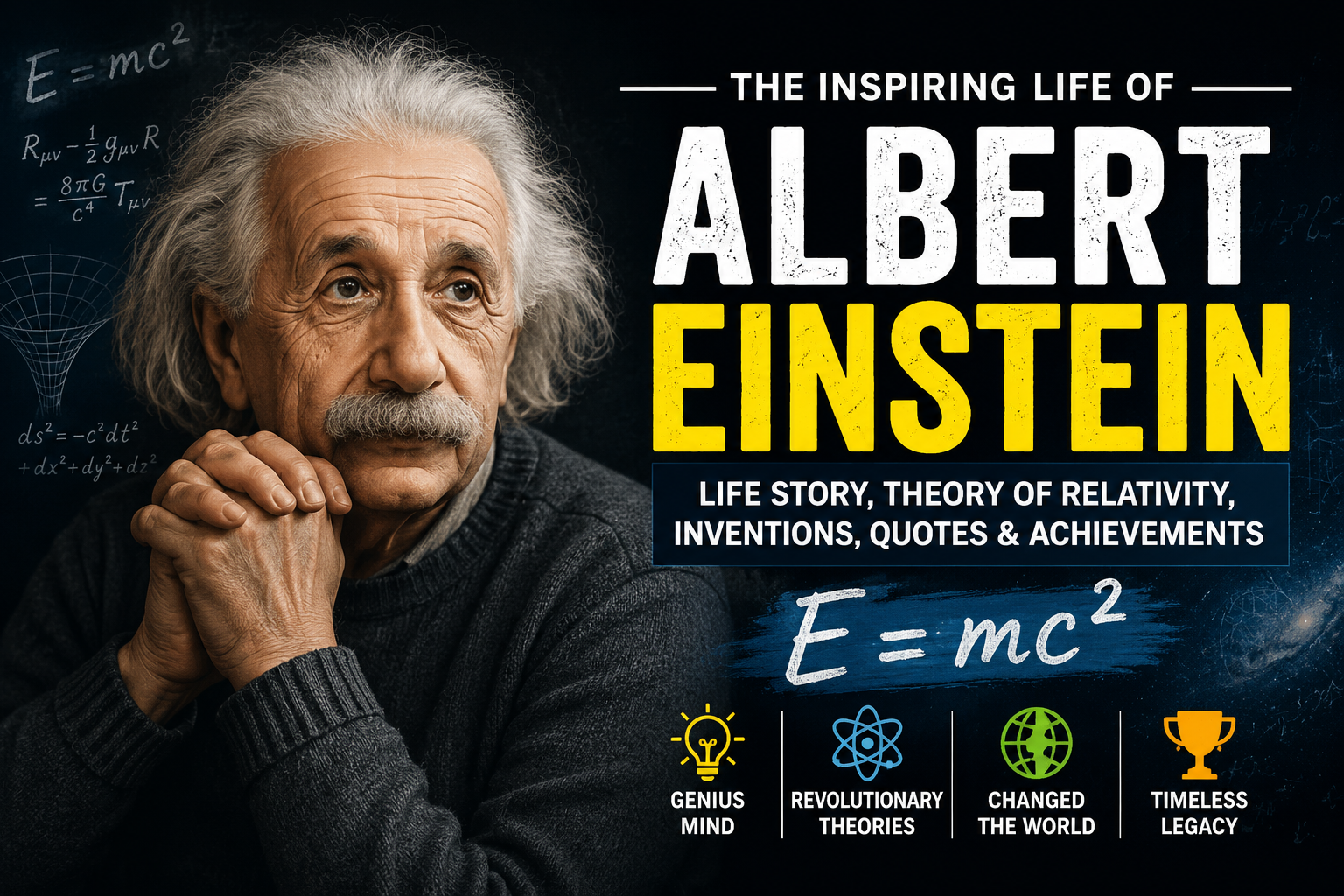
Albert Einstein
Albert Einstein (1879–1955) was a German-born theoretical physicist widely regarded as one of the greatest scientists in human history. Best known for developing the Theory of Relativity and the famous equation E = mc², Einstein revolutionized modern physics and transformed humanity's understanding of space, time, gravity, energy, and the universe. His groundbreaking discoveries earned him the Nobel Prize in Physics in 1921 and made him a global symbol of intelligence, innovation, curiosity, and scientific excellence. Today, Albert Einstein's contributions continue to influence physics, technology, astronomy, and scientific research around the world.
Profession:
Scientist
Nationality:
German
Born:
1879
Died:
1955
Introduction
Albert Einstein is one of the most influential and celebrated scientists of all time. His name has become synonymous with genius, creativity, intelligence, and innovation. More than a century after his greatest discoveries, Einstein's theories continue to shape our understanding of the universe.
Known for his wild hair, thoughtful personality, and extraordinary intellect, Einstein transformed the world through groundbreaking contributions to theoretical physics. His work laid the foundation for modern physics and changed humanity's understanding of space, time, energy, gravity, and the cosmos.
The story of Albert Einstein is not just the story of a brilliant scientist—it is the story of perseverance, imagination, curiosity, and the courage to question established beliefs.
Early Life and Childhood
Albert Einstein was born on March 14, 1879, in Ulm, Germany.
His father, Hermann Einstein, was an engineer and businessman, while his mother, Pauline Einstein, encouraged his love of music and learning.
Contrary to popular myths, Einstein was not a poor student. However, he developed differently from many children and preferred independent thinking over memorization.
As a child, he became fascinated by a compass his father showed him.
Watching the needle move without visible contact sparked a lifelong curiosity about the hidden forces of nature.
That simple experience inspired Einstein to ask one of the most important questions of his life:
"What invisible forces govern the universe?"
Einstein's Childhood Curiosity
Albert Einstein's journey toward becoming one of the greatest scientists in history began with an extraordinary sense of curiosity. As a young boy, he constantly asked questions about how the world worked. While many children accepted things as they appeared, Einstein wanted to understand the hidden laws behind nature.
One of the most influential moments of his childhood occurred when his father showed him a magnetic compass. Einstein was amazed that the needle continued pointing north even though no visible force seemed to move it. This experience sparked a lifelong fascination with invisible forces and natural laws.
His curiosity eventually led him to explore mathematics, physics, and philosophy, laying the foundation for his future discoveries.
Education and Love for Learning
Einstein attended school in Munich but disliked rigid teaching methods.
He often questioned teachers and challenged traditional ideas.
While many students focused on memorizing facts, Einstein focused on understanding concepts.
He developed a deep interest in:
- Mathematics
- Physics
- Philosophy
- Geometry
- Astronomy
At age 12, he independently studied advanced mathematics that many university students found difficult.
His intellectual curiosity set him apart from his peers.
Later, Einstein enrolled at the Swiss Federal Polytechnic School in Zurich, where he studied physics and mathematics.
Struggles After Graduation
After graduating, Einstein struggled to find a teaching position.
Many professors viewed him as unconventional because he challenged authority and often skipped lectures.
For several years he remained unemployed.
Eventually, he obtained a job as a technical examiner at the Swiss Patent Office in Bern.
Although the position seemed unrelated to scientific research, it became one of the most important periods of his life.
While reviewing patent applications during the day, Einstein spent evenings developing revolutionary ideas about physics.
The Patent Office became the birthplace of modern physics.
The Miracle Year of 1905
The year 1905 is often called Einstein's "Annus Mirabilis" (Miracle Year).
In a single year, he published four scientific papers that transformed science forever.
These papers explained:
Photoelectric Effect
Einstein demonstrated that light behaves as particles called photons.
This discovery became a foundation of quantum mechanics.
Brownian Motion
He provided evidence for the existence of atoms and molecules.
Special Theory of Relativity
He redefined humanity's understanding of space and time.
Mass-Energy Equivalence
He introduced the famous equation:
E = mc²
This equation revealed that matter and energy are interchangeable.
It remains one of the most famous formulas in history.
Understanding E = mc²
Einstein's equation changed science forever.
The formula means:
- E = Energy
- m = Mass
- c = Speed of Light
It demonstrates that even a tiny amount of matter contains enormous energy.
This discovery influenced:
- Nuclear power
- Particle physics
- Space science
- Modern technology
The equation became one of the most important scientific discoveries ever made.
The Theory of Special Relativity
Before Einstein, scientists believed time and space were fixed.
Einstein proved otherwise.
According to Special Relativity:
- Time can slow down.
- Length can change.
- Mass increases with speed.
- The speed of light remains constant.
These ideas seemed impossible at the time.
Today, they have been repeatedly confirmed through experiments.
Modern GPS technology depends on Einstein's theories.
Without relativity, GPS systems would become inaccurate within hours.
General Theory of Relativity
In 1915, Einstein introduced the General Theory of Relativity.
This theory transformed humanity's understanding of gravity.
Before Einstein, Isaac Newton described gravity as a force between objects.
Einstein proposed something more revolutionary.
He explained that:
Mass bends space-time.
Large objects like planets and stars create curves in space-time.
Other objects move along these curves, producing what we perceive as gravity.
This theory explained phenomena that Newton's laws could not.
General Relativity remains one of the greatest scientific achievements in history.
Confirmation of Einstein's Theory
Many scientists initially doubted Einstein's theory.
Everything changed in 1919.
Astronomers observed a solar eclipse and discovered that starlight bent around the Sun exactly as Einstein predicted.
The results shocked the scientific community.
Newspapers worldwide declared Einstein a genius.
Overnight, he became one of the most famous scientists in the world.
Nobel Prize in Physics
In 1921, Albert Einstein received the Nobel Prize in Physics.
Interestingly, he did not receive it for relativity.
Instead, he won for his explanation of the photoelectric effect.
This work became a cornerstone of quantum physics and modern electronics.
Today, technologies such as:
- Solar panels
- Cameras
- Sensors
- Lasers
depend on principles Einstein helped establish.
Contributions to Quantum Physics
Einstein played a major role in the development of quantum mechanics.
Although he contributed significantly to the field, he disagreed with some of its interpretations.
His famous statement remains:
"God does not play dice with the universe."
Einstein believed nature should follow deeper laws than pure randomness.
His debates with physicist Niels Bohr became legendary and advanced scientific understanding.
Einstein and the Atomic Age
During the 1930s, the rise of Nazi Germany threatened Europe.
As a Jewish scientist, Einstein left Germany and moved to the United States.
In 1939, he signed a letter warning President Franklin D. Roosevelt about the possibility of nuclear weapons.
This letter contributed to the creation of the Manhattan Project.
Although Einstein did not directly participate in building the atomic bomb, he later advocated for peace and international cooperation.
He spent much of his later life promoting nuclear disarmament.
Einstein's Work at Princeton
Einstein joined the Institute for Advanced Study in Princeton, New Jersey.
There he continued his research on:
- Unified Field Theory
- Cosmology
- Physics
- Mathematics
He sought a theory capable of unifying all forces of nature.
Although he never completed this goal, his pursuit inspired future generations of scientists.
Einstein's Personality
Despite worldwide fame, Einstein remained humble.
He valued:
- Curiosity
- Creativity
- Simplicity
- Peace
- Learning
He disliked excessive attention and often ignored social conventions.
Einstein loved:
- Music
- Violin
- Sailing
- Philosophy
- Mathematics
He frequently stated that imagination was more important than knowledge because imagination drives discovery.
Major Scientific Contributions
Theory of Relativity
Changed understanding of space, time, and gravity.
E = mc²
Demonstrated the relationship between mass and energy.
Photoelectric Effect
Laid the foundation for quantum mechanics.
Brownian Motion
Provided evidence for atomic theory.
Cosmology
Contributed to understanding the structure and evolution of the universe.
Bose-Einstein Statistics
Helped create modern quantum physics.
Einstein's Love for Music
Few people know that Albert Einstein was deeply passionate about music.
From an early age, he learned to play the violin and continued playing throughout his life. Einstein often described music as an essential part of his thinking process. Whenever he faced difficult scientific problems, he would play his violin to relax and stimulate creative ideas.
He especially admired the works of Mozart and Bach. Music helped Einstein maintain balance between logic and imagination.
According to Einstein:
"If I were not a physicist, I would probably be a musician."
His love for music demonstrates that creativity and science often go hand in hand.
Einstein's Relationship with Failure
Despite his reputation as a genius, Einstein experienced numerous setbacks and failures.
After graduating from university, he struggled to find academic employment. Many professors were unwilling to recommend him because he often challenged traditional teaching methods.
For years he worked at a patent office instead of a university.
Many scientists initially rejected his theories because they seemed too radical.
Rather than giving up, Einstein continued refining his ideas and trusting his reasoning.
His life teaches that success often comes after years of persistence and resilience.
Einstein's Views on Education
Albert Einstein believed that education should encourage creativity rather than memorization.
He often criticized educational systems that focused solely on exams and rote learning.
According to Einstein, true education develops the ability to think independently and solve problems creatively.
He believed that curiosity was more important than simply accumulating information.
His educational philosophy continues to influence modern teaching methods worldwide.
Einstein and Humanitarian Work
Einstein was not only a scientist but also a humanitarian.
Throughout his life, he advocated for:
- Peace
- Human rights
- Equality
- Social justice
- International cooperation
He publicly opposed racism and discrimination.
After moving to the United States, Einstein actively supported civil rights movements and spoke against racial inequality.
He believed that science should serve humanity rather than contribute to division and conflict.
Einstein's Vision of the Future
Einstein often reflected on the future of humanity.
He believed scientific progress had the power to improve human life dramatically but warned that technological advancement must be guided by wisdom and ethics.
Einstein feared that scientific discoveries could be misused if humanity failed to develop moral responsibility.
His warnings remain relevant in discussions about:
- Artificial Intelligence
- Nuclear Weapons
- Biotechnology
- Automation
- Global Security
Einstein and Space Exploration
Although Einstein never witnessed modern space missions, his theories became essential for space exploration.
Today, scientists use Einstein's theories to:
- Calculate spacecraft trajectories
- Understand black holes
- Study gravitational waves
- Explore distant galaxies
- Investigate the origins of the universe
Modern astronomy and cosmology rely heavily on Einstein's work.
Without relativity, many discoveries about the universe would not have been possible.
Einstein's Influence on Modern Technology
Many technologies used daily depend on principles connected to Einstein's discoveries.
Examples include:
- GPS Navigation
- Solar Panels
- Smartphones
- Satellite Communication
- Medical Imaging
- Particle Accelerators
- Quantum Computing
Although Einstein conducted theoretical research, his ideas eventually became the foundation for countless practical innovations.
Einstein's Search for a Unified Theory
During the final decades of his life, Einstein pursued one ambitious goal: a unified theory of everything.
He wanted to create a single framework capable of explaining all fundamental forces in nature.
Despite years of effort, he never completed this objective.
However, his quest inspired future generations of physicists and continues to influence modern research in:
- String Theory
- Quantum Gravity
- Unified Field Theory
- Cosmology
Many scientists still pursue the dream Einstein spent his final years chasing.
Why Albert Einstein Remains Relevant Today
More than seventy years after his death, Albert Einstein remains one of the most influential figures in science and human history.
His ideas continue shaping:
- Physics
- Engineering
- Technology
- Space Exploration
- Artificial Intelligence
- Scientific Research
Beyond science, Einstein represents intellectual curiosity, independent thinking, creativity, and lifelong learning.
His life story inspires students, researchers, entrepreneurs, innovators, and dreamers around the world.
Death of Albert Einstein
Albert Einstein died on April 18, 1955, in Princeton, New Jersey, United States.
He was 76 years old.
Even in his final days, Einstein continued working on scientific problems and seeking deeper understanding of the universe.
His passing marked the end of an extraordinary era in science.
Final Thoughts
Albert Einstein's life demonstrates the power of curiosity, imagination, and perseverance. He transformed humanity's understanding of the universe through groundbreaking discoveries that continue to influence modern science and technology.
Despite fame and recognition, Einstein remained committed to learning, questioning, and seeking truth. His journey proves that extraordinary achievements often begin with simple curiosity and a willingness to think differently.
Today, Albert Einstein's legacy continues to inspire millions of people to explore new ideas, challenge conventional wisdom, and pursue knowledge in the service of humanity.
Major Achievements
Albert Einstein's Greatest Achievements
Development of Special Relativity
Redefined space and time.
Development of General Relativity
Revolutionized understanding of gravity.
Nobel Prize in Physics
Awarded in 1921.
Photoelectric Effect
Laid the foundation for modern electronics.
E = mc²
One of the most famous scientific equations ever created.
Contributions to Quantum Theory
Helped establish modern quantum physics.
Scientific Influence
Inspired countless breakthroughs in science and technology.
Life Lessons from Albert Einstein
Life Lessons from Albert Einstein
Never Stop Being Curious
Einstein believed curiosity was more valuable than intelligence.
Question Everything
Progress often begins by challenging assumptions.
Imagination Creates Innovation
Great discoveries start as ideas.
Learn Continuously
Education does not end with school.
Persistence Matters
Einstein spent years refining theories.
Simplicity Is Powerful
Complex problems often have elegant solutions.
Think Independently
Do not follow the crowd blindly.
Embrace Mistakes
Mistakes help reveal new knowledge.
Stay Humble
True greatness requires humility.
Use Knowledge for Good
Science should improve humanity.
Famous Quotes
"Imagination is more important than knowledge."
"Life is like riding a bicycle. To keep your balance, you must keep moving."
"The important thing is not to stop questioning."
"Try not to become a man of success, but rather try to become a man of value."
"A person who never made a mistake never tried anything new."
"Logic will get you from A to B. Imagination will take you everywhere."
"Education is what remains after one has forgotten what one has learned in school."
"Peace cannot be kept by force; it can only be achieved by understanding."
"In the middle of difficulty lies opportunity."
"The true sign of intelligence is not knowledge but imagination."
Interesting Facts
Interesting Facts About Albert Einstein
Einstein did not enjoy rote memorization.
He played the violin throughout his life.
He spoke German and English.
He received over 300 scientific papers and publications.
He became a U.S. citizen in 1940.
Einstein's brain was studied after his death.
He disliked wearing socks.
He loved sailing despite being a poor swimmer.
Time magazine named him Person of the Century.
His name became a global symbol of genius.
He rejected several prestigious political positions.
He was offered the presidency of Israel.
Einstein advocated civil rights and equality.
He supported global peace movements.
He inspired generations of scientists.
Legacy
Albert Einstein's legacy extends far beyond physics.
His discoveries transformed humanity's understanding of reality and continue to influence countless fields.
His work helped shape:
Modern Physics
Astronomy
Space Exploration
Nuclear Energy
Quantum Computing
GPS Technology
Cosmology
Engineering
Telecommunications
Scientific Research
Einstein became more than a scientist.
He became a symbol of:
Genius
Curiosity
Creativity
Innovation
Independent Thinking
Today, students, scientists, entrepreneurs, researchers, and innovators continue drawing inspiration from his life.
More than seventy years after his death, Einstein remains one of the most admired individuals in human history.
His greatest contribution was not simply a theory or equation—it was teaching humanity to think differently about the universe.
Albert Einstein proved that curiosity, imagination, and determination can unlock the deepest mysteries of existence and leave a legacy that inspires generations to come.
Frequently Asked Questions
Albert Einstein was a German-born theoretical physicist who developed the Theory of Relativity and the famous equation E=mc². He is considered one of the greatest scientists in history.
Albert Einstein was born on March 14, 1879, in Ulm, Germany.
Albert Einstein is famous for developing the Theory of Relativity, the equation E=mc², and his contributions to modern physics and quantum theory.
E=mc² is Einstein's mass-energy equivalence formula, showing that mass and energy are interchangeable and closely related.
Yes. Albert Einstein won the Nobel Prize in Physics in 1921 for his work on the Photoelectric Effect.
His greatest achievements include the Theory of Relativity, E=mc², contributions to quantum physics, and transforming humanity's understanding of space, time, gravity, and energy.
Although no official IQ test result exists, experts estimate Einstein's IQ to have been between 160 and 190.
Some famous quotes include:
Einstein revolutionized physics through his discoveries about relativity, gravity, light, and energy, laying the foundation for many modern technologies including GPS, nuclear energy, and advanced scientific research.
Albert Einstein died on April 18, 1955, in Princeton, New Jersey, United States, at the age of 76.
Albert Einstein teaches us to stay curious, think independently, value imagination, embrace lifelong learning, question assumptions, and use knowledge to benefit humanity.
Einstein is considered a genius because his theories fundamentally changed science and helped humanity understand the universe in ways never thought possible before.