Bruce Lee
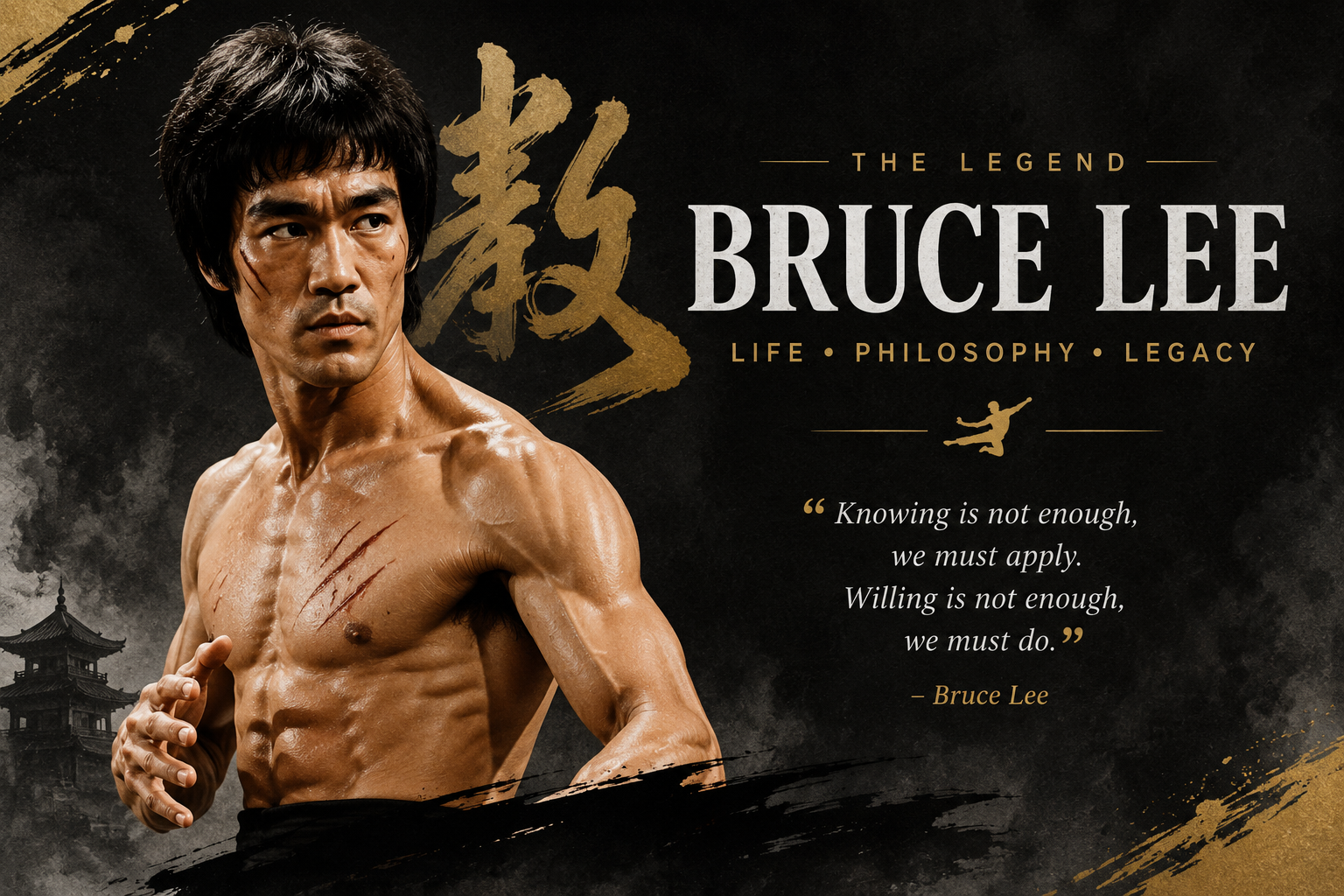
Bruce Lee (1940–1973) was a legendary martial artist, actor, philosopher, and founder of Jeet Kune Do. Born in San Francisco and raised in Hong Kong, he revolutionized martial arts and action cinema through iconic films such as Enter the Dragon, Fist of Fury, and Way of the Dragon. Known for his philosophy of self-improvement, discipline, and adaptability, Bruce Lee inspired millions worldwide with famous quotes like "Be water, my friend." Despite passing away at the age of 32, his influence continues to shape martial arts, fitness, personal development, and popular culture across generations.
Profession:
Martial Artist, Actor, Philosopher, Filmmaker, Author
Nationality:
American (Born in USA) / Hong Kong
Born:
1940
Died:
1973
Introduction: Why Bruce Lee Still Inspires Millions
When people search for Bruce Lee biography, Bruce Lee quotes, Bruce Lee life lessons, Bruce Lee success story, or who was Bruce Lee, they are often looking for more than just facts. They are searching for inspiration from a man who transformed weakness into strength, limitations into opportunities, and dreams into reality.
Bruce Lee was not just a martial artist. He was a philosopher, actor, teacher, writer, innovator, and one of the most influential figures in modern history. Decades after his death, his words continue to inspire entrepreneurs, athletes, students, artists, and anyone striving to become their best self.
As I sat down to read Bruce Lee's life story, I expected to learn about martial arts and movies. Instead, I discovered a man who spent his entire life fighting a much deeper battle—the battle against self-doubt, limitations, fear, and mediocrity. The more I read about him, the more I realized that his story is not only about punches and kicks. It is about becoming the strongest version of yourself.
This is the complete story of Bruce Lee.
Early Life of Bruce Lee
Bruce Lee was born on November 27, 1940, in San Francisco, California, USA.
His birth name was Lee Jun-fan. Although he was born in America, he spent most of his childhood in Hong Kong.
Bruce was born during a period of uncertainty. The world was going through war, and his family faced various challenges. His father, Lee Hoi-chuen, was a famous Cantonese opera singer and actor, while his mother, Grace Ho, came from a respected family.
From a very young age, Bruce displayed tremendous energy. He was curious, fearless, and often involved in street fights. Many people saw him as a troublesome child, but beneath that rebellious nature was a young boy searching for identity and purpose.
What makes Bruce Lee's story fascinating is that he was not born a martial arts legend. He was an ordinary child with flaws, weaknesses, and struggles.
Bruce Lee's Childhood Struggles
Growing up in Hong Kong was not always easy.
Bruce was often involved in neighborhood fights. His temper got him into trouble, and he frequently challenged other boys.
Many people today imagine Bruce Lee as an unbeatable warrior, but the truth is very different. He lost fights. He made mistakes. He experienced failures.
These struggles eventually pushed him toward martial arts.
Rather than allowing anger to control him, Bruce sought a way to channel his energy positively.
This decision would change his life forever.
Learning Martial Arts Under Ip Man
At the age of 13, Bruce Lee began studying Wing Chun under the legendary martial arts master Ip Man.
Bruce Lee learned discipline, focus, patience, and technique during this period.
Wing Chun emphasized efficiency, speed, balance, and practical combat skills.
Under Ip Man's guidance, Bruce started understanding that martial arts was not merely about fighting. It was about self-mastery.
He trained relentlessly.
While most teenagers were spending their free time relaxing, Bruce was practicing techniques repeatedly until they became second nature.
This commitment to improvement became one of the defining characteristics of his life.
Moving to America
As Bruce's street fights became more frequent, his parents worried about his future.
In 1959, he moved to the United States.
He arrived with very little money.
He had no fame.
No Hollywood connections.
No guarantee of success.
Like many immigrants, Bruce started from scratch.
He worked hard, took various jobs, and enrolled at the University of Washington in Seattle.
There, he studied philosophy—a subject that would deeply influence his future teachings.
While studying, Bruce also began teaching martial arts.
His classes attracted attention because his methods were different.
He believed martial arts should be practical, adaptable, and accessible to everyone regardless of race or background.
This was a revolutionary idea at the time.
The Birth of Jeet Kune Do
Bruce Lee eventually developed his own martial arts philosophy called Jeet Kune Do.
The term means "The Way of the Intercepting Fist."
Unlike traditional martial arts systems that followed rigid rules, Jeet Kune Do emphasized adaptability.
Bruce famously believed:
"Absorb what is useful, discard what is useless, and add what is specifically your own."
This philosophy extended beyond martial arts.
It became a blueprint for life.
Whether in business, relationships, education, or personal growth, Bruce taught people to focus on what works rather than blindly following traditions.
Bruce Lee's Philosophy: Be Like Water
One of Bruce Lee's most famous teachings is:
"Be water, my friend."
At first glance, these words seem simple.
But they contain profound wisdom.
Water adapts to any situation.
It can flow gently or crash powerfully.
It can fit into any container while maintaining its essence.
Bruce believed human beings should develop the same flexibility.
Life constantly changes.
Those who resist change often suffer.
Those who adapt continue growing.
This lesson remains relevant in today's rapidly changing world.
Bruce Lee's Rise in Hollywood
Breaking into Hollywood was not easy.
During the 1960s and early 1970s, Asian actors were often given limited opportunities.
Bruce faced rejection repeatedly.
Many producers believed audiences would not accept an Asian leading actor.
Yet Bruce refused to quit.
His determination eventually earned him roles in television and film.
One of his early breakthroughs came through the television series "The Green Hornet," where he played Kato.
Although his role was technically secondary, audiences were captivated by his speed, charisma, and martial arts abilities.
Suddenly, people began noticing Bruce Lee.
Bruce Lee Movies That Changed Cinema
Bruce Lee became an international superstar through films that revolutionized action cinema.
The Big Boss (1971)
This film transformed Bruce into a major star across Asia.
Fist of Fury (1972)
The movie showcased Bruce's incredible martial arts skills and emotional intensity.
Way of the Dragon (1972)
This film featured the legendary fight between Bruce Lee and Chuck Norris.
It remains one of the most iconic fight scenes in movie history.
Enter the Dragon (1973)
Widely regarded as Bruce Lee's masterpiece, Enter the Dragon introduced him to global audiences.
Even decades later, it remains one of the greatest martial arts films ever created.
Bruce Lee's Work Ethic
One aspect of Bruce Lee's life that deeply impressed me as a writer was his obsession with continuous improvement.
Bruce did not rely solely on talent.
He studied constantly.
He read thousands of books.
He took detailed notes.
He analyzed philosophy, psychology, fitness, nutrition, and human performance.
Many people see the final success.
Few see the years of preparation.
Bruce once said:
"I'm not afraid of the man who has practiced 10,000 kicks once. I'm afraid of the man who has practiced one kick 10,000 times."
This quote perfectly summarizes his approach to mastery.
Bruce Lee's Fitness Routine
Bruce Lee was decades ahead of his time.
His training methods influenced modern fitness culture.
He combined:
- Strength training
- Cardio workouts
- Martial arts practice
- Flexibility exercises
- Nutrition planning
At a time when many martial artists ignored scientific training methods, Bruce embraced innovation.
He constantly experimented with new techniques to improve performance.
His dedication made him one of the fittest athletes of his generation.
Bruce Lee's Most Famous Quotes
On Success
"If you love life, don't waste time, for time is what life is made up of."
On Growth
"Knowing is not enough, we must apply. Willing is not enough, we must do."
On Failure
"Mistakes are always forgivable if one has the courage to admit them."
On Confidence
"As you think, so shall you become."
On Discipline
"Long-term consistency beats short-term intensity."
On Adaptability
"Be water, my friend."
These quotes continue to inspire millions around the world.
Bruce Lee's Marriage and Family
Bruce Lee married Linda Lee Cadwell in 1964.
Their relationship was built on mutual support and respect.
Together, they had two children:
- Brandon Lee
- Shannon Lee
Despite his growing fame, Bruce remained deeply connected to his family.
He often emphasized the importance of love, loyalty, and personal responsibility.
Bruce Lee's Untimely Death
On July 20, 1973, Bruce Lee passed away at the age of 32.
His sudden death shocked the world.
Millions of fans mourned the loss of a man whose potential seemed limitless.
Although his life was short, its impact was enormous.
Most people spend decades trying to create a legacy.
Bruce Lee accomplished it in just thirty-two years.
The Legacy of Bruce Lee
Today, Bruce Lee's influence extends far beyond martial arts.
He inspired:
- Athletes
- Actors
- Entrepreneurs
- Writers
- Business leaders
- Students
- Motivational speakers
His philosophy continues to be studied worldwide.
Books about Bruce Lee remain bestsellers.
His quotes are shared daily across social media.
His films continue attracting new generations of fans.
Few individuals have influenced global culture as deeply as Bruce Lee.
Lessons We Can Learn From Bruce Lee
1. Never Stop Learning
Bruce was a lifelong student.
2. Adapt to Change
Flexibility is strength.
3. Discipline Creates Greatness
Success is built through consistent effort.
4. Believe in Yourself
Confidence begins within.
5. Create Your Own Path
Do not blindly follow others.
Think independently.
6. Action Matters More Than Knowledge
Knowledge without action changes nothing.
7. Turn Obstacles Into Opportunities
Challenges often become stepping stones toward success.
My Personal Reflection After Reading Bruce Lee's Biography
As a writer, reading Bruce Lee's biography left a lasting impression on me.
I expected to learn about martial arts.
Instead, I learned about self-development.
The most powerful realization was that Bruce Lee's greatness was not created overnight.
Behind every movie, every quote, and every achievement were years of discipline, study, failure, persistence, and relentless self-improvement.
His life reminded me that every person has hidden potential.
Most people never discover it because they stop too soon.
Bruce never stopped.
He kept learning.
Kept improving.
Kept evolving.
And perhaps that is why his influence continues decades after his death.
Whenever I face challenges in writing, business, or life, I often remember Bruce Lee's philosophy of becoming like water.
Adapt.
Flow.
Move forward.
Grow stronger.
Because life's greatest victories belong not to the strongest or smartest people, but to those who refuse to give up.
Conclusion
Bruce Lee was much more than a martial artist.
He was a visionary who challenged traditions, broke barriers, inspired millions, and transformed how the world views personal growth and self-mastery.
His story proves that greatness is not determined by where you begin but by how relentlessly you pursue your potential.
More than fifty years after his passing, Bruce Lee continues to teach us that success is built through discipline, courage, adaptability, and action.
His life remains a timeless reminder that every human being has the power to become extraordinary.
As Bruce Lee wisely said:
"The successful warrior is the average man, with laser-like focus."
And perhaps that single sentence captures his entire life story.
Major Achievements
Founded Jeet Kune Do, a revolutionary martial arts philosophy focused on adaptability and efficiency.
Became a global martial arts icon through movies like Enter the Dragon, The Big Boss, Fist of Fury, and Way of the Dragon.
Broke racial barriers in Hollywood and became the first Asian international action superstar.
Popularized martial arts worldwide and inspired modern MMA training methods.
Trained celebrities, athletes, and martial artists, including Hollywood stars.
Authored and inspired several books on martial arts, philosophy, and self-development.
Named among the most influential people of the 20th century by various global publications.
Revolutionized action movie choreography with realistic and fast-paced fight scenes.
Became a symbol of discipline, self-mastery, and personal growth.
Left a lasting legacy that continues to influence martial arts, fitness, cinema, and leadership decades after his death.
Life Lessons from Bruce Lee
1. Be Like Water
Adapt to changing situations instead of resisting them.
"Be water, my friend."
2. Focus on Continuous Improvement
Small daily improvements lead to extraordinary results over time.
3. Practice Creates Mastery
Success comes from repetition and consistency.
"I fear not the man who has practiced 10,000 kicks once, but I fear the man who has practiced one kick 10,000 times."
4. Take Action
Knowledge is valuable only when applied.
"Knowing is not enough, we must apply. Willing is not enough, we must do."
5. Believe in Yourself
Confidence begins with self-belief and self-respect.
6. Turn Obstacles into Opportunities
Every challenge can become a stepping stone toward growth.
7. Create Your Own Path
Don't blindly follow others; develop your own philosophy and vision.
8. Discipline Beats Talent
Talent without discipline rarely achieves greatness.
9. Never Stop Learning
Bruce Lee remained a student throughout his life, constantly reading and improving.
10. Live Fully and Purposefully
Time is life's most valuable asset.
"If you love life, don't waste time, for time is what life is made up of."
Key Success Principles of Bruce Lee
Self-Discipline
Consistency
Adaptability
Lifelong Learning
Courage
Self-Confidence
Action-Oriented Mindset
Focus
Resilience
Personal Growth
Famous Quotes
1. Be water, my friend.
2. Knowing is not enough, we must apply. Willing is not enough, we must do.
3. The successful warrior is the average man with laser-like focus.
4. Absorb what is useful, discard what is not, add what is uniquely your own.
5. Mistakes are always forgivable if one has the courage to admit them.
6. If you love life, don't waste time, for time is what life is made of.
7. To hell with circumstances; I create opportunities.
8. Do not pray for an easy life, pray for the strength to endure a difficult one.
9. A goal is not always meant to be reached; it often serves simply as something to aim at.
10. Simplicity is the key to brilliance.
Interesting Facts
• Bruce Lee was born on November 27, 1940, in San Francisco, California.
• He spent most of his childhood in Hong Kong.
• Bruce Lee appeared in more than 20 films during his career.
• He created Jeet Kune Do, a martial arts philosophy focused on adaptability and efficiency.
• He trained many famous Hollywood celebrities including Steve McQueen and Kareem Abdul-Jabbar.
• Bruce Lee could perform push-ups using only two fingers.
• His famous film Enter the Dragon became one of the most influential martial arts movies ever made.
• Despite his short life, he transformed martial arts and action cinema forever.
• Bruce Lee was also a philosopher who studied psychology, philosophy, and human potential.
• He passed away on July 20, 1973, at the age of 32.
Legacy
His creation of Jeet Kune Do challenged traditional limitations and encouraged people to think independently. Bruce Lee also broke racial barriers in Hollywood and became one of the first Asian global superstars.
Today, decades after his passing, Bruce Lee remains a symbol of discipline, courage, determination, resilience, and personal excellence. His teachings continue to influence martial artists, fitness enthusiasts, and self-development seekers around the world.
Frequently Asked Questions
Q. When was Bruce Lee born?
Bruce Lee was born on November 27, 1940, in San Francisco, California.
Q. What was Bruce Lee's philosophy?
Bruce Lee believed in adaptability, self-improvement, discipline, and the famous principle "Be water, my friend."
Q. How did Bruce Lee die?
Bruce Lee passed away on July 20, 1973, at the age of 32 in Hong Kong.
Q. What is Bruce Lee's most famous quote?
His most famous quote is: "Be water, my friend."