Elon Musk
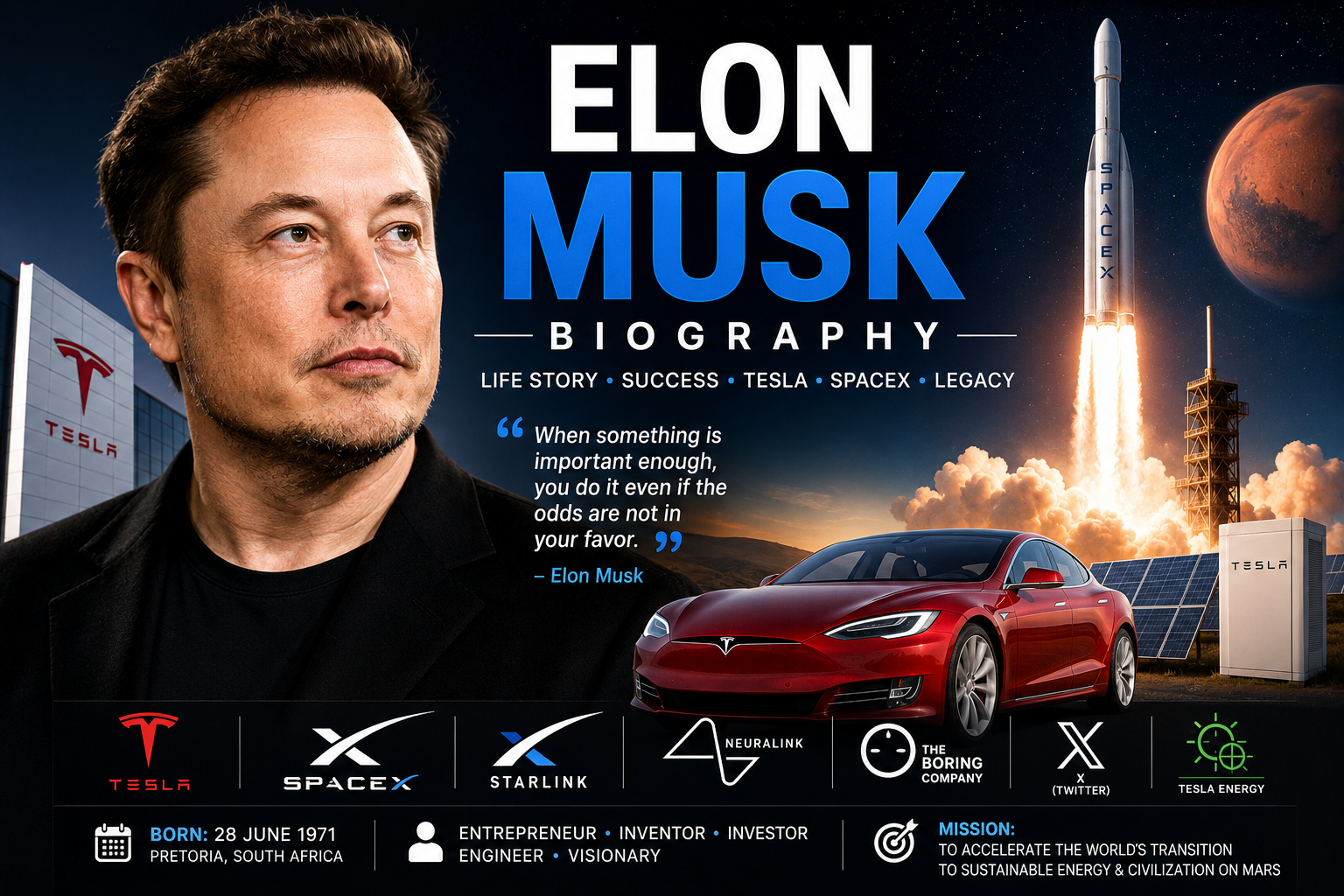
Elon Musk is a billionaire entrepreneur, inventor, and business leader known for leading Tesla, SpaceX, X, Neuralink, and The Boring Company. His innovations in electric vehicles, space exploration, renewable energy, and technology have made him one of the most influential figures of the modern era.
Profession:
Entrepreneur, Investor, Inventor, Businessman
Nationality:
South African, Canadian, American
Born:
1971
Introduction
Elon Musk is one of the most influential entrepreneurs, innovators, and business leaders of the 21st century. Known for leading revolutionary companies such as Tesla, SpaceX, Neuralink, X (formerly Twitter), and The Boring Company, Musk has transformed industries ranging from electric vehicles and space exploration to artificial intelligence and renewable energy.
When people search for Elon Musk biography, Elon Musk success story, Elon Musk net worth, Elon Musk life story, Tesla founder, SpaceX founder, and Elon Musk achievements, they are looking for the incredible journey of a man who dared to dream beyond Earth and worked relentlessly to turn impossible ideas into reality.
Today, Elon Musk is widely regarded as one of the most innovative minds in modern history. His mission is not merely to build successful companies but to solve humanity's biggest challenges and ensure the long-term survival of civilization.
Early Life of Elon Musk
Elon Reeve Musk was born on June 28, 1971, in Pretoria, South Africa.
His parents were:
- Errol Musk (Engineer)
- Maye Musk (Model and Dietitian)
Elon grew up with his brother Kimbal Musk and sister Tosca Musk.
From a very young age, Elon displayed extraordinary intelligence and curiosity. He loved reading books and learning about science, technology, engineering, and space.
Unlike many children, Elon spent countless hours reading encyclopedias, science fiction novels, and books about inventors and explorers.
His favorite topics included:
- Space
- Computers
- Physics
- Engineering
- Technology
These interests would later shape his future career.
Childhood Challenges
Although Elon was highly intelligent, his childhood was not easy.
He was often bullied at school.
Many classmates considered him different because he preferred reading and learning rather than participating in typical social activities.
At one point, he was severely beaten by bullies and required medical treatment.
These difficult experiences helped him develop resilience and mental toughness.
Years later, Musk stated that adversity taught him how to endure challenges and continue moving forward despite setbacks.
Love for Reading and Learning
One of Elon Musk's greatest strengths was his passion for learning.
As a child, he read almost everything he could find.
He reportedly read:
- Science fiction books
- Philosophy books
- Engineering books
- Computer manuals
- Encyclopedias
Musk once said he learned many important concepts simply by reading.
His favorite authors included:
- Isaac Asimov
- Douglas Adams
- J.R.R. Tolkien
These books inspired him to think about humanity's future and the possibilities of technology.
Elon Musk Learns Programming
At the age of 10, Elon became fascinated by computers.
He taught himself programming using a computer manual.
Unlike most children his age, he spent hours learning coding and software development.
By the age of 12, he had already created his first video game called:
Blastar
The game was a simple space-themed shooter.
Musk sold the game's code to a computer magazine for approximately $500.
This was his first entrepreneurial success.
Although the amount was small, it demonstrated his ability to create value through technology.
Dreaming Beyond South Africa
As Elon grew older, he became increasingly interested in innovation and entrepreneurship.
He believed that the greatest opportunities existed in North America.
Musk wanted to participate in technological revolutions that could change the world.
At age 17, he left South Africa and moved to Canada.
This decision marked the beginning of an extraordinary journey.
Leaving home was not easy, but Musk understood that achieving ambitious goals often requires taking risks.
Moving to Canada
Elon moved to Canada through his mother's Canadian citizenship.
Initially, life was challenging.
He worked various jobs, including:
- Farm labor
- Cleaning work
- Industrial jobs
These experiences taught him the value of hard work.
Despite financial difficulties, Musk remained focused on his long-term goals.
He knew education would play a crucial role in his future success.
University Education
After moving to Canada, Musk attended:
Queen's University
Located in Ontario, Canada.
He studied there for two years before transferring to:
University of Pennsylvania
In the United States.
At the University of Pennsylvania, Musk earned degrees in:
- Physics
- Economics
The combination of science and business provided a strong foundation for his future ventures.
Physics taught him analytical thinking.
Economics helped him understand markets and business strategy.
Passion for Big Problems
Unlike many entrepreneurs who focused on short-term opportunities, Musk wanted to solve major global challenges.
Even as a student, he identified three areas that he believed would significantly impact humanity's future:
Internet
Renewable Energy
Space Exploration
Years later, these three areas became the foundation of his business empire.
Stanford University and a Bold Decision
In 1995, Elon Musk was accepted into Stanford University for a PhD program in applied physics.
However, something extraordinary happened.
After only two days at Stanford, Musk dropped out.
Why?
Because he believed the internet revolution was beginning.
He saw an opportunity that could change the world.
Rather than pursuing academic research, he decided to become an entrepreneur.
This decision involved enormous risk.
But it also opened the door to incredible possibilities.
The Birth of Zip2
In 1995, Elon Musk and his brother Kimbal Musk founded:
Zip2
Zip2 was an online city guide and business directory.
At the time, the internet was still new.
Many businesses did not even have websites.
Musk believed the internet would transform how people find information.
The company helped newspapers provide online business directories and maps.
Early days were extremely difficult.
Musk often:
- Worked all night
- Slept in the office
- Showered at public facilities
- Focused entirely on growing the company
His commitment and determination became key factors in Zip2's success.
First Major Success
After several years of growth, Zip2 attracted investor interest.
In 1999, Compaq acquired Zip2 for approximately:
$307 Million
Elon Musk received around:
$22 Million
For a young entrepreneur in his twenties, this was a life-changing achievement.
Many people would have retired comfortably.
Musk had different plans.
He wanted to pursue even bigger goals.
Founding X.com
After selling Zip2, Musk immediately started another company.
This company was called:
X.com
X.com focused on online financial services and digital payments.
At the time, online banking was still in its early stages.
Musk believed the internet would transform finance just as it was transforming communication.
His vision was once again ahead of its time.
The Creation of PayPal
X.com eventually merged with another company and evolved into:
PayPal
PayPal revolutionized online payments.
The platform made it easier and safer for people to transfer money online.
As internet commerce expanded, PayPal grew rapidly.
The company became one of the most important businesses of the early internet era.
For Elon Musk, this was another step toward much larger ambitions.
He was already thinking about electric cars, renewable energy, and space exploration.
Most people considered these ideas impossible.
Musk saw them as the future.
PayPal Changes Online Payments
After the creation of PayPal, Elon Musk became one of the most recognized entrepreneurs in Silicon Valley.
PayPal revolutionized the way people transferred money online.
Before PayPal, sending money over the internet was often complicated and insecure.
PayPal offered:
- Fast transactions
- Secure payments
- Easy online transfers
- Global accessibility
As internet commerce grew, PayPal became increasingly popular.
Millions of users adopted the platform.
Major online businesses started relying on PayPal for payments.
The company quickly became one of the most important financial technology companies in the world.
eBay Acquires PayPal
In 2002, online marketplace giant eBay acquired PayPal for approximately:
$1.5 Billion
The acquisition generated significant wealth for Elon Musk.
He received around:
$180 Million
after taxes and expenses.
For most entrepreneurs, this would have been the ultimate achievement.
Musk viewed it differently.
Instead of retiring, he decided to invest nearly all his money into ambitious projects that many experts considered impossible.
The Vision Beyond Money
Unlike entrepreneurs focused solely on profits, Elon Musk wanted to solve major global challenges.
He believed humanity faced three critical issues:
Sustainable Energy
Space Exploration
The Future of Civilization
Rather than building another internet company, Musk chose to pursue missions that could transform humanity's future.
This decision would make him one of the most influential innovators of modern times.
Founding SpaceX
In 2002, Elon Musk founded:
Space Exploration Technologies Corporation (SpaceX)
The goal was simple but incredibly ambitious:
Make humanity a multi-planetary species.
Musk believed humans should eventually establish colonies on Mars.
At the time, many people laughed at the idea.
Space exploration was dominated by governments such as:
- NASA
- Roscosmos
- ESA
Very few believed a private company could compete in the space industry.
Musk thought otherwise.
The Challenge of Rocket Costs
One of the first problems Musk discovered was the enormous cost of rockets.
Existing rockets were extremely expensive.
Musk believed rockets could become dramatically cheaper through innovation and reusable technology.
Instead of accepting traditional industry practices, he challenged assumptions.
This mindset became a defining characteristic of his career.
The First SpaceX Rockets
SpaceX began developing:
Falcon 1
The company's first rocket.
Building rockets was far more difficult than creating software.
The company faced:
- Technical failures
- Manufacturing challenges
- Financial pressure
- Industry skepticism
Many experts predicted SpaceX would fail.
Yet Musk remained determined.
Rocket Failure Number One
In 2006, SpaceX launched its first Falcon 1 rocket.
The mission failed.
The rocket crashed shortly after launch.
Years of work appeared lost.
For many entrepreneurs, this would have been devastating.
Musk viewed failure as part of the learning process.
His philosophy was:
Failure is an option here. If things are not failing, you are not innovating enough.
Rocket Failure Number Two
SpaceX tried again.
The second Falcon 1 launch also failed.
The company lost more money.
Critics became increasingly vocal.
Many believed SpaceX would soon collapse.
Yet Musk refused to quit.
He continued investing his personal fortune into the company.
Rocket Failure Number Three
The third launch failed as well.
At this point:
- Investors were concerned.
- Employees were under pressure.
- Money was running out.
SpaceX was approaching bankruptcy.
The future of the company depended on one final attempt.
The Historic Fourth Launch
In September 2008, SpaceX launched Falcon 1 for the fourth time.
This launch succeeded.
For the first time, a privately developed liquid-fueled rocket successfully reached orbit.
The achievement made history.
It proved that private companies could compete in space exploration.
The success saved SpaceX.
Soon afterward, NASA awarded the company a major contract.
SpaceX had survived.
The Beginning of Tesla
While building SpaceX, Musk became involved with another company:
Tesla Motors
Tesla's mission was to accelerate the world's transition to sustainable energy.
At the time, electric vehicles were often viewed as:
- Slow
- Unattractive
- Impractical
Musk believed electric cars could be:
- Powerful
- Beautiful
- Efficient
He invested heavily in Tesla and eventually became its CEO.
The Financial Crisis
Tesla's early years were extremely difficult.
The company faced:
- Production delays
- Engineering problems
- Cash shortages
Many experts predicted Tesla would fail.
Investors questioned whether electric vehicles could ever become mainstream.
The global financial crisis of 2008 made matters even worse.
Near Bankruptcy
By late 2008, both Tesla and SpaceX were struggling.
Elon Musk had invested nearly all of his PayPal earnings into his companies.
At one point, he reportedly had difficulty paying personal expenses.
His businesses were dangerously close to collapse.
Musk later described this period as one of the most stressful times of his life.
He faced the possibility of losing everything.
Choosing Persistence Over Fear
Most people would have abandoned their dreams.
Musk continued pushing forward.
He believed the missions of Tesla and SpaceX were too important to abandon.
His determination became one of the defining characteristics of his success story.
The willingness to persist during adversity separated him from many other entrepreneurs.
Tesla Roadster
Tesla introduced:
Tesla Roadster
The Roadster demonstrated that electric vehicles could be exciting and high-performance.
The car challenged conventional assumptions about electric transportation.
It attracted attention from:
- Consumers
- Investors
- Technology enthusiasts
The Roadster became a major milestone in Tesla's journey.
Building the Future
As Tesla gained momentum and SpaceX achieved success, Musk's reputation grew rapidly.
He was no longer simply an internet entrepreneur.
He had become:
- A technology visionary
- A space pioneer
- A sustainable energy advocate
His companies were tackling some of humanity's most difficult challenges.
Yet even greater achievements were still ahead.
The coming years would bring:
- Falcon 9
- Reusable rockets
- Model S
- Gigafactories
- Solar energy projects
- Artificial intelligence ventures
These innovations would elevate Elon Musk into one of the most influential figures in modern history.
Lessons from Elon Musk's Early Journey
Take Calculated Risks
Musk repeatedly left comfortable opportunities to pursue bigger goals.
Learn Continuously
His success was built on relentless learning and self-education.
Embrace Failure
SpaceX failed three times before succeeding.
Think Long-Term
Musk focuses on decades, not quarters.
Solve Important Problems
The biggest opportunities often come from solving meaningful challenges.
Never Give Up
Persistence helped him survive moments when both Tesla and SpaceX were close to bankruptcy.
Tesla's Rise to Global Success
After surviving near bankruptcy in 2008, Tesla entered a new phase of growth.
Elon Musk's vision was becoming reality.
His goal was clear:
Accelerate the world's transition to sustainable energy.
Most major car manufacturers still doubted electric vehicles.
Many believed consumers would never replace gasoline-powered cars.
Musk disagreed.
He believed electric vehicles would eventually dominate the automotive industry.
The next few years proved him right.
Tesla Model S Changes the Car Industry
In 2012, Tesla introduced:
Tesla Model S
The Model S was unlike any electric vehicle before it.
It offered:
- Exceptional performance
- Long driving range
- Advanced technology
- Luxury design
- Zero emissions
The vehicle received widespread praise.
Consumers and critics were impressed.
Many automotive experts considered it one of the best cars ever built.
The Model S proved that electric vehicles could compete directly with luxury gasoline cars.
This was a turning point in automotive history.
Tesla Model X
Tesla continued innovating.
In 2015, the company launched:
Tesla Model X
The SUV introduced unique features such as:
Falcon Wing Doors
Advanced Safety Systems
Large Touchscreen Controls
Electric All-Wheel Drive
The Model X became one of the most technologically advanced SUVs in the world.
Tesla's reputation for innovation continued growing.
Tesla Model 3
While luxury vehicles were important, Musk wanted electric cars to become accessible to ordinary people.
This vision led to:
Tesla Model 3
Introduced in 2017.
The Model 3 became one of the best-selling electric vehicles in history.
Millions of customers placed orders.
The vehicle helped transform electric transportation from a niche market into a mainstream industry.
Today, nearly every major car manufacturer invests heavily in electric vehicles because of Tesla's influence.
Tesla Model Y
Tesla later launched:
Tesla Model Y
The compact electric SUV quickly became one of the company's most successful products.
Its popularity expanded Tesla's global reach.
The Model Y eventually became one of the best-selling vehicles worldwide.
This achievement demonstrated how far Tesla had come from its early struggles.
Gigafactories
To support massive vehicle production, Musk introduced the concept of:
Gigafactories
These large-scale manufacturing facilities produce:
- Batteries
- Electric vehicles
- Energy products
Gigafactories were built in:
- Nevada
- Texas
- California
- Germany
- China
The factories significantly reduced production costs and increased efficiency.
They became a crucial part of Tesla's success.
SpaceX Evolves into a Global Space Leader
While Tesla was growing rapidly, SpaceX was also achieving remarkable milestones.
The company introduced:
Falcon 9
A powerful rocket capable of transporting satellites, cargo, and astronauts into space.
Falcon 9 became one of the most successful rockets ever developed.
It dramatically reduced launch costs and changed the economics of space exploration.
The Reusable Rocket Revolution
One of Elon Musk's greatest innovations was:
Reusable Rockets
Traditionally, rockets were discarded after launch.
This made space travel extremely expensive.
Musk compared this approach to throwing away an airplane after every flight.
SpaceX developed technology that allowed rockets to:
- Return to Earth
- Land vertically
- Be reused
Many experts believed this was impossible.
Yet SpaceX achieved it.
Reusable rockets transformed the space industry forever.
Historic Rocket Landings
In 2015, SpaceX successfully landed a Falcon 9 booster.
The event became a historic moment in aerospace engineering.
Millions watched as a rocket returned safely and landed upright.
The achievement proved Musk's vision was achievable.
Today, reusable rockets are one of SpaceX's greatest competitive advantages.
NASA Partnership
SpaceX eventually became a major partner of NASA.
The company began transporting:
- Cargo
- Supplies
- Astronauts
to the International Space Station.
In 2020, SpaceX launched astronauts from American soil for the first time since the retirement of the Space Shuttle program.
This achievement marked a new era in space exploration.
Dragon Spacecraft
SpaceX developed:
Dragon
and later:
Crew Dragon
These spacecraft safely transport astronauts and cargo to space.
Crew Dragon became one of the most important human spaceflight vehicles in the world.
The success strengthened SpaceX's position as a global leader in aerospace technology.
Starship and the Mission to Mars
Elon Musk's ultimate goal remains:
Colonizing Mars
To achieve this vision, SpaceX is developing:
Starship
Starship is designed to become the most powerful rocket ever built.
The spacecraft aims to:
- Carry large numbers of people
- Transport cargo
- Enable interplanetary travel
Musk believes humanity should become a multi-planetary species to ensure long-term survival.
Although Mars colonization remains a future goal, Starship represents a significant step toward that vision.
Starlink Internet Network
SpaceX also created:
Starlink
Starlink uses thousands of satellites to provide internet access around the world.
The project aims to deliver:
- High-speed internet
- Global coverage
- Connectivity in remote regions
Millions of users now rely on Starlink services.
The project is helping bridge the digital divide in many areas.
SolarCity and Renewable Energy
Musk expanded beyond transportation and space.
He supported:
SolarCity
a renewable energy company focused on solar power.
The goal was to create a sustainable energy ecosystem that included:
- Solar panels
- Battery storage
- Electric vehicles
This vision aligned with Musk's broader mission of reducing dependence on fossil fuels.
Tesla Energy
Tesla introduced energy products such as:
Powerwall
Powerpack
Megapack
These battery systems help homes, businesses, and utilities store renewable energy.
Tesla Energy became an important part of the company's long-term strategy.
The Boring Company
In 2016, Elon Musk founded:
The Boring Company
The company's mission is to solve urban traffic problems through underground transportation tunnels.
Projects include:
- Tunnel networks
- Transportation systems
- Infrastructure innovation
The idea emerged from Musk's frustration with traffic congestion.
Neuralink
Another ambitious venture is:
Neuralink
Neuralink develops brain-computer interface technology.
Its goal is to help individuals with neurological conditions and potentially enhance human-computer interaction.
The project represents one of the most advanced areas of technological research.
Elon Musk Becomes the World's Richest Person
As Tesla's value increased dramatically, Elon Musk's wealth grew rapidly.
At various times, he became:
The Richest Person in the World
His net worth reached hundreds of billions of dollars.
However, Musk often emphasizes that wealth is not his primary motivation.
He frequently states that his focus is on solving important problems and building transformative technologies.
Leadership Style
Elon Musk is known for a unique leadership style characterized by:
Ambition
Innovation
Risk-Taking
Intensity
Problem Solving
Long-Term Thinking
He often challenges teams to achieve goals that appear impossible.
Although demanding, his leadership has produced groundbreaking innovations.
Major Achievements Before Age 50
By the time Elon Musk reached his early fifties, he had helped build:
- PayPal
- Tesla
- SpaceX
- Starlink
- Neuralink
- The Boring Company
- Tesla Energy
Few entrepreneurs in history have successfully transformed so many industries.
His influence extends across:
- Transportation
- Energy
- Aerospace
- Finance
- Artificial Intelligence
- Internet Infrastructure
Yet Musk believes humanity's greatest achievements still lie ahead.
Elon Musk Acquires Twitter
In 2022, Elon Musk made headlines worldwide by acquiring Twitter for approximately $44 billion.
Following the acquisition, Twitter was rebranded as:
X
Musk's vision was to transform X into an all-in-one platform that combines:
- Social Media
- Messaging
- Payments
- Business Tools
- Artificial Intelligence
The acquisition generated global attention and became one of the biggest technology stories of the decade.
Elon Musk's Personal Life
Despite his public success, Elon Musk has often described his life as demanding and stressful.
He is known for:
- Working extremely long hours
- Sleeping at factories during critical periods
- Focusing intensely on company missions
Musk has several children and has stated that family is important to him.
His personal life often attracts media attention, but he generally prefers discussing technology, innovation, science, and the future of humanity.
Elon Musk Net Worth
Elon Musk has frequently ranked among the richest people in the world.
His wealth comes primarily from:
- Tesla
- SpaceX
- X (Twitter)
- Neuralink
- The Boring Company
- Other Investments
At various times, his net worth has exceeded:
$200 Billion
making him one of the wealthiest individuals in history.
However, Musk often emphasizes that his primary goal is not wealth but solving important global problems.
Awards and Recognition
Elon Musk has received numerous honors for his contributions to technology and innovation.
These include recognition from:
- Time Magazine
- Forbes
- Fortune
- Engineering Organizations
- Space Industry Associations
In 2021, Time named him:
Person of the Year
for his impact on technology, transportation, energy, and space exploration.
Conclusion
Elon Musk's life story is a remarkable example of vision, determination, innovation, and persistence. From creating a simple video game as a child to leading some of the world's most influential technology companies, Musk has consistently challenged conventional thinking and pursued ambitious goals.
His journey teaches us that extraordinary achievements often require risk, hard work, resilience, and the courage to pursue ideas that others consider impossible. Whether through Tesla, SpaceX, Starlink, Neuralink, or future projects, Elon Musk continues to inspire millions and shape the future of humanity.
Major Achievements
Co-Founder of PayPal
Helped transform online payments worldwide.
Founder of SpaceX
Built the world's most successful private aerospace company.
CEO of Tesla
Led the global electric vehicle revolution.
Created Reusable Rockets
One of the most important achievements in aerospace history.
Developed Starlink
Providing internet access to millions worldwide.
Advanced Renewable Energy
Through Tesla Energy and solar technologies.
Promoted Artificial Intelligence Research
Through Neuralink and AI-related initiatives.
Inspired a New Generation of Entrepreneurs
His journey motivates innovators worldwide.
Life Lessons from Elon Musk
Think Big
Musk chooses problems that can change the future.
Take Risks
Great rewards often require significant risk.
Learn Constantly
Reading and self-education played major roles in his success.
Work Hard
His dedication and work ethic are extraordinary.
Focus on Solutions
Rather than complaining about problems, Musk builds solutions.
Embrace Failure
Failure is often part of the path to success.
Stay Persistent
Persistence helped him survive some of the most difficult moments in business history.
Famous Quotes
"When something is important enough, you do it even if the odds are not in your favor." One of Musk's most powerful lessons about persistence.
"Failure is an option here. If things are not failing, you are not innovating enough." A reminder that innovation requires experimentation.
"Some people don't like change, but you need to embrace change if the alternative is disaster." Reflects Musk's belief in continuous improvement.
"Persistence is very important. You should not give up unless you are forced to give up." One of the principles that guided him through Tesla and SpaceX's difficult years.
"I think it is possible for ordinary people to choose to be extraordinary." A quote that inspires millions of entrepreneurs worldwide.
Interesting Facts
Elon Musk taught himself programming.
He learned coding as a child and created a video game called Blastar at age 12.
He sold his first software at age 12.
The game earned him approximately $500.
He dropped out of Stanford after only two days.
He left to pursue opportunities in the internet industry.
SpaceX almost went bankrupt.
After three rocket failures, the fourth launch saved the company.
Tesla was close to collapse in 2008.
Musk invested nearly all of his remaining money to keep the company alive.
He founded multiple billion-dollar companies.
Including:
Tesla
SpaceX
PayPal
Starlink
Neuralink
His dream is to establish a city on Mars.
This remains one of his most ambitious long-term goals.
He often works over 80 hours per week.
His work ethic is considered legendary.
He has appeared in movies and television shows.
Including cameo appearances in:
Iron Man 2
The Simpsons
The Big Bang Theory
He inspired the modern electric vehicle revolution.
Today nearly every major automaker invests heavily in electric cars.
Legacy
Elon Musk's influence extends across multiple industries.
His work has transformed:
Transportation
Through Tesla.
Space Exploration
Through SpaceX.
Internet Connectivity
Through Starlink.
Renewable Energy
Through Tesla Energy.
Artificial Intelligence
Through Neuralink and related initiatives.
Few individuals in history have influenced as many industries simultaneously.
His vision continues shaping the future of humanity.
Frequently Asked Questions
Who is Elon Musk?
What is Elon Musk famous for?
Is Elon Musk the founder of Tesla?
What is Elon Musk's net worth?
Why is Elon Musk important?
What is Elon Musk's dream?