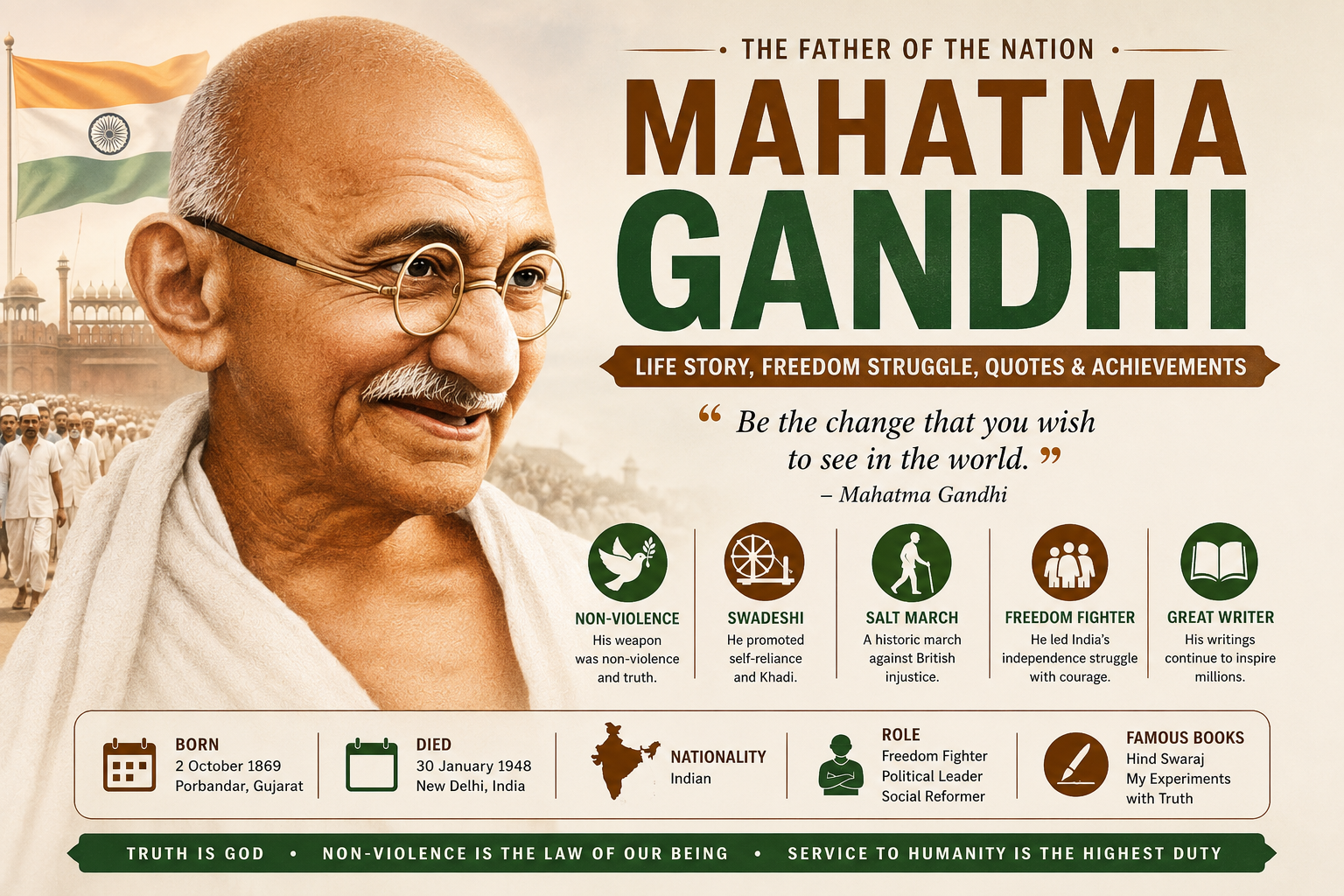
Mahatma Gandhi
Mahatma Gandhi (1869–1948), born as Mohandas Karamchand Gandhi, was one of the greatest leaders in world history and the driving force behind India's independence movement. Known as the Father of the Nation, Gandhi pioneered the principles of Truth (Satya) and Non-Violence (Ahimsa), which became the foundation of India's struggle against British rule. After studying law in London and fighting racial discrimination in South Africa, he returned to India and led historic movements such as the Non-Cooperation Movement, Salt March, Civil Disobedience Movement, and Quit India Movement. Gandhi inspired millions through his simple lifestyle, moral courage, and commitment to justice. His philosophy of Satyagraha influenced global leaders like Martin Luther King Jr. and Nelson Mandela. Through his writings, speeches, and actions, Gandhi promoted peace, equality, self-reliance, and social reform. His legacy continues to inspire people worldwide to pursue truth, compassion, and positive change.
Profession:
Freedom Leader
Nationality:
Indian
Born:
1869
Died:
1948
Introduction
Mahatma Gandhi, popularly known as the Father of the Nation, was one of the most influential leaders in world history. His philosophy of truth (Satya) and non-violence (Ahimsa) transformed India's freedom struggle and inspired civil rights movements across the globe.
Born as Mohandas Karamchand Gandhi on October 2, 1869, Gandhi dedicated his life to justice, equality, human dignity, and national independence. Through peaceful resistance, moral courage, and unwavering commitment to truth, he led millions of Indians against British colonial rule without advocating violence.
Today, Mahatma Gandhi remains a symbol of peace, simplicity, leadership, and moral strength whose teachings continue to inspire people worldwide.
Birth and Family Background
Mohandas Karamchand Gandhi was born on October 2, 1869, in Porbandar, Gujarat, India.
His father, Karamchand Gandhi, served as the Chief Minister (Diwan) of Porbandar State.
His mother, Putlibai Gandhi, was deeply religious and greatly influenced Gandhi's character.
She taught him:
- Honesty
- Compassion
- Discipline
- Self-control
- Spirituality
These values remained with Gandhi throughout his life.
Childhood and Early Influences
As a child, Gandhi was shy and quiet.
Unlike many future leaders, he was not known for exceptional academic brilliance or public speaking skills during his school years.
However, he possessed:
- Strong moral values
- Honesty
- Curiosity
- Sensitivity toward others
- Stories from Indian epics such as:
- Ramayana
- Mahabharata
- Harishchandra deeply influenced him.
The story of King Harishchandra's commitment to truth especially left a lasting impression.
Education
Gandhi completed his early schooling in Rajkot.
In 1887, he passed his matriculation examination and joined Samaldas College in Bhavnagar.
However, he found college education challenging and uninspiring.
His family later decided to send him to England to study law.
Journey to England
In 1888, Gandhi traveled to London to pursue legal studies.
At that time, crossing the sea was controversial in traditional Indian society.
Despite opposition from some community members, Gandhi remained determined.
Before leaving India, he promised his mother that he would:
- Avoid alcohol
- Avoid meat
- Maintain moral discipline
He faithfully kept these promises.
Life in London
Life in England exposed Gandhi to new cultures and ideas.
Initially, he struggled to adapt.
He experimented with:
- Western clothing
- Etiquette
- Social customs
However, he soon realized that true self-respect comes from authenticity rather than imitation.
During his years in London, Gandhi developed interests in:
- Religion
- Philosophy
- Ethics
- Literature
- He read:
- The Bhagavad Gita
- The Bible
- Works of Tolstoy
- Philosophical writings
These texts significantly shaped his worldview.
Becoming a Lawyer
In 1891, Gandhi completed his legal studies and returned to India as a qualified barrister.
However, establishing a successful law practice proved difficult.
He lacked confidence in courtroom advocacy and struggled to find clients.
This period taught him humility and perseverance.
Soon, an unexpected opportunity would change his life forever.
Journey to South Africa
In 1893, Gandhi accepted a legal assignment in South Africa.
The contract was supposed to last only one year.
Instead, it transformed him into a global leader.
South Africa at that time practiced severe racial discrimination.
Indians and Africans faced widespread injustice.
Soon after arriving, Gandhi personally experienced racism.
The Train Incident
One of the most famous events in Gandhi's life occurred at Pietermaritzburg railway station.
Despite holding a valid first-class ticket, he was ordered to move because of his race.
When he refused, he was forcibly thrown off the train.
That cold night became a turning point.
Instead of returning to India, Gandhi decided to fight injustice.
This moment marked the birth of his lifelong commitment to civil rights.
Fighting Discrimination
Gandhi soon realized that racial discrimination affected thousands of Indians living in South Africa.
They faced:
- Unfair laws
- Restricted rights
- Social discrimination
- Economic exploitation
He began organizing the Indian community and advocating for equal treatment.
His efforts earned respect among Indians and attention from authorities.
Birth of Satyagraha
During his struggle in South Africa, Gandhi developed a revolutionary philosophy called:
Satyagraha
The word means:
"Truth Force" or "Soul Force"
Satyagraha emphasized:
- Non-violence
- Truth
- Moral courage
- Civil resistance
Instead of attacking opponents, Gandhi encouraged people to resist injustice peacefully.
This idea would later become the foundation of India's freedom movement.
Early Successes
Through peaceful campaigns, Gandhi successfully challenged several discriminatory policies.
His leadership united people from different:
- Religions
- Languages
- Social backgrounds
These victories strengthened his belief in non-violent resistance.
Spiritual Development
South Africa also became a period of profound spiritual growth.
Gandhi deepened his understanding of:
- Hinduism
- Christianity
- Islam
- Jainism
- Buddhism
He concluded that all religions contain valuable truths.
This belief shaped his lifelong commitment to religious harmony.
Simplicity and Self-Discipline
During this period, Gandhi adopted a simpler lifestyle.
He practiced:
- Self-restraint
- Simplicity
- Fasting
- Meditation
- Service
He believed personal transformation was essential before attempting to change society.
Emergence of a Leader
By the time Gandhi left South Africa in 1915, he had transformed from a shy lawyer into a respected leader.
He had:
- Developed Satyagraha
- Organized mass movements
- Fought racial discrimination
- Inspired thousands
Most importantly, he had discovered the methods that would later help India achieve independence.
Return to India (1915)
After spending over two decades fighting racial discrimination in South Africa, Mahatma Gandhi returned to India in January 1915.
He was welcomed as a respected leader who had successfully challenged injustice through peaceful resistance.
However, Gandhi did not immediately enter politics.
Instead, he traveled extensively across India to understand the country's realities.
He wanted to see firsthand:
- The condition of farmers
- Poverty levels
- Social inequalities
- British oppression
- Rural life
These journeys convinced him that India needed both political freedom and social reform.
Meeting Gopal Krishna Gokhale
One of Gandhi's most important mentors in India was Gopal Krishna Gokhale.
Gokhale advised Gandhi to spend time understanding India before taking leadership roles.
Gandhi followed this advice seriously.
The lessons learned during this period helped shape his future leadership style.
Establishment of Sabarmati Ashram
In 1917, Gandhi established the Sabarmati Ashram near Ahmedabad.
The Ashram became a center for:
- Spiritual discipline
- Education
- Social reform
- National service
Residents followed principles such as:
- Truth
- Non-violence
- Simplicity
- Self-reliance
- Equality
The Ashram later became the headquarters of many national movements.
Champaran Satyagraha (1917)
Gandhi's first major success in India came through the Champaran Movement in Bihar.
Farmers were being forced by British landlords to grow indigo under exploitative conditions.
They suffered:
- Low income
- Heavy taxes
- Harsh treatment
Gandhi investigated their problems and launched a peaceful protest.
The British government eventually accepted many farmer demands.
This victory established Gandhi as a national leader.
Kheda Satyagraha (1918)
Soon after Champaran, Gandhi led another movement in Kheda, Gujarat.
Farmers faced severe crop failures and could not pay taxes.
Despite their suffering, British authorities demanded full tax payments.
Gandhi organized non-violent resistance.
The government eventually suspended tax collection and provided relief.
This success further increased public trust in Gandhi.
Ahmedabad Mill Workers Strike
Gandhi also supported industrial workers.
In Ahmedabad, textile workers demanded fair wages.
Using fasting and peaceful negotiation, Gandhi helped secure better conditions.
This movement demonstrated that Satyagraha could address labor disputes as well as political issues.
Rise as National Leader
By 1920, Gandhi had become the most influential leader in India.
His message resonated with millions because he spoke the language of ordinary people.
He emphasized:
- Self-reliance
- Truth
- Unity
- Non-violence
- National pride
For the first time, India's freedom struggle became a mass movement involving farmers, workers, students, and women.
Non-Cooperation Movement (1920)
One of Gandhi's most important campaigns was the Non-Cooperation Movement.
He urged Indians to peacefully withdraw support from British institutions.
People were encouraged to:
- Boycott foreign goods
- Leave government jobs
- Avoid British schools
- Reject British honors
- Support local industries
The movement spread rapidly across India.
Millions participated.
Promotion of Khadi and Swadeshi
Gandhi believed political independence required economic self-reliance.
He encouraged Indians to wear:
Khadi
Hand-spun and handwoven cloth.
The spinning wheel became a symbol of India's freedom movement.
By producing their own clothing, Indians could reduce dependence on British imports.
The Swadeshi movement promoted:
- Local production
- Rural employment
- Economic empowerment
Chauri Chaura Incident
In 1922, a violent incident occurred in Chauri Chaura, Uttar Pradesh.
Protesters clashed with police and several officers were killed.
Although Gandhi had not encouraged violence, he believed the movement had deviated from non-violent principles.
He made the controversial decision to suspend the Non-Cooperation Movement.
Many supporters were disappointed.
However, Gandhi remained committed to Ahimsa.
Gandhi's Imprisonment
British authorities viewed Gandhi as a threat.
In 1922, he was arrested and sentenced to prison.
Even behind bars, his influence continued to grow.
People increasingly viewed him as the moral leader of the nation.
Campaign Against Untouchability
Beyond political freedom, Gandhi sought social reform.
One of his major campaigns targeted untouchability.
He believed discrimination based on caste was morally wrong.
He referred to marginalized communities as:
Harijans
Meaning "Children of God."
He worked tirelessly to promote:
- Equality
- Dignity
- Social inclusion
The Salt March (1930)
One of Gandhi's most famous movements was the Salt Satyagraha.
The British government imposed taxes on salt, an essential item used by every citizen.
Gandhi viewed this tax as unjust.
In March 1930, he began a 240-mile march from Sabarmati Ashram to Dandi.
Thousands joined him.
When he reached the coast, Gandhi symbolically produced salt from seawater.
This simple act challenged British authority.
Impact of the Salt March
The Salt March captured international attention.
Newspapers around the world reported the event.
The movement inspired:
- Mass protests
- Civil disobedience
- National unity
Millions of Indians participated.
The Salt March became one of the most successful non-violent protests in history.
Round Table Conferences
During the early 1930s, Gandhi participated in discussions with British leaders regarding India's future.
He attended the Round Table Conference in London.
Although immediate progress was limited, Gandhi continued advocating peaceful negotiations.
Civil Disobedience Movement
The Salt March evolved into a broader Civil Disobedience Movement.
Participants:
- Refused taxes
- Boycotted British goods
- Defied unjust laws
The British government responded with arrests.
Thousands were imprisoned, including Gandhi.
Yet the movement strengthened India's determination for freedom.
Gandhi and National Unity
Gandhi consistently emphasized unity among:
- Hindus
- Muslims
- Sikhs
- Christians
- Other communities
He believed independence could only succeed if Indians stood together.
Religious harmony became a central part of his mission.
Quit India Movement (1942)
During World War II, Gandhi launched one of his most powerful campaigns:
Quit India Movement
On August 8, 1942, he issued the famous call:
"Do or Die."
The movement demanded immediate British withdrawal from India.
The British government responded harshly.
Gandhi and many leaders were arrested.
Despite repression, the movement intensified public pressure for independence.
International Influence
By the 1940s, Gandhi had become one of the world's most recognized leaders.
His philosophy inspired people globally.
Many admired his commitment to:
- Peace
- Justice
- Human rights
- Non-violence
Leaders and intellectuals around the world followed his work closely.
Road to Independence
Following World War II, Britain faced increasing pressure.
Years of non-violent resistance had weakened colonial control.
Negotiations accelerated.
Eventually, the British government agreed to transfer power.
On August 15, 1947, India achieved independence.
For millions of Indians, Gandhi's leadership had made freedom possible.
Gandhi's Reaction to Independence
Although India became free, Gandhi was deeply saddened by the partition of India and Pakistan.
Violence erupted in several regions.
Rather than celebrating, Gandhi focused on restoring peace and harmony.
He traveled tirelessly, urging people to reject hatred and violence.
Personal Life of Mahatma Gandhi
Despite becoming one of the most influential leaders in history, Mahatma Gandhi lived an extraordinarily simple life.
He believed that leaders should live like the people they serve.
Throughout his life, Gandhi practiced:
- Simplicity
- Self-discipline
- Truthfulness
- Self-control
- Service
He wore simple hand-spun Khadi clothing and owned very few possessions.
His lifestyle reflected his belief that happiness comes from character and purpose rather than material wealth.
Marriage and Family
At the age of 13, Gandhi married Kasturba Gandhi.
Like many marriages of that era, it was arranged by their families.
Over time, Kasturba became one of Gandhi's strongest supporters.
The couple had four sons:
- Harilal Gandhi
- Manilal Gandhi
- Ramdas Gandhi
- Devdas Gandhi
Although Gandhi loved his family, his public responsibilities often required long periods away from home.
Kasturba remained actively involved in many social and political movements.
Philosophy of Truth (Satya)
Truth was the foundation of Gandhi's entire life.
He believed:
"Truth is God."
According to Gandhi, truth was not merely speaking honestly.
It meant:
- Living honestly
- Acting honestly
- Thinking honestly
He constantly examined his own actions and admitted mistakes whenever necessary.
His commitment to truth became the basis of his political and spiritual philosophy.
Philosophy of Non-Violence (Ahimsa)
Gandhi's most famous principle was:
Ahimsa (Non-Violence)
He believed violence creates more violence.
Instead of defeating opponents through force, Gandhi encouraged people to transform them through:
- Love
- Compassion
- Moral courage
- Understanding
His philosophy demonstrated that peaceful resistance could defeat powerful systems of oppression.
Satyagraha: The Power of Truth
Gandhi developed the concept of:
Satyagraha
Meaning:
"Truth Force"
or
"Soul Force"
Satyagraha required:
- Non-violence
- Discipline
- Courage
- Self-sacrifice
Rather than attacking enemies, practitioners peacefully resisted injustice.
This method became one of the most powerful tools in modern political history.
Gandhi's Views on Education
Gandhi believed education should prepare individuals for life rather than merely jobs.
He advocated:
- Character building
- Practical skills
- Moral values
- Self-reliance
His educational philosophy emphasized learning through experience and service.
He wanted education to create responsible citizens capable of contributing to society.
Gandhi's Views on Religion
Gandhi deeply respected all religions.
He regularly studied:
- Hinduism
- Christianity
- Islam
- Buddhism
- Jainism
He believed every religion contains valuable truths.
According to Gandhi:
"All religions are different roads converging to the same point."
This message of religious harmony remains relevant today.
Gandhi's Views on Women
Gandhi strongly supported women's participation in society and public life.
He believed women possessed:
- Moral strength
- Courage
- Leadership abilities
Thousands of women joined India's freedom movement because of Gandhi's encouragement.
He advocated:
- Education for women
- Equal dignity
- Social reform
Books Written by Mahatma Gandhi
Gandhi was also a prolific writer.
His writings continue inspiring readers worldwide.
The Story of My Experiments with Truth
This is Gandhi's autobiography.
It describes:
- Childhood
- Education
- Spiritual growth
- Political struggles
- Personal lessons
It remains one of the most influential autobiographies ever written.
Hind Swaraj
Written in 1909.
The book discusses:
- Freedom
- Civilization
- Self-rule
- National development
It remains a foundational text in Gandhi's philosophy.
Satyagraha in South Africa
This work explains the origins and development of Satyagraha.
It details Gandhi's experiences fighting racial discrimination.
Key to Health
A practical guide on:
- Diet
- Health
- Simplicity
- Natural living
Constructive Programme
This book outlines Gandhi's vision for social transformation and nation-building.
Assassination of Mahatma Gandhi
Following India's independence, Gandhi devoted himself to promoting peace between communities.
However, tensions remained high after Partition.
On January 30, 1948, Gandhi was assassinated in New Delhi while attending a prayer meeting.
He was 78 years old.
His death shocked India and the world.
Millions mourned the loss of a leader who had dedicated his life to peace and justice.
Global Influence
Gandhi's ideas influenced numerous leaders, including:
- Martin Luther King Jr.
- Nelson Mandela
- Dalai Lama
- Cesar Chavez
- Aung San Suu Kyi
His philosophy continues inspiring movements for:
- Civil rights
- Human rights
- Peace
- Social justice
Final Thoughts
Mahatma Gandhi's journey from a shy young boy in Porbandar to one of the most influential leaders in human history is a story of courage, conviction, and moral strength.
Through truth, non-violence, and unwavering determination, he helped liberate a nation and inspired generations worldwide.
His life proves that real power comes not from force but from character, integrity, and service to humanity.
His timeless message continues to guide millions:
"Be the change that you wish to see in the world."
That philosophy ensures Mahatma Gandhi's place among the greatest leaders the world has ever known.
Major Achievements
Major Achievements of Mahatma Gandhi
Leader of India's Freedom Movement
Gandhi transformed India's struggle into a mass movement involving millions.
Development of Satyagraha
Created a new method of peaceful resistance used worldwide.
Salt March
Led one of the most influential protests in modern history.
Promotion of Non-Violence
Demonstrated that peaceful action can achieve political change.
Social Reform
Worked against:
Untouchability
Discrimination
Poverty
Social injustice
Global Inspiration
Inspired civil rights leaders around the world.
Life Lessons from Mahatma Gandhi
Leadership Lessons from Gandhi
Lead by Example
Gandhi practiced what he preached.
Stay True to Your Values
He never compromised his core principles.
Serve Others
Leadership begins with service.
Remain Humble
Despite global fame, Gandhi remained simple.
Be Fearless
He confronted powerful governments without fear.
Focus on Long-Term Goals
He understood that meaningful change requires patience.
Famous Quotes
Famous Quotes of Mahatma Gandhi
"Be the change that you wish to see in the world."
"An eye for an eye will only make the whole world blind."
"The future depends on what you do today."
"Strength does not come from physical capacity. It comes from an indomitable will."
"Live as if you were to die tomorrow. Learn as if you were to live forever."
"Happiness is when what you think, what you say, and what you do are in harmony."
"Freedom is not worth having if it does not include the freedom to make mistakes."
"In a gentle way, you can shake the world."
Interesting Facts
Interesting Facts About Mahatma Gandhi
Gandhi Was a Lawyer
He studied law in London before becoming a political leader.
He Was Nominated for the Nobel Peace Prize Multiple Times
Although never awarded, he remains one of history's most respected peace advocates.
He Inspired Martin Luther King Jr.
King adopted Gandhi's philosophy of non-violent resistance.
He Inspired Nelson Mandela
Mandela applied many Gandhian principles in South Africa.
He Walked Thousands of Miles
Many campaigns involved extensive journeys on foot.
He Preferred Simplicity
His possessions were remarkably few.
His Birthday Is Celebrated Worldwide
October 2 is observed as:
International Day of Non-Violence
by the United Nations.
Legacy
Mahatma Gandhi's legacy extends far beyond India's independence.
He remains a symbol of:
Truth
Non-violence
Courage
Leadership
Service
His teachings continue influencing politics, education, spirituality, and social activism around the world.
Institutions, roads, universities, and memorials across many countries honor his contributions.
More importantly, his ideas remain alive in those who strive for justice through peaceful means.
Frequently Asked Questions
Mahatma Gandhi was an Indian freedom fighter, political leader, and social reformer who led India's struggle for independence through non-violent resistance and truth-based activism.
Mahatma Gandhi's real name was Mohandas Karamchand Gandhi.
Mahatma Gandhi was born on October 2, 1869, in Porbandar, Gujarat, India.
He is called the Father of the Nation because of his leadership role in India's independence movement and his influence on millions of Indians through non-violence and truth.
Mahatma Gandhi is famous for leading India's freedom struggle, promoting non-violence (Ahimsa), developing Satyagraha, and inspiring peaceful resistance movements around the world.
Satyagraha is Gandhi's philosophy of non-violent resistance based on truth, moral courage, and peaceful civil disobedience.
The Salt March was a historic protest led by Gandhi in 1930 against the British salt tax. He marched approximately 240 miles from Sabarmati Ashram to Dandi to make salt as an act of civil disobedience.
His main principles included:
Some of Gandhi's most famous books include:
Gandhi inspired global leaders such as Martin Luther King Jr., Nelson Mandela, and the Dalai Lama through his philosophy of peaceful resistance and social justice.
India gained independence from British rule on August 15, 1947, after decades of struggle in which Gandhi played a central role.
Mahatma Gandhi was assassinated on January 30, 1948, in New Delhi, India.
Some famous quotes include:
"An eye for an eye will only make the whole world blind."
What can we learn from Mahatma Gandhi's life?
Honesty
Leadership
Courage
Patience
Self-Discipline
Non-Violence
Service to Society
Integrity
Perseverance
Moral Responsibility
Why is Mahatma Gandhi still relevant today?