Steve Jobs
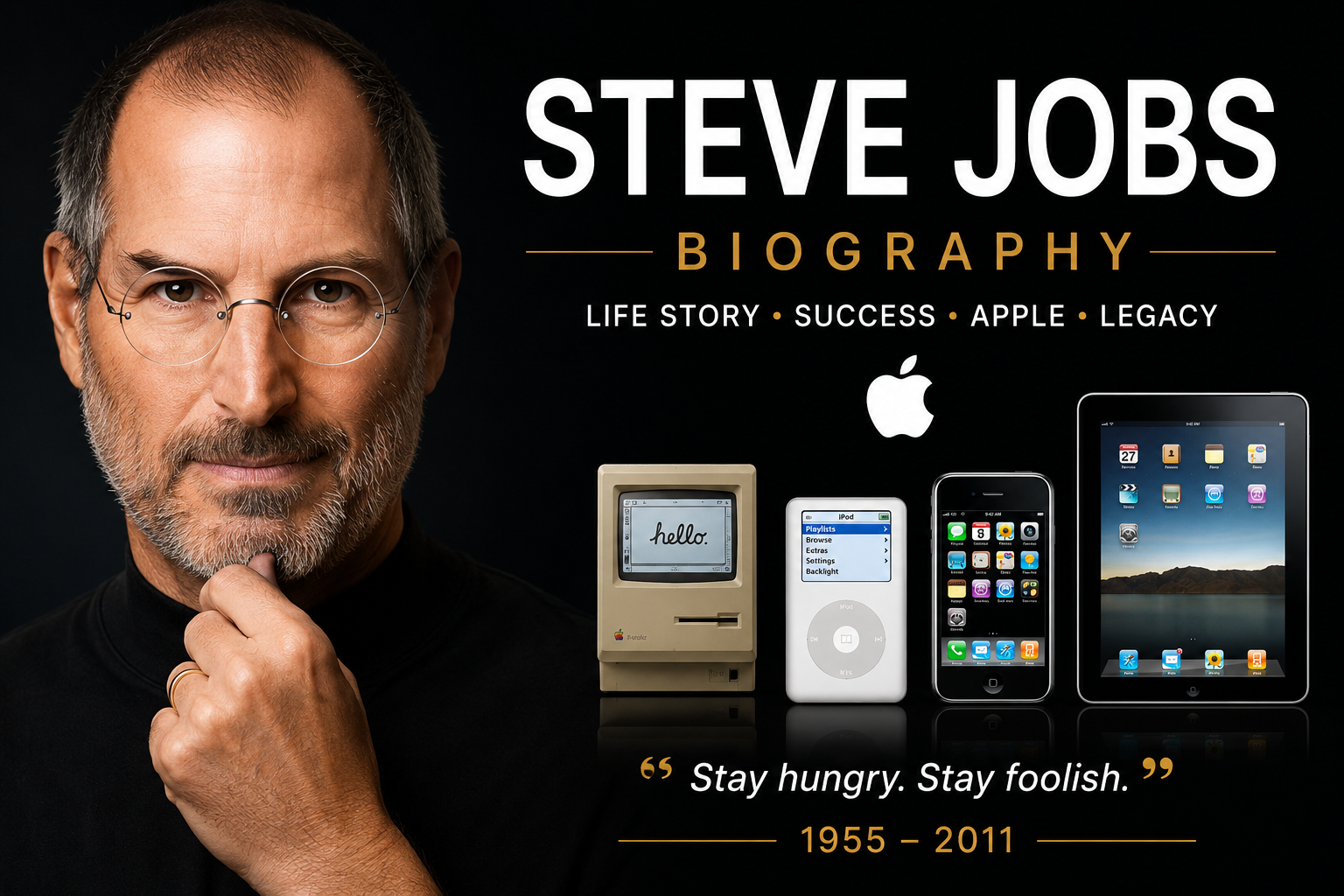
Steve Jobs was an American entrepreneur, inventor, and co-founder of Apple Inc. He is widely regarded as one of the greatest innovators in modern history. Through revolutionary products such as the Macintosh, iPod, iPhone, and iPad, Jobs transformed technology, communication, and entertainment. His vision, creativity, and relentless pursuit of excellence made Apple one of the world's most valuable companies and inspired generations of entrepreneurs.
Profession:
Entrepreneur, Inventor, Businessman, Co-Founder of Apple Inc.
Nationality:
American
Born:
1955
Died:
2011
Introduction
Steve Jobs was one of the most influential entrepreneurs, innovators, and business leaders in history. Known as the co-founder of Apple Inc., Jobs revolutionized personal computing, smartphones, digital music, animation, and technology design. His journey from a college dropout to the creator of some of the world's most successful products has inspired millions of people worldwide.
When people search for terms like Steve Jobs biography, Steve Jobs success story, Steve Jobs life story, Steve Jobs achievements, Steve Jobs Apple founder, and Steve Jobs inspirational journey, they are looking for the remarkable story of a man who changed the way humans communicate, work, learn, and entertain themselves.
Steve Jobs was not just a businessman. He was a visionary who believed technology should be simple, beautiful, and accessible to everyone. His commitment to innovation and excellence transformed Apple into one of the most valuable companies in the world.
This biography explores Steve Jobs' early life, education, challenges, successes, leadership style, inventions, lessons, quotes, and lasting legacy.
Early Life of Steve Jobs
Steve Jobs was born on February 24, 1955, in San Francisco, California, United States.
His biological parents were:
- Abdulfattah Jandali
- Joanne Schieble
Due to personal circumstances, they decided to place Steve for adoption shortly after his birth.
Steve was adopted by:
- Paul Jobs
- Clara Jobs
The couple lived in Mountain View, California, an area that would later become famous as Silicon Valley.
Steve often credited his adoptive parents for giving him a stable and supportive childhood.
His father, Paul Jobs, was a mechanic and craftsman who taught Steve how to work with his hands and appreciate quality workmanship.
Years later, Steve said that his father's attention to detail influenced the way he designed Apple products.
Childhood Curiosity and Intelligence
From an early age, Steve Jobs displayed exceptional curiosity.
He enjoyed:
- Electronics
- Technology
- Engineering
- Design
- Reading
Growing up in Silicon Valley exposed him to engineers and inventors who were working on groundbreaking technologies.
Many of his neighbors worked in technology companies.
Steve frequently attended technology gatherings and became fascinated by computers.
His natural curiosity helped him learn concepts far beyond what was taught in school.
School Life
Steve attended Homestead High School in Cupertino, California.
During high school, he developed a strong interest in electronics.
One of the most important events of his teenage years was meeting a young engineering genius named:
Steve Wozniak
Wozniak was five years older than Jobs.
Despite the age difference, the two quickly became friends because they shared similar interests:
- Electronics
- Computers
- Innovation
- Experimentation
This friendship would eventually change the technology industry forever.
Steve Jobs and Steve Wozniak
The partnership between Steve Jobs and Steve Wozniak became one of the most famous collaborations in business history.
While Wozniak was an engineering genius capable of building incredible technology, Jobs possessed extraordinary vision, marketing skills, and product intuition.
Together, they complemented each other perfectly.
Jobs could see how technology could change people's lives.
Wozniak knew how to build it.
This combination would eventually lead to the creation of Apple.
College and Dropping Out
After graduating from high school, Steve Jobs enrolled at Reed College in Portland, Oregon.
However, college was expensive.
Jobs struggled to find meaning in many of the required courses.
After only six months, he officially dropped out.
At first glance, this appeared to be a failure.
However, dropping out allowed him to attend classes that genuinely interested him.
One of these classes would have an enormous impact on Apple's future.
The Famous Calligraphy Class
After dropping out, Jobs attended a calligraphy course.
The class taught:
- Typography
- Fonts
- Letter spacing
- Design principles
At the time, he had no practical reason for learning these skills.
Years later, when Apple created the Macintosh computer, Jobs used the lessons from calligraphy to introduce beautiful typography into personal computing.
This decision transformed computer design forever.
Most computers before Macintosh had plain and unattractive text.
Macintosh introduced elegant fonts and visual design that inspired the entire technology industry.
Jobs later said:
"You can't connect the dots looking forward; you can only connect them looking backward."
This became one of his most famous life lessons.
Spiritual Journey and Search for Meaning
In his early twenties, Steve Jobs became deeply interested in spirituality and self-discovery.
He explored:
- Meditation
- Philosophy
- Buddhism
- Eastern culture
In 1974, he traveled to India seeking spiritual enlightenment.
The journey profoundly influenced his thinking.
During his time in India, Jobs learned:
- Simplicity
- Mindfulness
- Focus
- Minimalism
These principles later shaped Apple's design philosophy.
Many Apple products reflected Jobs' belief that simplicity creates beauty.
Working at Atari
Before founding Apple, Jobs worked for Atari, a leading video game company.
At Atari, he gained practical experience in:
- Product development
- Engineering environments
- Business operations
Although Jobs was talented, he often challenged authority and preferred unconventional approaches.
Even during his early career, he demonstrated characteristics that would later define him:
- Confidence
- Creativity
- Vision
- Perfectionism
The Beginning of Apple
In 1976, Steve Jobs and Steve Wozniak decided to start their own company.
Their goal was ambitious:
To make computers accessible to ordinary people.
At that time, computers were large, expensive, and primarily used by businesses and researchers.
Jobs believed computers could become personal tools for everyone.
To fund the business:
- Jobs sold his Volkswagen van.
- Wozniak sold his calculator.
Together, they raised enough money to start building computers.
They founded:
Apple Computer Company
The company began in the Jobs family garage.
What started in a small garage would eventually become one of the most valuable companies in human history.
The Apple I
The first product created by Apple was:
Apple I
Designed primarily by Steve Wozniak, the Apple I was revolutionary for its time.
Unlike many competing systems, it was easier to use and more practical.
Jobs convinced local computer stores to purchase the machines.
His salesmanship and belief in the product helped Apple secure its first customers.
The Apple I marked the beginning of a technological revolution.
The Launch of Apple II
Following the success of Apple I, Apple introduced:
Apple II
This product became a massive commercial success.
Apple II offered:
- Color graphics
- User-friendly design
- Greater functionality
It became one of the first highly successful personal computers.
Sales exploded.
Apple quickly transformed from a small startup into a rapidly growing technology company.
For Steve Jobs, this was only the beginning.
His vision extended far beyond personal computers.
He wanted to create products that would change the world.
Apple's Explosive Growth
The success of Apple II transformed Apple Computer from a small garage startup into one of the fastest-growing technology companies in America.
By the late 1970s, Apple was generating millions of dollars in revenue.
Investors, customers, and technology experts began recognizing Apple's enormous potential.
Steve Jobs, still in his twenties, had become one of the most talked-about entrepreneurs in Silicon Valley.
However, Jobs was not satisfied with Apple's early success.
He believed the future of computing would be much bigger than anyone imagined.
His vision was to create computers that were:
- Easy to use
- Beautifully designed
- Powerful enough for ordinary people
- Accessible to millions
This vision led him toward his next revolutionary project.
Steve Jobs Visits Xerox PARC
One of the most important moments in Steve Jobs' career occurred when he visited Xerox PARC (Palo Alto Research Center).
During this visit, Jobs saw technologies that would shape the future of computing:
Graphical User Interface (GUI)
Instead of typing commands, users could interact with icons and windows.
Computer Mouse
A device that allowed people to point and click rather than memorize complex commands.
Jobs immediately recognized the potential of these innovations.
While many people saw them as interesting experiments, Jobs saw the future.
He famously said that it was one of the most important experiences of his life.
The visit inspired Apple to build a new generation of computers.
The Macintosh Project
Steve Jobs became deeply involved in the development of a revolutionary computer called:
Macintosh
The Macintosh project represented Jobs' vision of technology for everyone.
He wanted to create a machine that was:
- Simple
- Friendly
- Elegant
- Easy to learn
Jobs pushed his team relentlessly.
He demanded perfection in:
- Hardware
- Software
- Design
- Packaging
- User experience
Many employees found his standards extremely challenging.
However, those same standards helped create one of the most important products in technology history.
The Famous 1984 Super Bowl Advertisement
In January 1984, Apple launched one of the most famous advertisements ever created.
The commercial aired during the Super Bowl.
Directed by Ridley Scott, the advertisement portrayed Apple as a company challenging conformity and empowering individuals.
The commercial generated enormous attention worldwide.
Many marketing experts still consider it one of the greatest advertisements ever produced.
The ad introduced the world to:
Apple Macintosh
The Macintosh changed the computer industry forever.
Macintosh Revolutionizes Personal Computing
The Macintosh introduced features that later became standard across the technology industry:
Graphical User Interface
Mouse Navigation
Beautiful Typography
User-Friendly Design
Visual Computing
For the first time, computers became accessible to people without technical expertise.
The Macintosh influenced future versions of:
- Microsoft Windows
- Personal computers
- Smartphones
- Tablets
Today, many features we take for granted originated from concepts popularized by Macintosh.
Steve Jobs' Leadership Style
Steve Jobs became famous for his unique leadership style.
He was known for being:
Visionary
He could see opportunities long before others.
Demanding
He expected excellence from everyone around him.
Passionate
He cared deeply about every product.
Perfectionist
He believed even hidden parts should be beautifully designed.
Innovative
He constantly challenged conventional thinking.
Jobs often pushed teams beyond what they believed was possible.
Many employees described working with him as difficult but transformational.
His ability to inspire extraordinary performance became legendary.
Challenges Inside Apple
As Apple continued growing, internal conflicts began emerging.
The company was no longer a small startup.
It had become a large corporation with:
- Investors
- Executives
- Board members
- Thousands of employees
Managing rapid growth created tension.
Some executives believed Jobs was too aggressive and unpredictable.
Others believed his leadership was essential to Apple's future.
The disagreements gradually intensified.
John Sculley Joins Apple
In 1983, Steve Jobs recruited John Sculley from PepsiCo.
Jobs famously asked him:
"Do you want to sell sugar water for the rest of your life, or do you want to come with me and change the world?"
Inspired by Jobs' vision, Sculley joined Apple as CEO.
Initially, the partnership appeared promising.
However, major conflicts eventually developed between the two leaders.
Power Struggles at Apple
By 1985, disagreements regarding Apple's direction became severe.
Sales challenges and management conflicts increased pressure inside the company.
The Apple board ultimately sided with Sculley.
As a result:
Steve Jobs Lost Control of Apple
At only 30 years old, Jobs was effectively forced out of the company he had founded.
For many people, this would have been the end.
For Jobs, it became the beginning of an even greater journey.
The Pain of Leaving Apple
Being removed from Apple was devastating.
Jobs later admitted that he felt:
- Humiliated
- Depressed
- Lost
- Disappointed
He believed he had failed publicly.
The company he helped build had rejected him.
Yet this difficult experience taught him one of life's greatest lessons:
Sometimes failure creates opportunities for new success.
Years later, Jobs described being fired from Apple as one of the best things that ever happened to him.
Starting NeXT
After leaving Apple, Steve Jobs founded a new company:
NeXT
NeXT focused on creating advanced computers for:
- Universities
- Researchers
- Developers
Although NeXT computers were not massive commercial successes, the company developed powerful technologies.
The software created at NeXT would later play a crucial role in Apple's future.
Jobs continued learning and refining his leadership skills.
His experiences at NeXT helped him mature as an entrepreneur.
The Birth of Pixar
In 1986, Jobs purchased a small graphics division from Lucasfilm.
He renamed the company:
Pixar
At the time, few people believed computer animation could become a major industry.
Jobs saw enormous potential.
He invested millions of dollars into Pixar despite years of financial losses.
Many people thought he was making a mistake.
However, Jobs remained patient.
His belief in creativity and innovation never wavered.
Pixar Creates History
After years of effort, Pixar achieved a breakthrough.
In 1995, Pixar released:
Toy Story
Toy Story became:
- The world's first fully computer-animated feature film
- A huge commercial success
- A critical masterpiece
The movie transformed the entertainment industry.
Pixar went on to create numerous classics, including:
- Finding Nemo
- Monsters Inc.
- Cars
- The Incredibles
- Up
Steve Jobs became Pixar's largest shareholder and one of Hollywood's most successful businessmen.
A New Beginning
By the mid-1990s:
- Apple was struggling.
- NeXT possessed advanced software.
- Pixar was thriving.
Few people realized that these developments were setting the stage for one of the greatest business comebacks in history.
The man who had once been forced out of Apple was about to return.
And when Steve Jobs returned, he would transform Apple into the most influential technology company on Earth.
Steve Jobs Returns to Apple
By the mid-1990s, Apple was facing serious problems.
The company that had once revolutionized personal computing was now struggling.
Apple suffered from:
- Declining sales
- Poor product strategy
- Lack of innovation
- Strong competition from Microsoft
Many industry experts believed Apple was heading toward failure.
Meanwhile, Steve Jobs' company NeXT had developed advanced operating system technology.
In 1996, Apple decided to purchase NeXT for approximately $429 million.
This decision brought Steve Jobs back to Apple.
At first, he returned as an advisor.
Soon, his influence began growing.
Within a short period, Jobs became Apple's leader once again.
The comeback of Steve Jobs is considered one of the greatest business comebacks in history.
Restructuring Apple
When Jobs returned, he discovered Apple was producing too many confusing products.
The company lacked focus.
Jobs made difficult decisions.
He simplified Apple's product lineup dramatically.
Instead of dozens of products, Apple would focus on creating only a few exceptional ones.
His philosophy was simple:
"Focus is about saying no."
Jobs believed that eliminating distractions was essential for success.
This strategy became one of the foundations of Apple's future growth.
The Launch of iMac
In 1998, Apple introduced:
iMac
The iMac represented a completely new approach to personal computers.
It featured:
- Modern design
- Bright colors
- Simplicity
- Internet connectivity
The product immediately attracted attention.
Consumers loved its appearance and ease of use.
The iMac became a massive success and helped restore Apple's reputation.
For the first time in years, Apple was growing again.
Jobs had proven that great design could be a competitive advantage.
The Importance of Design
Steve Jobs believed design was much more than appearance.
He often said:
"Design is not just what it looks like and feels like. Design is how it works."
This philosophy influenced every Apple product.
Jobs insisted that technology should be:
- Beautiful
- Functional
- Intuitive
- Simple
Apple's obsession with design helped differentiate it from competitors.
Today, companies worldwide follow principles that Jobs helped popularize.
The Digital Music Revolution
In the early 2000s, digital music was becoming increasingly popular.
However, listening to music digitally was often frustrating.
Most devices were difficult to use.
Steve Jobs saw an opportunity.
He envisioned a product that would allow people to carry their entire music collection in their pockets.
This vision led to the creation of:
iPod
The Launch of iPod
In 2001, Apple introduced the iPod.
The device was simple yet revolutionary.
Its famous promise was:
"1,000 songs in your pocket."
The iPod offered:
- Easy navigation
- Large storage capacity
- Elegant design
- Excellent user experience
Consumers loved it.
Sales grew rapidly.
The iPod became one of the most successful consumer electronics products in history.
iTunes Changes the Music Industry
Steve Jobs understood that hardware alone was not enough.
People also needed a convenient way to purchase music.
Apple launched:
iTunes Store
The service allowed users to legally buy individual songs online.
This transformed the music industry.
Before iTunes:
- Music piracy was widespread.
- Buying digital music was complicated.
After iTunes:
- Music became easier to purchase.
- Artists reached global audiences.
- Consumers enjoyed a better experience.
Jobs once again changed an entire industry.
Apple Stores
Another important innovation was the creation of:
Apple Retail Stores
Many experts believed Apple stores would fail.
They argued that technology companies should not operate retail stores.
Jobs disagreed.
He wanted customers to experience Apple products directly.
Apple Stores focused on:
- Product demonstrations
- Customer education
- Exceptional service
The stores became incredibly successful and are now among the most profitable retail locations in the world.
The Vision for a Smartphone
By the mid-2000s, mobile phones were becoming increasingly important.
However, most phones had:
- Small screens
- Complicated interfaces
- Poor internet experiences
Steve Jobs believed phones could be much better.
Apple secretly began developing a revolutionary device.
The project required years of work.
Jobs and his team focused relentlessly on creating something extraordinary.
The Introduction of iPhone
On January 9, 2007, Steve Jobs introduced:
iPhone
During the presentation, he announced:
"Today, Apple is going to reinvent the phone."
The audience was amazed.
The iPhone combined:
- A phone
- An iPod
- An internet device
into a single product.
The device featured:
- Touchscreen technology
- Mobile internet
- Visual voicemail
- Elegant design
The launch changed the world forever.
How iPhone Changed Society
The iPhone transformed:
Communication
People could stay connected everywhere.
Business
Mobile productivity became mainstream.
Entertainment
Music, videos, and games became portable.
Education
Learning resources became instantly accessible.
Photography
Smartphones replaced many traditional cameras.
The modern smartphone industry was largely shaped by Apple's innovations.
Today, billions of people use concepts pioneered by the iPhone.
App Store Revolution
In 2008, Apple launched:
App Store
This allowed developers to create applications for iPhone users.
The App Store created entirely new industries.
Millions of entrepreneurs and developers built businesses around mobile applications.
Popular services such as:
- Uber
- Airbnb
benefited from the mobile app revolution.
The App Store became one of Apple's most important innovations.
The Launch of iPad
In 2010, Apple introduced:
iPad
Many critics initially questioned the need for a tablet computer.
However, consumers quickly embraced the device.
The iPad became popular for:
- Reading
- Education
- Entertainment
- Business
- Creativity
Once again, Jobs demonstrated his ability to identify future trends before others.
Steve Jobs' Leadership Principles
Several principles guided Jobs throughout his career.
Focus
Concentrate on a few important goals.
Simplicity
Remove unnecessary complexity.
Excellence
Never settle for average quality.
Innovation
Think differently from competitors.
Customer Experience
Create products people love.
These principles remain relevant for entrepreneurs and leaders today.
Apple Becomes a Global Giant
Under Steve Jobs' leadership, Apple grew into one of the world's most valuable companies.
Products such as:
- Mac
- iPod
- iPhone
- iPad
generated enormous success.
Millions of customers became loyal Apple users.
The company transformed from a struggling computer manufacturer into a global technology leader.
Jobs had achieved what many considered impossible.
Yet his most important lessons were not about money.
They were about passion, creativity, purpose, and believing that one person can change the world.
Steve Jobs' Battle with Cancer
At the height of his success, Steve Jobs faced one of the greatest challenges of his life.
In 2003, doctors diagnosed him with a rare form of pancreatic cancer known as:
Pancreatic Neuroendocrine Tumor
Unlike the more common and aggressive form of pancreatic cancer, this type was relatively rare and treatable.
Initially, Jobs delayed conventional treatment because he preferred alternative approaches.
For several months, he explored:
- Special diets
- Natural therapies
- Alternative medicine
Eventually, he underwent surgery in 2004.
The operation was successful, and Jobs returned to work.
However, his health challenges continued over the following years.
Despite ongoing medical issues, he remained deeply involved in Apple's most important projects.
His determination inspired millions around the world.
Steve Jobs' Personal Life
Although Steve Jobs was known for his public achievements, he also valued family life.
In 1991, he married:
Laurene Powell Jobs
The couple built a strong relationship and had three children together.
Jobs was also the father of Lisa Brennan-Jobs from an earlier relationship.
Over time, he worked to strengthen his relationship with Lisa.
Friends and colleagues often described Jobs as:
- Passionate
- Intelligent
- Intense
- Private
- Visionary
Although he spent much of his life building revolutionary products, family remained an important part of his personal journey.
The Launch of iPhone 4 and iPad
Even while dealing with health challenges, Jobs continued leading Apple through some of its most successful years.
Products introduced during this period included:
iPhone 4
iPad
MacBook Air
App Store Expansion
iCloud Foundation
These innovations helped Apple dominate the global technology industry.
By 2010, Apple had become one of the most admired companies in the world.
Millions of customers eagerly awaited every product announcement.
Steve Jobs Resigns as CEO
As his health declined, Steve Jobs realized he could no longer perform his duties at the level he expected.
On August 24, 2011, he resigned as CEO of Apple.
In his resignation letter, he wrote:
"I have always said if there ever came a day when I could no longer meet my duties and expectations as Apple's CEO, I would be the first to let you know."
Tim Cook succeeded him as CEO.
Although Jobs stepped down, he continued serving as Apple's Chairman.
His influence remained strong until the end of his life.
Steve Jobs Net Worth
At the time of his death, Steve Jobs' estimated net worth was approximately:
$10 Billion+
Much of his wealth came from:
- Apple shares
- Pixar ownership
- Disney stock
However, Jobs rarely focused on money alone.
He believed creating exceptional products was more important than becoming rich.
His primary motivation was innovation and impact.
Steve Jobs' Leadership Style
Steve Jobs was not a conventional leader.
He challenged assumptions and demanded excellence.
His leadership style emphasized:
- Vision
- Innovation
- Perfectionism
- Accountability
- Creativity
Although his approach was sometimes controversial, it consistently produced extraordinary results.
Many modern entrepreneurs study Jobs' leadership principles to improve their own businesses.
Death of Steve Jobs
On October 5, 2011, Steve Jobs passed away at the age of 56.
His death shocked the world.
Tributes poured in from:
- World leaders
- Entrepreneurs
- Scientists
- Artists
- Technology companies
- Millions of fans
People recognized that Steve Jobs had changed modern life in profound ways.
Few individuals in history have influenced technology, communication, entertainment, and design as deeply as Steve Jobs.
Conclusion
Steve Jobs' life story is one of vision, persistence, creativity, and courage. From a garage startup to creating Apple, Pixar, iPhone, iPad, and some of the world's most iconic innovations, he demonstrated the power of believing in big ideas.
His journey teaches us that success is not about avoiding failure but about learning from it, staying curious, and pursuing excellence. Steve Jobs remains a symbol of innovation and entrepreneurship whose influence will continue shaping future generations.
Stay hungry. Stay foolish.
Major Achievements
Steve Jobs' Greatest Achievements
Throughout his career, Jobs achieved extraordinary success.
Co-Founder of Apple
Created one of the most valuable companies in history.
Revolutionized Personal Computing
Helped make computers accessible to ordinary people.
Created Macintosh
Introduced graphical computing to the masses.
Built Pixar
Transformed the animation industry.
Launched iPod
Changed digital music forever.
Created iTunes Store
Revolutionized music distribution.
Introduced iPhone
Transformed global communication.
Introduced iPad
Created a new category of computing devices.
Built Apple Stores
Redefined technology retail experiences.
Life Lessons from Steve Jobs
Steve Jobs' Life Lessons
Follow Your Passion
Jobs loved technology and design.
His passion fueled decades of innovation.
Think Differently
Instead of copying competitors, Jobs created new markets.
Innovation comes from seeing opportunities others miss.
Focus on Excellence
Jobs believed average products create average results.
Great success requires exceptional quality.
Never Stop Learning
Even after dropping out of college, Jobs continued learning throughout his life.
Simplicity Wins
One of his greatest lessons was:
Simplicity is the ultimate sophistication.
Embrace Failure
Being fired from Apple seemed like failure.
However, it eventually led to Pixar, NeXT, and his historic return.
Failures often become stepping stones to success.
Build Products People Love
Jobs focused on creating experiences rather than simply selling products.
Customers reward companies that solve real problems.
Famous Quotes
"Stay hungry. Stay foolish." Perhaps his most famous quote. It encourages continuous learning and curiosity.
"Your time is limited, so don't waste it living someone else's life." A powerful reminder to follow your own path.
"Innovation distinguishes between a leader and a follower." This quote reflects Jobs' commitment to creativity and innovation.
"The people who are crazy enough to think they can change the world are the ones who do." One of the most inspirational messages ever shared by an entrepreneur.
"Have the courage to follow your heart and intuition." Jobs believed intuition often leads to extraordinary discoveries.
Interesting Facts
Interesting Facts About Steve Jobs
Steve Jobs was adopted shortly after birth by Paul and Clara Jobs.
He dropped out of Reed College after just six months.
A calligraphy class he attended inspired the beautiful fonts used in Apple computers.
Steve Jobs traveled to India in search of spiritual enlightenment.
Apple was founded in the garage of his parents' home in 1976.
He sold his Volkswagen van to help finance Apple.
Steve Jobs was fired from Apple in 1985, the company he co-founded.
He founded NeXT after leaving Apple and later sold it to Apple.
Jobs purchased Pixar Animation Studios, which produced Toy Story.
He returned to Apple in 1997 and led one of the greatest business comebacks in history.
Steve Jobs introduced revolutionary products including the iMac, iPod, iPhone, and iPad.
His Stanford University commencement speech is one of the most viewed inspirational speeches ever.
His famous motto was "Stay Hungry. Stay Foolish."
Steve Jobs held more than 300 patents related to technology and design.
Time Magazine named him one of the most influential people in the world.
Legacy
Steve Jobs' legacy extends far beyond Apple.
His ideas transformed:
Technology
Design
Business
Entertainment
Communication
Education
Entrepreneurship
Billions of people use technologies influenced by his vision every day.
Whether through smartphones, tablets, digital music, or animated films, Steve Jobs continues to impact the world long after his passing.
His story proves that one person's ideas can change the lives of millions.
Frequently Asked Questions
Steve Jobs was an American entrepreneur, inventor, and co-founder of Apple Inc., widely regarded as one of the greatest innovators in history.
Steve Jobs is famous for creating revolutionary products such as:
and for transforming Apple into one of the world's most valuable companies.
Steve Jobs was forced out of Apple in 1985 after internal leadership conflicts.
What disease did Steve Jobs have?
What was Steve Jobs' net worth?
What is Steve Jobs' most famous quote?