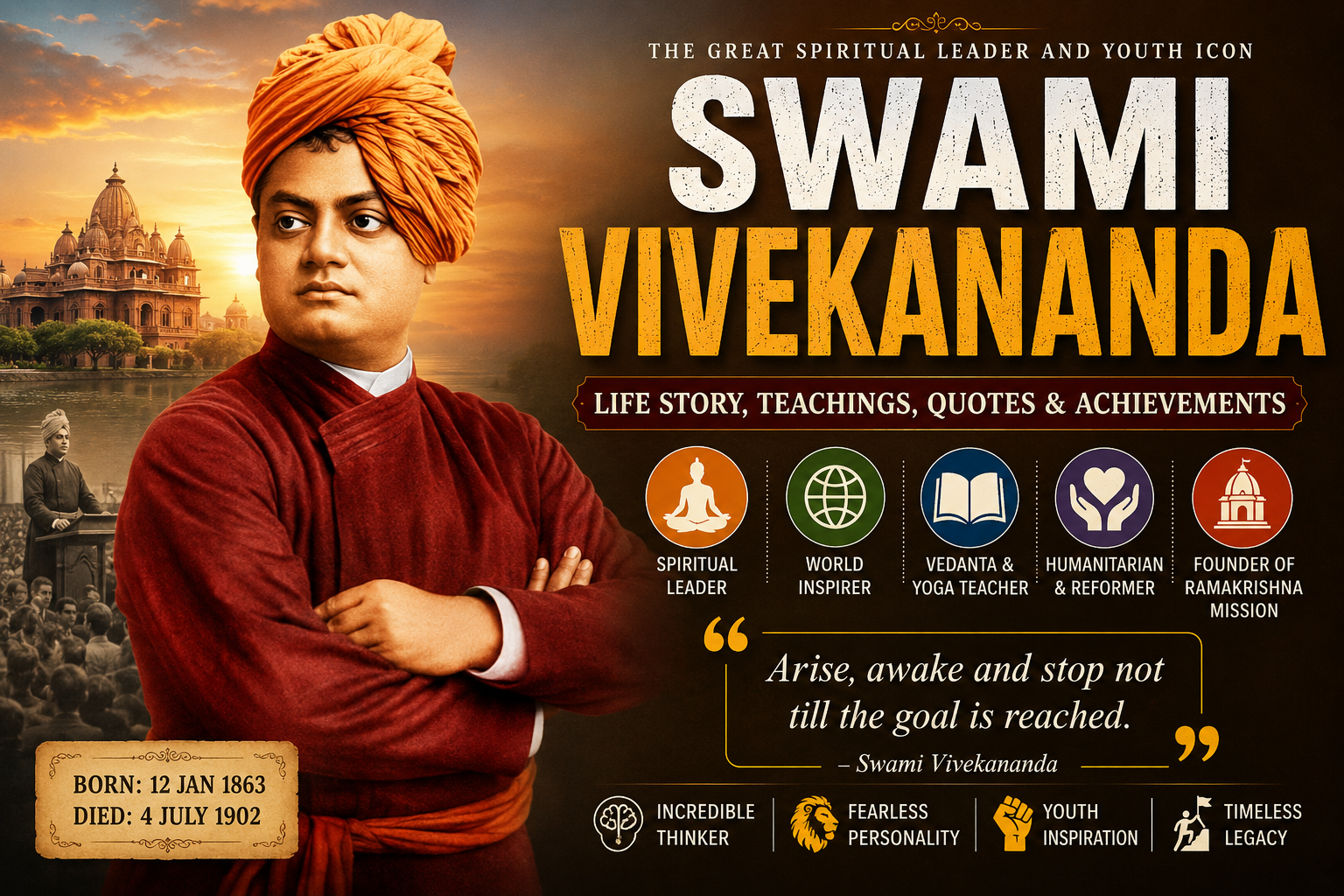
Swami Vivekananda
Swami Vivekananda (1863–1902) was a renowned Indian spiritual leader, philosopher, monk, and the chief disciple of Sri Ramakrishna Paramahamsa. Born as Narendranath Datta in Kolkata, he became one of the most influential figures in modern Indian history. Swami Vivekananda gained worldwide recognition after his historic Chicago Speech at the Parliament of Religions in 1893, where he introduced Vedanta, Yoga, and Hindu philosophy to the Western world. He emphasized self-confidence, character building, education, spirituality, leadership, and service to humanity. Through his powerful teachings, books, and speeches, he inspired millions of people to realize their inner strength and potential. Vivekananda founded the Ramakrishna Mission in 1897, which continues to serve society through education, healthcare, and humanitarian work. His famous message, "Arise, Awake and Stop Not Till the Goal Is Reached," continues to motivate students, entrepreneurs, leaders, and spiritual seekers across the world.
Profession:
Monk
Nationality:
Indian
Born:
1863
Died:
1902
Introduction
Swami Vivekananda was one of the greatest spiritual leaders, philosophers, visionaries, and youth icons in the history of India. He introduced the timeless wisdom of Vedanta and Yoga to the Western world and inspired millions of people through his teachings on self-confidence, strength, spirituality, education, service, and character building.
Born as Narendranath Datta on January 12, 1863, in Kolkata, India, Vivekananda transformed from a curious young seeker into a global spiritual ambassador who changed how the world viewed Indian philosophy and culture.
Today, more than a century after his passing, his teachings continue to guide students, entrepreneurs, leaders, monks, teachers, and seekers worldwide.
Birth and Family Background
Swami Vivekananda was born into a respected Bengali family in Kolkata.
His father, Vishwanath Datta, was a successful lawyer at the Calcutta High Court. He was known for his progressive thinking, intellectual curiosity, and broad-minded views.
His mother, Bhuvaneshwari Devi, was deeply religious and possessed a strong spiritual character. She often narrated stories from the Ramayana and Mahabharata to young Narendra, which had a profound influence on his personality.
Vivekananda inherited both rational thinking from his father and spirituality from his mother.
This unique combination later shaped his philosophy.
Childhood and Early Qualities
Even as a child, Narendra displayed extraordinary intelligence, courage, and leadership abilities.
He possessed:
- Exceptional memory
- Fearlessness
- Sharp reasoning skills
- Deep curiosity
- Strong concentration
- Compassion for others
Unlike many children, he was never satisfied with superficial answers.
He constantly questioned:
- Life
- Religion
- Human existence
- The soul
- God
He loved physical activities and believed in developing both body and mind.
Narendra practiced:
- Wrestling
- Gymnastics
- Horse riding
- Swimming
- Meditation
His powerful personality became evident from a young age.
Education and Academic Excellence
Narendra was an outstanding student.
He studied at:
Metropolitan Institution
and later at
Scottish Church College
During his student life, he mastered various subjects including:
- Philosophy
- History
- Literature
- Logic
- Psychology
- Religion
- Science
He had a remarkable ability to memorize information and grasp complex ideas quickly.
Teachers and classmates were often amazed by his intellectual capabilities.
Interest in Western Philosophy
During college, Vivekananda became fascinated by Western thinkers.
He studied:
- Plato
- Aristotle
- Hegel
- Kant
- Herbert Spencer
- John Stuart Mill
Their ideas expanded his intellectual horizons.
However, despite appreciating Western thought, he felt something was missing.
Philosophy provided theories but not direct spiritual experience.
Narendra wanted truth, not merely arguments.
This desire eventually led him toward a spiritual journey.
Search for God
One of the defining features of Narendra's life was his relentless search for God.
He visited numerous religious leaders and asked them a simple yet profound question:
"Have you seen God?"
Most teachers offered philosophical explanations.
None satisfied him.
Narendra was not interested in blind faith.
He wanted direct spiritual experience.
His quest continued until he met a remarkable saint named Sri Ramakrishna.
Meeting Sri Ramakrishna Paramahamsa
In 1881, Narendra visited Dakshineswar Temple near Kolkata.
There he met Sri Ramakrishna Paramahamsa.
When Narendra asked:
"Have you seen God?"
Ramakrishna immediately replied:
"Yes, I have seen God. I see Him more clearly than I see you."
This answer shocked Narendra.
For the first time, someone spoke about God as a living reality rather than a philosophical concept.
Although impressed, Narendra remained skeptical.
Being naturally rational, he tested Ramakrishna repeatedly.
However, each encounter strengthened his conviction that Ramakrishna possessed genuine spiritual realization.
Spiritual Training Under Ramakrishna
Over the next several years, Narendra became one of Ramakrishna's closest disciples.
Under his guidance, he learned:
- Meditation
- Devotion
- Self-control
- Spiritual discipline
- Vedanta philosophy
- Universal religion
Ramakrishna taught him that all religions ultimately lead to the same truth.
This idea later became central to Vivekananda's teachings.
Narendra experienced profound spiritual states and gradually transformed into a dedicated seeker.
The Passing of Ramakrishna
In 1886, Sri Ramakrishna passed away.
His death deeply affected Narendra and other disciples.
After Ramakrishna's passing, the disciples formed a monastic brotherhood.
Narendra emerged as their natural leader.
He formally embraced monastic life and later became known as:
Swami Vivekananda
This marked the beginning of a new chapter in his life.
Formation of the Ramakrishna Brotherhood
After taking monastic vows, Vivekananda and fellow monks lived a life of simplicity and spiritual practice.
They focused on:
- Meditation
- Study
- Service
- Self-discipline
However, Vivekananda realized that spirituality should not remain confined to monasteries.
He believed it should address the practical problems of humanity.
This conviction inspired him to travel across India.
Journey Across India
Between 1888 and 1893, Vivekananda traveled extensively throughout India as a wandering monk.
He visited:
- Varanasi
- Ayodhya
- Delhi
- Jaipur
- Alwar
- Mysore
- Hyderabad
- Mumbai
- Madras
- Kanyakumari
These journeys exposed him to both India's greatness and its struggles.
He encountered:
- Poverty
- Hunger
- Illiteracy
- Social inequality
- Colonial oppression
At the same time, he witnessed India's rich spiritual heritage.
These experiences shaped his future mission.
Realization of India's True Need
During his travels, Vivekananda realized that India needed more than religious rituals.
The country required:
- Education
- Confidence
- Strength
- Social reform
- Economic development
He believed spirituality and practical action must go together.
His vision was to create strong individuals capable of transforming society.
Meditation at Kanyakumari
One of the most significant moments of his life occurred at Kanyakumari.
Swimming across the ocean, he reached a rock where he meditated for several days.
While meditating, he reflected on:
- India's past glory
- Present suffering
- Future potential
There he resolved to dedicate his life to uplifting humanity and restoring India's self-confidence.
This decision would soon lead him to the world stage.
Vivekananda's Core Beliefs
By this stage, several principles had become central to his philosophy:
- Every soul is potentially divine.
- Strength is life; weakness is death.
- Service to humanity is service to God.
- Education should build character.
- All religions are paths to the same truth.
- Self-confidence is essential for success.
These teachings continue inspiring millions today.
The Journey to America
By the early 1890s, Swami Vivekananda had traveled extensively throughout India and understood the challenges facing the nation.
He realized that India possessed immense spiritual wisdom but lacked confidence due to centuries of foreign rule and social decline.
At the same time, the Western world was making tremendous progress in science, technology, and industry but often lacked spiritual understanding.
Vivekananda believed that the East and West could learn from each other.
During his travels, many admirers encouraged him to represent Hinduism at the upcoming World's Parliament of Religions in Chicago, United States.
However, the journey was not easy.
He faced:
- Financial difficulties
- Lack of official support
- Uncertainty about acceptance
- Cultural barriers
Despite these obstacles, he remained determined.
With support from followers and well-wishers, he sailed to America in 1893.
Struggles in America
Upon arriving in America, Vivekananda encountered several unexpected challenges.
The Parliament was still months away.
He had limited money and no proper credentials.
At one point, he even struggled to find accommodation and food.
Despite these difficulties, he never lost faith.
Eventually, he met Professor John Henry Wright of Harvard University.
Impressed by Vivekananda's knowledge and wisdom, Professor Wright famously remarked:
"To ask you for credentials is like asking the sun for proof that it shines."
His recommendation helped Vivekananda secure a place at the Parliament of Religions.
The Historic Chicago Speech
On September 11, 1893, Swami Vivekananda stepped onto the stage at the Parliament of Religions.
Representatives from various religions had gathered from around the world.
When his turn came, he began with the words:
"Sisters and Brothers of America."
The audience erupted into applause.
The standing ovation reportedly lasted several minutes.
This simple greeting reflected genuine love, respect, and universal brotherhood.
It immediately won the hearts of thousands.
Why the Chicago Speech Was Historic
Vivekananda's speech became one of the most influential speeches in religious history.
He spoke about:
- Religious tolerance
- Universal acceptance
- Harmony among faiths
- Human unity
- Spiritual freedom
He declared:
"We believe not only in universal toleration but we accept all religions as true."
At a time when religious divisions were common, this message was revolutionary.
The speech transformed Vivekananda into a global spiritual icon overnight.
International Fame
Following the Parliament, newspapers across America praised Vivekananda.
Many described him as:
- The Cyclonic Monk of India
- A Spiritual Genius
- A Philosopher-Saint
- The Voice of India
His lectures attracted thousands of listeners.
Universities, churches, and cultural organizations invited him to speak.
For the first time, many Western audiences were introduced to:
- Vedanta
- Yoga
- Hindu philosophy
- Meditation
- Indian spirituality
Teaching Vedanta to the West
One of Vivekananda's greatest achievements was introducing Vedanta philosophy to the Western world.
Vedanta teaches that:
Every soul is divine.
God exists within all beings.
Truth can be experienced directly.
All religions ultimately lead to the same reality.
Vivekananda explained these concepts in a rational and scientific manner.
This made Indian spirituality accessible to modern thinkers.
His lectures appealed not only to religious audiences but also to scientists, philosophers, and intellectuals.
Introduction of Yoga to the World
Today, millions practice yoga worldwide.
However, few realize that Vivekananda played a major role in introducing yogic philosophy to the West.
He taught:
Raja Yoga
The path of meditation and mental discipline.
Karma Yoga
The path of selfless action.
Bhakti Yoga
The path of devotion and love.
Jnana Yoga
The path of knowledge and wisdom.
His teachings laid the foundation for the global yoga movement that exists today.
Vivekananda's Message of Strength
One of the central themes of Vivekananda's teachings was strength.
He repeatedly emphasized:
"Strength is life, weakness is death."
He believed fear was one of humanity's greatest enemies.
According to him:
- Fear destroys confidence.
- Fear limits potential.
- Fear prevents growth.
He encouraged people to become fearless and courageous.
His message continues inspiring students, entrepreneurs, and leaders worldwide.
The Return to India
In 1897, after several years abroad, Vivekananda returned to India.
He received a hero's welcome.
Thousands gathered to hear him speak.
His success abroad filled Indians with pride during British colonial rule.
He urged the nation to:
- Believe in itself
- Educate the masses
- Build character
- Serve society
- Develop strength
His speeches awakened national consciousness across India.
Founding the Ramakrishna Mission
One of Vivekananda's most significant achievements was establishing the:
Ramakrishna Mission
Founded in 1897, its purpose was:
- Spiritual growth
- Education
- Healthcare
- Disaster relief
- Social service
The mission was built upon the principle:
"Service to man is service to God."
This idea transformed spirituality from mere ritual into active service.
Today, Ramakrishna Mission operates:
- Schools
- Colleges
- Hospitals
- Libraries
- Rural development programs
- Relief projects
Across India and many countries.
Vivekananda's Educational Philosophy
Vivekananda believed education was the most powerful tool for transforming society.
He defined education as:
"The manifestation of the perfection already in man."
Unlike traditional systems focused on memorization, he believed education should develop:
- Character
- Confidence
- Discipline
- Leadership
- Moral values
His educational vision remains highly relevant today.
Books Written by Swami Vivekananda
Swami Vivekananda left behind a rich literary legacy.
His books continue inspiring millions worldwide.
Raja Yoga
One of his most famous works.
It explains:
- Meditation
- Concentration
- Mind control
- Spiritual realization
This book introduced yogic philosophy to many Western readers.
Karma Yoga
Focuses on selfless action and service.
Key message:
Work without attachment to results.
Serve humanity as worship.
Bhakti Yoga
Explains the path of devotion.
It teaches:
- Love for God
- Faith
- Surrender
- Spiritual growth
Jnana Yoga
Deals with:
- Self-realization
- Consciousness
- Reality
- Spiritual wisdom
It remains one of the most profound books on Vedanta philosophy.
Lectures from Colombo to Almora
A collection of speeches delivered during his return journey to India.
The book contains many of his ideas about:
- Nation-building
- Education
- Spirituality
- Social reform
My Master
A tribute to Sri Ramakrishna.
It explains Ramakrishna's life and teachings.
Inspired Talks
Contains conversations and spiritual insights shared with disciples.
Practical Vedanta
One of Vivekananda's most influential works.
It demonstrates how spiritual principles can be applied in everyday life.
Vivekananda's Influence on Indian Nationalism
Although not a political leader, Vivekananda profoundly influenced India's freedom movement.
Many freedom fighters admired him.
These included:
- Mahatma Gandhi
- Subhas Chandra Bose
- Sri Aurobindo
- Bal Gangadhar Tilak
Subhas Chandra Bose once said:
"Swami Vivekananda is the maker of modern India."
His teachings helped Indians regain confidence in their culture and heritage.
His Vision for Youth
Vivekananda believed young people held the key to national progress.
He often said:
"Give me 100 energetic young men and I shall transform India."
He encouraged youth to develop:
- Confidence
- Discipline
- Leadership
- Character
- Fearlessness
This is one reason why his birthday, January 12, is celebrated as:
National Youth Day in India
Relationship with Science
Unlike many spiritual teachers, Vivekananda respected scientific inquiry.
He believed:
- Science and spirituality complement each other.
- Truth should be explored fearlessly.
- Religion should not oppose reason.
His conversations with scientists and intellectuals helped bridge the gap between science and spirituality.
Impact on Global Spirituality
Vivekananda changed how the world viewed India.
Before him, many Westerners misunderstood Hinduism.
After his lectures:
- Vedanta gained recognition.
- Yoga became respected.
- Indian philosophy attracted global interest.
His influence continues shaping spiritual movements around the world.
Personal Life and Character
Although the world knows him as Swami Vivekananda, at heart he remained a humble seeker dedicated to truth and service.
His personality was a rare combination of:
- Spiritual depth
- Intellectual brilliance
- Fearlessness
- Compassion
- Leadership
- Discipline
People who met him often described him as charismatic and inspiring.
His powerful voice, sharp intellect, and magnetic presence left a lasting impression on everyone.
Despite global fame, Vivekananda lived a simple life and never sought wealth, power, or personal recognition.
He believed that life's purpose was to realize one's divine potential and help others do the same.
Leadership Qualities of Swami Vivekananda
Vivekananda possessed extraordinary leadership abilities.
Unlike many leaders who merely gave instructions, he led through example.
His leadership was based on:
Vision
He could see possibilities where others saw obstacles.
Courage
He fearlessly challenged ignorance, superstition, and weakness.
Service
He believed leaders must serve people rather than dominate them.
Confidence
He encouraged people to believe in themselves.
Integrity
He practiced what he preached.
These qualities continue making him one of the most admired leaders in Indian history.
Challenges and Struggles
Swami Vivekananda's life was not easy.
Behind his success were many hardships.
Financial Difficulties
After his father's death, his family faced severe financial problems.
There were times when the family struggled to secure basic necessities.
Despite these difficulties, Vivekananda remained committed to education and spiritual growth.
Spiritual Doubts
Before becoming a disciple of Ramakrishna, he experienced deep spiritual uncertainty.
He questioned:
- Religion
- God
- Human suffering
- Life's purpose
His search for answers was intense and often painful.
Criticism and Opposition
Many people opposed his ideas.
Some conservative groups criticized him for presenting Hinduism to Western audiences.
Others misunderstood his message of religious harmony.
Yet he remained steadfast.
Health Problems
Years of constant travel, public speaking, and intense work affected his health.
He suffered from:
- Asthma
- Diabetes
- Insomnia
- Chronic fatigue
Even while struggling physically, he continued serving humanity.
Vivekananda's Views on Women
Swami Vivekananda strongly supported women's education and empowerment.
He believed:
"There is no chance for the welfare of the world unless the condition of women is improved."
He advocated:
- Equal education
- Respect for women
- Social upliftment
- Greater opportunities
His progressive views were far ahead of his time.
Vivekananda's Views on Religion
One of Vivekananda's most revolutionary teachings was religious harmony.
He believed:
- All religions contain truth.
- Different paths lead to the same destination.
- Religious conflict arises from ignorance.
He encouraged people to respect every faith while remaining true to their own beliefs.
This message remains highly relevant in today's world.
Why Vivekananda Remains Relevant Today
In today's world, people face:
- Stress
- Anxiety
- Lack of purpose
- Social division
- Information overload
Vivekananda's teachings offer solutions through:
- Self-confidence
- Discipline
- Meditation
- Service
- Character building
His message remains timeless because it addresses universal human challenges.
Death of Swami Vivekananda
On July 4, 1902, Swami Vivekananda passed away at Belur Math near Kolkata.
He was only 39 years old.
Despite his short life, he accomplished what many could not achieve in several lifetimes.
His passing marked the end of an extraordinary journey but not the end of his influence.
Final Thoughts
Swami Vivekananda's life is one of the most inspiring success stories in history. From a curious young seeker named Narendranath Datta to a world-renowned spiritual leader, his journey demonstrates the transformative power of faith, discipline, courage, and self-belief.
He taught humanity that true greatness comes not from wealth or fame but from character, service, and the realization of one's highest potential.
His timeless message continues to inspire generations:
"Arise, awake and stop not till the goal is reached."
These words remain a guiding light for anyone seeking success, purpose, wisdom, and spiritual growth in life.
Major Achievements
Major Achievements of Swami Vivekananda
Historic Chicago Speech (1893)
Introduced Indian spirituality to the world and established him as a global religious leader.
Global Spread of Vedanta
Popularized Vedanta philosophy throughout America and Europe.
Introduction of Yoga to the West
Played a significant role in bringing yoga philosophy to international audiences.
Establishment of Ramakrishna Mission
Created one of the world's most respected spiritual and humanitarian organizations.
Revival of Hindu Philosophy
Restored confidence in India's spiritual traditions during colonial rule.
Inspiration for Modern India
Influenced generations of leaders, freedom fighters, educators, and thinkers.
Life Lessons from Swami Vivekananda
Top Life Lessons from Swami Vivekananda
Believe in Yourself
Self-confidence is the first step toward success.
Develop Strength
Physical, mental, and spiritual strength are essential for growth.
Never Stop Learning
Education should continue throughout life.
Serve Humanity
Helping others is one of the highest forms of worship.
Focus on Your Goal
Concentration and determination lead to achievement.
Conquer Fear
Fear prevents people from realizing their potential.
Build Character
Character is more valuable than wealth or status.
Respect All Religions
Harmony creates progress.
Take Responsibility
Do not blame circumstances for failure.
Live with Purpose
A meaningful life requires dedication to a higher cause.
Influence on Modern Leaders
Many influential figures were inspired by Vivekananda.
These include:
Mahatma Gandhi
Subhas Chandra Bose
Sri Aurobindo
Rabindranath Tagore
Jawaharlal Nehru
APJ Abdul Kalam
His ideas continue influencing entrepreneurs, educators, and leaders worldwide.
Famous Quotes
Most Famous Quotes of Swami Vivekananda
"Arise, awake and stop not till the goal is reached."
"All power is within you; you can do anything and everything."
"Strength is life, weakness is death."
"Take risks in your life. If you win, you can lead. If you lose, you can guide."
"You cannot believe in God until you believe in yourself."
"The greatest religion is to be true to your own nature."
"Fear is death, fear is sin."
"We are what our thoughts have made us."
"Talk to yourself once in a day, otherwise you may miss meeting an excellent person in this world."
"The world is the great gymnasium where we come to make ourselves strong."
Interesting Facts
Interesting Facts About Swami Vivekananda
His Birth Name Was Narendranath Datta
Before becoming a monk, he was known as Narendra.
He Had a Photographic Memory
He could memorize books after reading them only once.
He Was an Excellent Singer
Music played an important role in his life.
He Loved Physical Fitness
He practiced exercise and believed strength was essential.
He Traveled Across India on Foot
Many of his journeys were completed without money or possessions.
He Was Only 30 Years Old at Chicago
Despite his young age, he impressed scholars from around the world.
National Youth Day
India celebrates January 12 as National Youth Day in his honor.
He Predicted India's Future Rise
Vivekananda believed India would once again become a major force in the world.
Legacy
Swami Vivekananda's legacy continues through:
Ramakrishna Mission
Educational institutions
Spiritual organizations
Youth movements
Books and lectures
His teachings have inspired millions to live with courage, purpose, and service.
Today, he is remembered as:
A spiritual giant
A youth icon
A philosopher
A patriot
A humanitarian
A global ambassador of Indian culture
More than a century after his death, his words continue motivating people to rise above limitations and discover their inner strength.
Frequently Asked Questions
Swami Vivekananda was an Indian Hindu monk, philosopher, spiritual leader, and chief disciple of Sri Ramakrishna Paramahamsa. He introduced Vedanta and Yoga to the Western world and inspired millions through his teachings.
Swami Vivekananda's birth name was Narendranath Datta.
Swami Vivekananda was born on January 12, 1863, in Kolkata (Calcutta), West Bengal, India.
He is famous for his historic speech at the Parliament of Religions in Chicago in 1893, where he introduced Indian spirituality, Vedanta, and universal brotherhood to the world.
Swami Vivekananda taught self-confidence, strength, spirituality, service to humanity, education, character building, and religious harmony.
His most famous quote is:
What are the major books written by Swami Vivekananda?
Raja Yoga
Karma Yoga
Bhakti Yoga
Jnana Yoga
Practical Vedanta
Inspired Talks
My Master
Lectures from Colombo to Almora
What is the Ramakrishna Mission?
Why is National Youth Day celebrated in India?
What were Swami Vivekananda's views on education?
How did Swami Vivekananda influence India?
What is Swami Vivekananda's greatest achievement?
When did Swami Vivekananda die?
What is Swami Vivekananda's legacy?
What can we learn from Swami Vivekananda?
Self-confidence
Discipline
Fearlessness
Service to humanity
Leadership
Positive thinking
Goal-setting
Spiritual growth
Character building
Lifelong learning